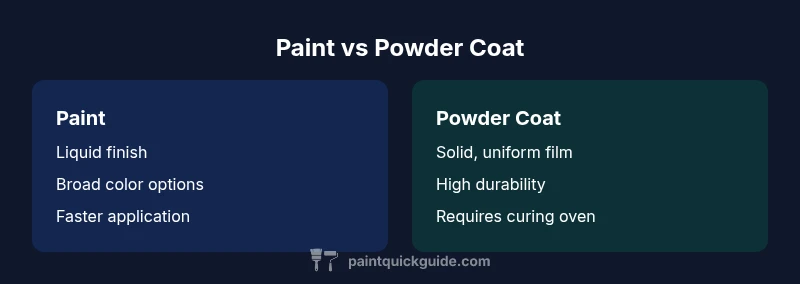
Paint versus Powder Coat: A Practical Comparison for Home and Auto
A comprehensive, step-by-step comparison of paint versus powder coat covering durability, finish options, cost, and best use cases for home projects, cars, and metal surfaces.


Paint versus powder coat presents two coating paths with distinct advantages. Paint offers lower upfront cost, faster application, and easier touch-ups, while powder coating delivers superior durability, corrosion resistance, and a uniform finish for metal parts. This comparison helps homeowners, DIYers, and auto enthusiasts decide based on surface, climate, and maintenance needs.
Key Differences Between Paint and Powder Coat
When you compare paint versus powder coat, you weigh aesthetics, durability, and cost against application methods and curing requirements. According to PaintQuickGuide, the choice often hinges on use-case: interior surfaces or lightweight items benefit from paint’s flexibility and color variety, while metal components exposed to harsh environments profit from powder coat’s uniform finish and excellent abrasion resistance. The fundamental difference is how each coating is applied and cured. Paint relies on conventional liquid chemistry that dries or cures at room temperature or with mild heat, whereas powder coat uses electrostatic deposition followed by high-temperature baking. Surface preparation, color options, and repairability also diverge: painting can be touched up locally and offers an easier color match, while powder coating requires reapplication for chips or damage but yields a nearly flawless, thick layer once cured.
PaintQuickGuide Team notes that the decision should consider surface geometry, accessibility for curing, and long-term maintenance expectations. For DIY projects, paint remains straightforward and forgiving, but when durability and corrosion resistance are paramount, powder coating often wins out.
Application Methods and Curing: How Each Coating Is Applied
Paint is applied as a liquid film using brushes, rollers, or spray guns. It cures by drying or air cure, with some systems relying on UV curing for specialized coatings. This flexibility makes paint ideal for a wide range of substrates—from wood and drywall to painted metals—and for quick-turnaround projects. Powder coating, by contrast, uses an electrostatic spray that charges powder particles, which then bond to the grounded surface. After application, the coated item goes into a curing oven where the powder flows and cross-links to form a hard, durable finish. The bake temperature and time depend on the polymer chemistry and part size. Practically, powder coating demands controlled equipment and a baking process, which can add complexity and cost but pays off in consistent film thickness and superior resistance to chipping and fading.
Finish Options and Aesthetics
Paint offers a broad palette of colors, sheens, and finishes—from matte to high gloss—and supports nuanced textures like metallic, pearl, or chalky effects when using specialty paints. Powder coating tends to deliver exceptionally smooth, uniform finishes with high color consistency across batches. While factory powder coats are limited to single-surface color options for each cycle, newer multi-color and textured powders are expanding choices, especially for automotive and architectural metalwork. For intricate shapes, paint may better accommodate detailed shading or gradient effects, whereas powder coat excels at large flat or curved metal components with minimal peel risk.
Durability and Longevity Under Different Conditions
In indoor environments, high-quality paints can provide durable surfaces when correctly prepared and applied, but they are more vulnerable to chemical exposure and abrasion over time. Powder coating shines in outdoor or industrial settings due to its resistance to corrosion, UV fade, and impact at typical service temperatures. For automotive wheels, grills, or garden furniture, powder coating often outperforms paint in long-term wear. However, certain paints, especially two-part epoxy systems, can rival powder coats in specific conditions when applied by skilled technicians. The key trade-off is that powder coating’s durability comes with bake-oven requirements, whereas paint is more forgiving in terms of equipment and environmental controls.
Surface Prep, Substrates, and Compatibility
Surface prep is critical for both coatings but differs in rigor and technique. Paint requires clean, dry surfaces, with sanding or etching for better adhesion on bare metals or repaired areas. Some surfaces, such as previously coated plastics or certain substrata, may demand a specialized primer. Powder coating demands meticulous surface preparation, including cleaning, blasting, and masking to maintain thickness uniformity and avoid pinholes. It’s typically restricted to conductive substrates like steel and aluminum; non-conductive materials cannot be powder-coated without specialized processes. The prep stage often dictates overall cost and schedule: poor prep undermines durability for both coatings but has more dramatic consequences in powder coating due to the baked film.
Cost, Time, and Convenience Considerations
Paint generally has a lower upfront cost and a shorter lead time, especially for small or DIY projects. It also offers simpler, more forgiving application for beginners. Powder coating involves higher initial setup costs, equipment, and access to a curing oven or a dedicated facility, but it can deliver longer service life for metal parts with fewer re-coats. Turnaround times vary: paint can be completed the same day in many cases, while powder coating often requires scheduling, transport, and a multi-step curing process. For users weighing convenience against durability, the decision often leans toward paint for quick refreshes and powder coating for enduring finishes on hardware, automotive components, and outdoor metal work.
Environmental Impact, Safety, and Regulatory Considerations
Paints release volatile organic compounds (VOCs) and may contain solvents that require ventilation and proper disposal. Water-based and low-VOC paints mitigate some environmental concerns but still require care. Powder coating is solvent-free, producing minimal fumes and disposal hazards when properly managed, though the powder dust must be contained to prevent inhalation and contamination. Both methods entail safety considerations: PPE for workers, appropriate ventilation, and adherence to local regulations. When evaluating environmental impact, powder coating often offers advantages for mass-produced or outdoor components due to lower solvent emissions, while high-performance paints must be chosen with an eye to clean-up and waste handling.
Maintenance, Repairs, and Longevity Strategies
Maintenance needs differ. Painted surfaces typically require periodic cleaning and occasional touch-ups, with repairs often localized and easily matched to existing color. Powder-coated finishes, once cured, are highly resistant to scratching and chemicals, but damage usually requires re-coating of the affected area to maintain uniform appearance. In practice, you’ll need to decide whether you can perform touch-ups or whether you’re prepared to remove and recoat larger areas. Routine maintenance, such as cleaning and ruling out corrosion-prone spots, helps extend the life of either coating, but powder coat’s overall longevity tends to be superior for metal parts exposed to the elements.
Real-World Use Cases: Home Interiors, Outdoor Metal, and Automotive Components
For home interiors—walls, cabinetry, or furniture—paint remains the most versatile and easiest to refresh. If you’re refinishing metal railings, outdoor furniture, or automotive components, powder coating often provides a tougher barrier against weather, moisture, and wear. Car parts such as wheels and undercarriage components benefit from powder coat’s consistent thickness and color stability, while plastic or wood components might not be suitable candidates. When choosing between coatings for a project, you should weigh the surface geometry, exposure conditions, repairability, and long-term maintenance expectations. Paint excels in quick, customizable projects; powder coat excels in durability and industrial-grade resilience.
Authority sources and further reading
For readers seeking deeper technical grounding, consult these authoritative sources:
- https://www.epa.gov
- https://www.energy.gov
- https://www.nist.gov These sources provide context on coating technologies, environmental considerations, and standards that inform practical decisions in real-world projects.
Note: Always verify local regulations and facility capabilities before selecting a coating method, especially for high-stakes applications like automotive components or exterior architectural metal.
Practical Decision Framework: When to Choose Paint vs Powder Coat
To decide, start with the surface and environment. If you require rapid completion, broad color choices, or easy touch-ups, paint is typically the better option. If you need a durable, uniform finish on metal exposed to harsh conditions, powder coating frequently delivers superior performance, albeit with higher upfront costs and curing requirements. Consider the scale of the project, available equipment, and future maintenance plans. In many cases, a staged approach—paint for interior or decorative surfaces and powder coat for critical metal components—offers an optimal balance of cost, ease, and durability.
Comparison
| Feature | Paint | Powder Coat |
|---|---|---|
| Application Method | Liquid application via brush/roller/spray | Electrostatic spray + bake |
| Curing Process | Air-dry or UV-curing options | Thermoset bake in oven |
| Finish Options | Wide color range; various sheens; textures possible | Extremely uniform; limited textures; strong gloss options |
| Durability | Good to excellent in interiors and mild outdoor use; susceptible to chips | Very high resistance to abrasion, corrosion, and weathering |
| Surface Prep | Cleaning, priming, and sanding as needed | Meticulous cleaning, blasting, masking for thickness control |
| Repairability | Touch-ups easy; color matching feasible | Repairs require recoating entire area to match thickness |
| Turnaround Time | Typically faster; DIY-friendly | Longer due to equipment and curing time |
| Typical Substrates | Wood, drywall, many plastics; metals with primer | Metals (steel, aluminum) primarily; conductive substrates |
| Cost Profile | Lower upfront cost; scalable for DIY | Higher upfront cost; best for high-volume or long-term use |
Upsides
- Lower upfront cost and easier DIY for paint
- Faster application and simpler color changes
- Wider color options and textures for interior projects
- Repairable with local touch-ups
What's Bad
- Less durability in harsh outdoor conditions
- Chips and wear can be more noticeable over time
- Finish may require more frequent maintenance for outdoor use
- Repairing large areas can be challenging
Powder coating excels in durability for metal parts; paint remains versatile for DIY and aesthetic flexibility
Choose powder coating for outdoor metal components or high-wear surfaces. Opt for paint for interior projects, fast turnaround, and easy touch-ups.
Your Questions Answered
Can powder coating be used on wood or plastic surfaces?
Powder coating is predominantly used on metal surfaces due to its curing process. Wood and many plastics require special primers or cannot be powder-coated without fusion coatings. For non-metal substrates, paint or veneer alternatives are typically more practical.
Powder coating is mainly for metal. For wood or plastic, stick with paint or specialty finishes designed for those materials.
Is DIY powder coating feasible for home workshops?
DIY powder coating is possible but requires an electrostatic gun, a clean bake oven, and proper safety measures. Small parts can be practical, but larger items may need professional facilities for uniform coating and temperature control.
DIY powder coating works for small parts with the right equipment and safety practices, but larger items are easier at a shop.
Which coating is more environmentally friendly?
Powder coating generally produces fewer solvent emissions and less hazardous waste than many solvent-based paints. However, it requires proper powder containment and dust control. Environmental impact depends on the specific product and application process.
Powder coating often has lower solvent emissions, but it needs proper dust control and containment.
Can color matching be limited with powder coating?
Powder coating offers excellent color stability, but color matching can be less flexible than liquid paints for small batches or custom shades. Recoating a part may be necessary to maintain uniform color and finish.
Powder colors stay very stable, but tiny shade adjustments can be harder than with paint.
What are common surface prep steps for both coatings?
Both coatings require thorough cleaning and surface preparation. For metal, this often means removing oils and rust, followed by suitable priming for paint or precise blasting for powder coating to ensure adhesion.
Clean and prep the surface well; metal may need priming or blasting depending on coating choice.
Which coating is better for high-contrast gradients and details?
Paint typically excels at complex color schemes and gradients due to its liquid nature and color-mixing ability. Powder coating fares best for uniform color layers on metal and may not be ideal for fine gradient work.
Paint is better for gradients; powder coat is superb for solid, uniform finishes.
Quick Summary
- Assess project environment before deciding
- Paint offers speed and variety for DIY tasks
- Powder coating provides superior durability on metal
- Prep quality drives results for both coatings
- Maintenance strategy should align with coating choice