Paint vs Wrap: A Practical Comparison
An analytical comparison of painting and wrapping for home interiors/exteriors and vehicles, covering durability, costs, design options, prep, maintenance, and when to choose each approach.


When choosing between paint and wrap, consider durability, cost, and reversibility. Paint offers a long-lasting finish and easier color matching, while wrap provides faster color changes, more design options, and often easier removal. For homes and cars, paint is usually cost-effective for large areas when you own the property; wraps excel for bold graphics and temporary changes.
What paint vs wrap means for homes and cars
For homeowners and auto enthusiasts alike, the choice between paint and wrap hinges on a few core questions: What surface are we covering? What is the desired look? How long should the finish last, and how reversible should the change be? In this guide we unpack the practical differences between paint and wrap, with a focus on homes and cars. The PaintQuickGuide team notes that this decision is rarely about a single factor; it’s a balance of cost, durability, design flexibility, and future plans for the surface. According to PaintQuickGuide, a clear early step is to inventory your objectives: durability for walls that face the elements, or bold, temporary graphics for a vehicle. This framing helps reduce buyer’s remorse and aligns expectations with real-world results. The discussion that follows uses real-world scenarios, not marketing promises, to help you decide which path fits your project.
Quick differences that matter (at a glance)
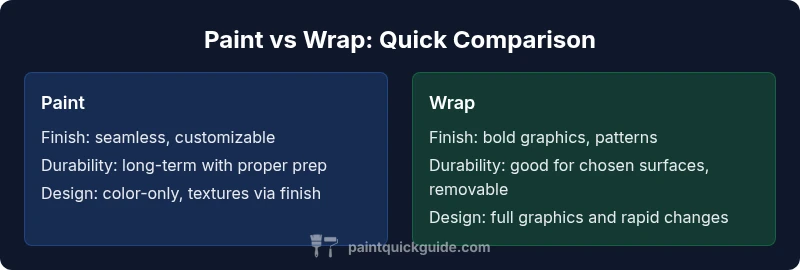
In most projects, the immediate contrasts between paint and wrap boil down to four factors: finish options, cost trajectory, installation speed, and future reversibility. Paint offers broad color selection and deep, seamless finishes, while wrap enables high-visibility graphics, patterns, and rapid color changes without permanent surface alteration. Durability often favors quality paint when surfaces are well-prepped and protected with sealants; wraps can endure under vehicle-use or exterior conditions but may require periodic replacement to maintain a fresh look. Price-wise, painting large interior or exterior areas spreads cost over time with ongoing maintenance considerations, whereas wraps tend to come with higher upfront costs but longer intervals between re-dos for certain use-cases. For most homeowners and hobbyists, the decision also hinges on whether the goal is a long-lived look or a temporary, eye-catching statement.
Durability and longevity in practice
Durability varies by surface, climate, and maintenance. When you paint a home exterior or interior, quality primers, multiple coats, and protective topcoats can yield decades of service with proper upkeep. On the other hand, vehicle wraps are designed for mobility and flexibility; they typically help guard the underlying finish during the wrap period and can be removed without repainting, provided application and removal are performed by skilled installers. PaintQuickGuide analysis shows that longevity often depends on substrate compatibility and exposure. Exterior walls benefit from weather-resistant paints and sealed joints; vehicle wraps rely on film quality, edge sealing, and UV-resistant inks. In both cases, preparation—and a clear maintenance plan—correlates strongly with how long the result lasts.
Costs and value: paint vs wrap
Cost considerations for paint and wrap depend on surface area, complexity, and labor. For homes, interior or exterior painting usually involves materials (primer, paint, sealant) and labor, with per-square-foot costs varying by finish level and climate. In contrast, wraps incur higher upfront investment, especially for vehicles or large architectural projects, but offer longer intervals between refreshes and the ability to maintain or update branding without permanent changes. PaintQuickGuide analysis shows that long-term value often trends toward paint for walls where you expect stable décor, and toward wraps for high-visibility, temporary updates (like seasonal aesthetics or marketing graphics). Always obtain multiple bids and consider the total life-cycle cost rather than sticker price alone.
Design options and finish quality
Paint offers nearly unlimited color choices and finishes—from matte and satin to high-gloss and specialty textures. Modern paints can mimic exotic finishes and textures with ferric, pearl, or metallic looks, though some effects require professional technique. Wraps provide bold graphics, patterns, and color-blocking that would be difficult or costly to reproduce with paint. For vehicles, wraps can incorporate full custom graphics or photography, while walls can benefit from decorative textures. One practical distinction: paint often ages gracefully with color fade and sheen changes; wraps retain a more consistent look until they’re removed or replaced. For most tasks, think about how you’ll feel about the appearance five or ten years from now.
Prep work and installation realities
Prep work is a constant across both options, but the level of disruption differs. Painting requires surface cleaning, sanding, repairs, priming, masking, and time for each coat to cure. Exterior surfaces add weather constraints and moisture checks; interior walls demand humidity control and ventilation. Wrap installation involves a meticulous surface inspection, cleaning, and directional planning for patterns. The process is generally quicker for small- to mid-sized projects but becomes intricate for curved surfaces or textured materials. In both cases, the quality of the outcome hinges on surface condition, professional skill, and adherence to recommended curing times. A crucial point: rushing either process can compromise adhesion, finish integrity, or long-term durability.
Maintenance and removal care
Maintenance differs by finish. Painted surfaces respond well to routine cleaning with mild cleaners and occasional resealing to prevent chalking or fading in sun-exposed areas. Wraps require compatible cleaners and caution to avoid adhesive degradation; regular inspection for edge lifting or sun damage is essential. Removal complexity varies: paint removal can require sanding or chemical treatments, while wraps are designed to be peeled away, typically leaving the surface intact if applied by a trained installer. A practical tip: document your surface history (paint type, primer, sealants) so you know exactly how to plan future changes without damaging underlying materials.
When to choose paint vs wrap: a decision guide
If your primary objective is longevity with a classic finish, paint generally wins for walls and furniture where a seamless look matters. If you want fast customization, bold graphics, or temporary changes (for events, branding, or seasonal shifts), wrap is often the smarter choice. Consider surface sensitivity (wood, plaster, metal, fiberglass), exposure to weather or the elements, maintenance capacity, and your tolerance for future changes. Always align your choice with the expected lifespan, the impact on resale or property value, and the costs involved—both upfront and ongoing. This approach reduces the risk of regret and helps you plan a coherent design strategy that fits your budget and timeline.
Real-world scenarios: homes, offices, and cars
In residential settings, painting exterior siding or interior walls is a common, cost-effective solution that yields durable, proven results when prepped correctly. For creative spaces or feature walls, paint can deliver unique textures and finishes that are easy to refresh with a repaint. In cars, a high-quality wrap can deliver vibrant branding, color shifts, or a protective layer, with removal offering the possibility of returns to the original finish. For commercial properties, wraps may serve as a dynamic advertising medium that can be updated without a permanent repaint. Each scenario benefits from a clear project scope, a professional assessment of surface condition, and a plan for maintenance and future changes.
Common mistakes to avoid
Rushed prep is one of the biggest errors in both paths. Skipping repairs, poor cleaning, or incorrect primer selections can lead to premature peeling, chalking, or edge lifting in wraps. Underestimating curing times for paints, especially on exterior surfaces, can trap moisture and cause adhesion issues later. For wraps, failing to account for complex curves, edge management, or environmental exposure can shorten life or compromise aesthetics. Always test a small area first when introducing new products, and document conditions before starting a full project. The more you know about substrate history, the better your result will be.
Practical surface-type checklist
- Walls (paint): ensure clean, dry, and sound substrate; verify humidity levels; select appropriate primer and topcoat; plan for moisture barriers if needed.
- Car (wrap): ensure panel alignment, smooth surfaces, and professional cut lines; confirm warranty terms; prepare for a staged installation to minimize downtime.
- Exterior surfaces: consider UV resistance, weather sealing, and maintenance schedules; factor seasonal timing.
- Interior trims (paint): consider moisture and abrasion resistance; choose satin or semi-gloss for durability; test colors in different lighting.
- Graphics or branding (wrap): plan for visibility and legibility; test color accuracy and edge wrap around contours.
Comparison
| Feature | Paint | Wrap |
|---|---|---|
| Durability/Longevity | Typically several years with proper prep and sealants | Vehicle wraps or architectural wraps offer multi-year life with careful installation; shorter lifespans on some curved or textured surfaces |
| Cost Range (materials + labor) | Moderate to high upfront cost for large interior/exterior walls; cost scales with surface area | Higher upfront cost for design, install, and materials; long-term replacement intervals can reduce ongoing maintenance |
| Finish and design options | Unlimited color choices; diverse finishes (matte, satin, gloss, textures) | Bold graphics, patterns, and photographic imagery; quick color changes without permanent surface alteration |
| Prep work required | Repair, cleaning, priming, masking; multiple coats with curing time | Thorough cleaning, edge sealing, and surface preparation; may involve precise measuring for curves |
| Time to complete | Longer projects with multiple coats; weather and humidity affect timing | Typically faster for coverage, but requires curing and edge work for quality |
| Removal/reversibility | Removal training may be needed; possible surface refinishing to restore original look | Designed for removal; can often be peeled away with minimal surface damage when done by pros |
| Maintenance | Routine cleaning and periodic resealing; color retention dependent on exposure | Regular inspection for edge lift and UV wear; adhesive care important during maintenance |
Upsides
- Long-term durability with proper prep and coatings
- Extensive color and finish options with paint
- Fast color changes and bold graphics with wrap
- Removable/non-destructive option when installed correctly (wrap)
What's Bad
- Higher upfront time and cost for professional paint projects
- Paint can be less practical for dramatic changes on vehicles without repaint
- Wraps require specialized installation and can lift if poorly maintained
- Paint matching after years can be challenging in some cases
Paint generally serves as the better long-term value for walls and large flat surfaces; wraps excel for bold, temporary, or graphic-driven changes.
Choose paint when durability, traditional aesthetics, and long-term value matter most. Opt for wrap when you want fast customization, branding, or a temporary look without committing to a permanent change.
Your Questions Answered
What is the main difference between paint and wrap for homes and cars?
Paint provides a traditional, durable finish with broad color options; wraps offer bold graphics and temporary changes. The best choice depends on surface, desired lifespan, and whether you’ll want to revert later.
Paint gives durability and color longevity; wraps give graphics and quick changes. Choose based on surface and how long you want the look to last.
Which option is more cost-effective in the long run?
Long-term cost-effectiveness depends on surface, climate, and maintenance. Paint often wins for walls and exterior surfaces with proper care, while wraps can be cost-effective for temporary branding or frequent design updates.
Paint tends to be cheaper over time for walls, but wraps save money when frequent changes are needed.
What maintenance is required for each option?
Paint requires regular cleaning and periodic sealing; wraps need adhesive-friendly cleaners and periodic inspection for edge lifts. Removal considerations differ if you plan to switch looks.
Keep paint sealed and clean; check wraps for edge lifting and avoid harsh cleaners.
Can you wrap over an existing paint job?
Yes, many wraps can be applied over painted surfaces if the paint is in good condition and properly prepared. Peeling or damaged paint needs repair before wrapping to avoid issues.
Wraps can go over good paint, but bad paint needs fixing first.
Is a wrap reversible on a car?
Most vehicle wraps are designed for removal and can restore the original finish if handled by professionals, though improper removal can damage underlying paint.
A pro can remove the wrap and leave the original paint mostly intact.
Which should a homeowner choose for exterior walls?
For exterior walls, durable paints with proper primers and sealants typically offer longer life and lower maintenance than temporary graphics. Wraps are less common for full-house exteriors unless branding or special effects are desired.
Paint is usually the better long-term choice for exterior walls unless you need a temporary look.
Quick Summary
- Assess surface type before deciding
- Estimate life-cycle cost, not just upfront price
- Factor climate and maintenance into durability
- Consider reversibility and future design goals
- Consult a professional to validate feasibility