Is Oil Paint Harder Than Acrylic? A Practical Comparison
A detailed, evidence-based comparison of oil vs acrylic paints, covering drying times, blending, cleanup, surface prep, cost, and project suitability for home painters and auto refinishing hobbyists.


What the word 'harder' really means when comparing paints
When painters ask is oil paint harder than acrylic, they’re really asking which medium is more difficult to learn or more demanding in workflow. The answer hinges on several axes: drying time, open working time, surface preparation, clean-up, ventilation, and long-term maintenance. For many DIY homeowners, acrylic’s fast-drying behavior lowers the learning curve and reduces mess, making it feel less hard. For automotive refinishing or fine art, oil’s longer open time and forgiving blending often justify its complexity. Throughout this article, PaintQuickGuide discusses the tangible differences you’ll encounter in the real world, and how to adapt your approach to the medium you choose.
Understanding the two media at a glance
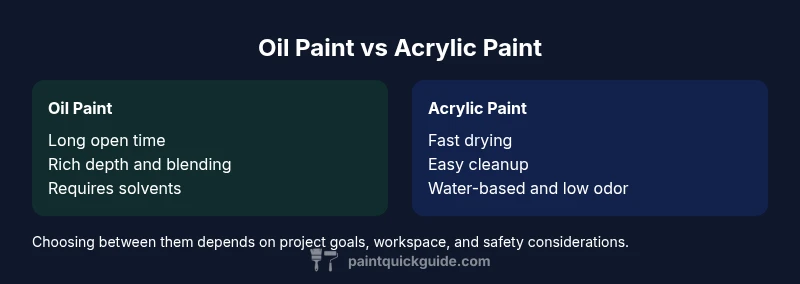
Oil paint and acrylic paint share a purpose—cover a surface with color—but their chemistry drives distinct experiences. Acrylics are water-based dispersions that dry by solvent evaporation and film formation, whereas oils use linseed or other drying oils to form a film over days or weeks. This fundamental difference translates into practical effects: acrylics dry fast and can be layered quickly, while oils stay workable longer, enabling subtle transitions and glazing. For the question is oil paint harder than acrylic, the answer scales with your project goals, ventilation, studio setup, and patience. According to PaintQuickGuide, matching technique to medium is the quickest route to success. The keyword here is context: what you need in a given project will determine whether oil or acrylic feels harder to you.
Drying time and workability: the most cited difference
Drying time is often the first factor that makes people think oil paints are harder to work with. Acrylics dry in minutes to hours on most typical studio conditions, which accelerates revisions but reduces open time for blending. Oils, by contrast, offer an extended working period—minutes or hours depending on pigment, medium, and surface. The trade-off is clear: fast-drying acrylics demand quick decisions and careful planning, while slow-drying oils reward patient glazing and gradual refinement. In practical terms, is oil paint harder than acrylic? For beginners, acrylic’s pace is friendlier; for experienced painters seeking depth, the extra time is a feature, not a bug.
Blending, glazing, and color depth: what to expect
Oil paints blend seamlessly and allow rich glazing with a natural luminosity that many artists associate with depth. The extended open time makes it possible to rework edges, soften transitions, and push color through multiple glaze layers. Acrylics can approach a similar effect but require deliberate techniques such as slow-drying acrylics, retarder mediums, or multiple glaze layers that dry in between. If your goal is luminous, nuanced color with subtle tonal shifts, oil offers an advantage that can feel like a higher entry barrier but delivers stronger, more flexible results in the right hands. The PaintQuickGuide team notes that practice with thinning agents, medium choices, and varnishing can tilt the odds toward success in either medium.
Surfaces and preparation: substrate matters
Both media reward clean, properly primed surfaces, but the preparation steps differ. Acrylics adhere well to many substrates when they’re properly primed and sealed, and they tolerate a broader range of moisture and surface textures. Oils require well-sealed, oil-primed surfaces to prevent absorption and to minimize cracking over time. Surface prep becomes a critical factor in determining which medium feels harder to you: if you start with a poor primer or a porous substrate, oil finishes may crack or craze, while acrylics may peel or lift if the surface isn’t adequately prepared. In either case, pre-test on a small area to estimate how the medium will behave on your chosen substrate.
Durability, aging, and protective varnishes
Oil paintings often benefit from controlled aging, with varnishes that enhance color depth and protect the surface. This additional step can add complexity and time to a project, but it’s standard practice for fine art or high-end auto refinishing that seeks long-term stability. Acrylics are inherently more resistant to water in their film form and dry to a tougher, sometimes more flexible finish that resists cracking if properly applied. The durability question—whether oil is harder than acrylic—depends on how well you manage varnishing, UV exposure, and layer adhesion. PaintQuickGuide emphasizes testing varnish compatibility and climate-controlled storage to preserve results over time.
Cleanup, ventilation, and health considerations
Solvent-based tools required for oil painting raise health and safety considerations. You’ll typically need proper ventilation, solvent handling protocols, and disposal practices that may feel onerous to a hobbyist working in a small space. Acrylics, being water-based, simplify cleanup and reduce odor, making the process easier for casual spaces and indoor projects. That said, clean-up complexity should not be your only criterion; long-term outcomes and your willingness to manage ventilation and solvent safety also influence whether oil feels harder than acrylic for your situation.
Costs, supply, and long-term value
Oil painting supplies—turpentine or odorless solvents, drying oils, varnishes, and longer-lasting pigments—can be more expensive upfront and require investment in proper storage and ventilation equipment. Acrylics are typically more affordable in beginner kits and blend-friendly mediums. Over time, the cost difference can balance out depending on how many layers you plan, your drying time constraints, and your appetite for experimenting with glazing versus fast-building layers. PaintQuickGuide discusses cost considerations not just in sticker price but in time, odor, space, and long-term maintenance.
Real-world scenarios: when to choose each medium
For a small, indoor hobby project with quick turnarounds, acrylics offer a lower barrier to entry and faster results. For a portrait or landscape where color depth and subtle tonal shifts matter, oil paints often deliver a richer finish after glazing. Auto refinishing, with its own safety, ventilation, and curing requirements, benefits from a disciplined workflow that takes advantage of oil’s blending or acrylic’s speed depending on the job stage. The key is to map your project’s constraints (time, workspace, and finish) to the medium’s strengths, rather than treating the question is oil paint harder than acrylic as a fixed yes/no.
A practical decision framework you can apply today
Start by listing your top priorities: speed, color depth, surface type, and cleanup tolerance. If speed dominates, lean acrylic; if depth and subtle blending matter, lean oil. Run a small side-by-side test on a similar substrate and document drying times, edge behavior, and varnish compatibility. This empirical approach is the best way to answer is oil paint harder than acrylic for your specific project. Over time, you’ll develop a preferred workflow that minimizes difficulty and maximizes results.