Paint or Stain Concrete: A Practical Comparison Guide
Compare painting vs staining concrete finishes for floors, patios, and countertops. Learn appearances, durability, prep, costs, and maintenance to pick the best finish for indoor and outdoor spaces.


Paint or stain concrete: which finish delivers the best balance of appearance, durability, and maintenance? Painting provides bold color and strong spill resistance, while staining preserves texture and a natural look. The choice depends on traffic, exposure, and lifecycle costs. This comparison guides interior and exterior applications for homes and garages, with practical tips from PaintQuickGuide.
Concrete finishes: color, texture, and performance
Concrete surfaces are inherently porous and textured, which means your choice of finish will affect both look and feel as well as maintenance. When you decide whether to paint or stain concrete, you weigh texture visibility, traffic patterns, and long-term costs. In practical terms, the decision comes down to two core needs: color control versus texture preservation. The PaintQuickGuide team emphasizes that the smartest choice balances aesthetics with lifecycle costs. By focusing on these drivers, homeowners can narrow options quickly and make informed budget decisions.
- Texture visibility matters: if you want to hide imperfections, painting with a sealing topcoat can deliver a uniform surface. If you prefer the natural texture of concrete, staining may be the better path.
- Exposure matters: interior floors and exterior patios behave differently under sunlight and moisture, which affects durability and maintenance.
- Lifecycle costs: paints may require more frequent refreshes in busy areas, while stains often demand periodic resealing. According to PaintQuickGuide, consider both upfront costs and future maintenance when planning a project.
For a quick mental model, imagine concrete surfaces as a canvas: you can either layer color and protection (paint) or enhance the existing texture with color that soaks in (stain). This framing helps you compare options without getting lost in product details.
The following sections dive into how each finish works, practical prep steps, and what to expect in terms of durability, maintenance, and cost over time.
How painting concrete works
Painting concrete isn’t just about slapping color on a slab. Successful paint projects rely on surface preparation, product selection, and proper sealing. Most interior and exterior concrete paints are water-based, though epoxy and acrylic enamel options exist for high-traffic areas. The key steps are cleaning, etching or profiling, applying a bonding primer, and then multiple coats of topcoat. A penetrating sealer or gloss topcoat can further enhance spill resistance and washability.
- Surface prep: remove oils, dust, and imperfections. Etching or diamond grinding may be necessary to achieve optimal adhesion on rough or old concrete.
- Primer choice: bonding primers improve adhesion on challenging surfaces and can help colors stay true over time.
- Topcoat options: choose between matte, satin, or gloss sheens; darker colors may require more coats to achieve even coverage.
- Durability factors: sealing after painting improves stain resistance and helps extend the life of the finish. Paints with UV inhibitors are preferable for outdoor use to slow fading.
Practical tip: for retail or workshop spaces, epoxy-based paints offer higher chemical resistance, while latex acrylics are easier to touch up and maintain for residential use. PaintQuickGuide recommends testing color in a small area before full-scale application to ensure compatibility with the substrate.
How staining concrete works
Staining concrete relies on pigments that penetrate the surface or adhere to its surface for color. The two main categories are penetrating stains (water- or acid-based) and color-enhancing topical stains (dyes or tinted sealers). Penetrating stains emphasize the natural texture and color variations of the concrete, producing a variegated look that ages gracefully. Dyes create more uniform color but can be less durable on high-traffic areas unless sealed. Proper sealing after staining is essential to protect color and reduce wear.
- Penetrating stains: achieve a durable color that won’t peel; maintenance typically involves cleaning and occasional resealing.
- Dyes and color enhancers: can provide brighter hues but may require more frequent reapplication on floors with heavy foot traffic.
- Sealers: a clear sealer is often applied after staining to lock in color and improve spill resistance and abrasion resistance.
- Durability: sealing quality and traffic pattern influence longevity; outdoor applications risk fading and UV damage if not properly protected.
Aesthetic outcomes vary: penetrating stains tend to highlight the concrete’s natural variegation, while surface stains produce more uniform color. PaintQuickGuide notes that staining is generally favored when the goal is a natural, textured appearance with lower reflectivity.
Surface preparation: paving the way for a lasting finish
Regardless of whether you paint or stain concrete, prep is the majority of the work. Skipping steps can lead to uneven color, poor adhesion, and premature failure. The typical sequence includes cleaning to remove oils and debris, repairing cracks, and profiling the surface to create a mechanical bond for coatings. For painted finishes, consider etching or grinding to increase porosity for primer adhesion. For stains, ensure the surface is clean and dry, with any efflorescence removed.
- Cleaning and degreasing: use a mild degreaser on garage floors and professional-grade cleaners on exterior patios.
- Crack repair: fill small cracks with epoxy or polyurethane sealant; large cracks should be stabilized before finishing.
- Surface profiling: light sanding or grinding can improve adhesion for both painting and staining.
- Moisture management: test moisture levels to avoid trapping damp conditions under coats; if moisture is high, address it before proceeding.
With proper prep, both finishes can deliver long-lasting results. PaintQuickGuide emphasizes that the best results come from patience during prep, not rushing to apply a color.
Durability and protection: sealing, UV exposure, and wear
Durability hinges on how you finish and protect the surface after application. Painted concrete benefits from topcoats or sealers that resist chemicals, abrasion, and moisture. Outdoor painted surfaces must withstand UV exposure and temperature fluctuations, so UV-blocking pigments and high-quality sealers are essential. Stained concrete relies on precise sealing to protect color and prevent water ingress. In both cases, routine maintenance—recoating when color dulls or wear appears—extends life.
- Sealer choice: solvent- or water-based sealers, depending on exposure and porosity, affect the final look and maintenance interval.
- UV protection: UV-blocking additives help reduce fading in sun-exposed areas.
- Abrasion resistance: for high-traffic areas, choose durable topcoats with good abrasion resistance.
- Maintenance schedule: painted finishes may require resealing every 3-7 years; stains often need resealing every 2-5 years.
PaintQuickGuide notes that proper sealing is often the difference between a finish that lasts five years and one that lasts a decade in outdoor applications.
Aesthetic outcomes: color range, texture, and feel
Appearance is the most visible difference between painting and staining concrete. Painted finishes offer bold color, uniform coverage, and the ability to change color with relative ease. Stains preserve the concrete’s natural texture and color variation, giving a more organic, factory-finished look. Both approaches benefit from color consults and test patches to ensure the final result matches your expectations.
- Color control: paints provide a wide color palette, including near-matte to high-gloss sheens; stains emphasize natural tone and texture.
- Texture balance: staining reveals the surface texture, while painting masks it—this matters for slip resistance and foot feel underfoot.
- Patterning possibilities: stamping, stenciling, or color-blocking can be applied with painted finishes; staining can be used with decorative sealers to achieve subtle gradients.
- Light reflection: gloss levels influence perceived depth and legibility of the color, especially in low-light spaces.
PaintQuickGuide analysis shows that for spaces where texture is a feature, staining generally delivers the most natural aesthetic with less risk of looking flat over time.
Maintenance, rediscovery, and lifecycle costs
Maintenance considerations are crucial when choosing between paint and stain. Painted surfaces often require more frequent refreshes to maintain color and gloss, especially in sunny or crowded indoor spaces. Stains, particularly when sealed, can offer lower maintenance with occasional resealing to refresh color. Budgeting for resurfacing becomes a factor in lifecycle costs, especially in entryways, kitchens, and outdoor patios where foot traffic is heavy.
- Schedule: plan resealing or recoating based on wear patterns rather than a fixed calendar year.
- Cleaning: use non-abrasive cleaners and avoid harsh chemicals that can degrade coatings.
- Repairs: chips or worn areas may be easier to touch up in painted finishes; stains may require reapplication to maintain color uniformity.
- Longevity estimates: both finishes can last 5-15 years depending on prep, application quality, and environment; reality often sits between these extremes based on usage.
A practical approach is to align maintenance with visible wear: if color looks dull or chips appear, schedule a refresh. This keeps costs predictable and outcomes consistent. PaintQuickGuide underscores the importance of proactive maintenance planning rather than reactive fixes.
Indoor vs outdoor: space-specific guidance and best practices
Indoor and outdoor concrete present different challenges. Indoors, you may prioritize odor, slip resistance, and ease of cleaning; outdoors, exposure to sun, rain, and temperature swings dominates. Painted finishes can yield dramatic indoor color schemes but require careful sealing for floors with moisture exposure. Stains work well outdoors to highlight texture and provide a more natural appearance while often needing periodic sealant reapplication.
- Interior floors: consider low-sheen paints for a modern look or penetrating stains for texture; ensure the substrate is dry and free of sealants that could impede adhesion.
- Exterior patios and driveways: UV-resistant paints and penetrating sealers help resist fading and moisture; staining can offer a durable, textured finish that ages gracefully.
- Safety considerations: anti-slip additives in topcoats and sealers are important for wet areas and high-traffic zones.
For most homeowners, the decision comes down to whether you want a strong color statement (paint) or a natural look with texture preserved (stain).
Quick-start decision framework: matching space, need, and budget
To help you decide quickly, use this framework: (1) Define the space (indoor vs outdoor, traffic level, moisture exposure). (2) Choose appearance first (colorful uniform vs natural texture). (3) Assess maintenance willingness (frequent refresh vs longer seal intervals). (4) Estimate budget and life-cycle costs over 5-10 years. (5) Plan prep time and scheduling around exterior seasons. This framework aligns with practical project planning and helps you avoid overcommitment before evaluating the space.
- If you want bold color and easy cleanup: lean toward painted concrete with a durable topcoat.
- If you want to preserve texture and minimize color updates: choose staining with a robust sealer.
Remember that the best results come from thorough prep and proper sealing rather than a quick color choice. PaintQuickGuide emphasizes testing a small area before a full-scale application to prevent surprises.
Practical implementation plan: a 2-weekend workflow for homeowners
A structured plan reduces guesswork and speeds up results. Weekend one focuses on prep and primer or stain application, while weekend two handles topcoats or sealers and any touch-ups. Adjust the plan for weather, humidity, and indoor airflow to minimize fumes and ensure proper curing. A step-by-step outline:
- Day 1: Clear the space, protect surroundings, and clean the concrete thoroughly. Repair cracks if needed.
- Day 2-3: Profile or etch the surface if painting; clean and neutralize for staining.
- Day 4-5: Apply primer (for paint) or stain sealer (for stain). Allow adequate drying time.
- Day 6-7: Apply finish coats or sealers; add anti-slip additives if necessary.
- Follow-up: inspect adhesion and color uniformity; perform any touch-ups after curing.
This phased approach minimizes disruptions and improves the chances of a long-lasting result. The PaintQuickGuide team recommends documenting the process with photos at each stage to track progress and decisions over time.
Comparison
| Feature | Painted concrete | Stained concrete |
|---|---|---|
| Appearance | Solid color with uniform coverage; hides texture when desired | Natural or textured look; texture remains visible |
| Durability & protection | Topcoats/sealers protect color and resist spills; easier to wipe clean | Sealers protect color but wear depends on traffic; texture remains prominent |
| Maintenance & re-coats | Recoat every 3-7 years; color refresh may be needed earlier | Recoat every 2-5 years; color maintenance depends on sealant |
| Prep requirements | Cleaning, etching or profiling, primer | Cleaning, surface profiling, and sealing; ensure dry surface |
| Typical cost range (per sq ft, rough) | Moderate to high upfront with color options | Moderate upfront; color depth varies with stain type |
| Best for spaces | High-traffic interiors, basements, and areas needing color control | Showcasing texture, exterior patios, and spaces aiming for a natural look |
Upsides
- Offers strong color control and easy spill cleanup
- Potentially longer-lasting finish with proper sealing
- Wide range of color options and finish sheens
- Can hide surface imperfections with the right prep and primer
- Easier to touch up small areas than stains when color is uniform
What's Bad
- Requires more surface prep and periodic sealing
- Higher potential for uneven color if prep is rushed
- Paint may chip or peel in high-traffic outdoor areas without robust sealing
- Some colors can fade in strong UV exposure if not properly protected
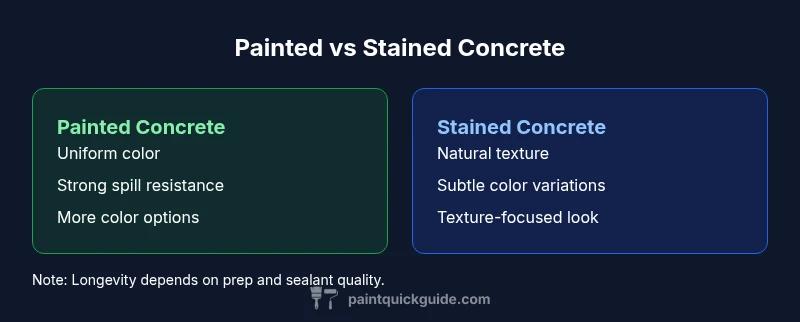
Painted concrete offers bold color and easy maintenance in many spaces, while stained concrete preserves texture and a natural look.
Choose painting for a strong, easy-to-clean surface with color control. Choose staining when you want texture to show through and a more natural concrete appearance. Proper prep and sealing are the keys to long-term satisfaction with either finish.
Your Questions Answered
Can I paint concrete over an existing stained surface?
Yes, but proper prep is essential. Clean and abrade the surface to create adhesion, apply a bonding primer, and then paint with a high-quality topcoat suitable for concrete. Expect color change and potential adhesion challenges if the stain was not properly sealed.
Yes, with good prep and a bonding primer. Start by cleaning and lightly abrading the surface, then apply primer before painting.
Is staining better for outdoor concrete patios than painting?
Staining outdoors preserves texture and tends to wear more evenly in sunlight, but sealing quality greatly affects color longevity. Painting outdoors requires UV-stable pigments and a robust sealer to resist fading and cracking.
Outdoors, staining is popular for texture, but you still need a strong sealer to protect color.
Do I need to etch concrete before painting?
Etching or profiling improves primer adhesion on smooth or sealed concrete. If the surface is rough or has old coatings, profiling ensures the paint bonds properly and lasts longer.
Yes, profile the surface so the primer sticks well.
How long do painted or stained concrete finishes typically last?
Lifespan varies with environment and maintenance. Painted finishes often require re-coating every few years, while stains may last longer between reseals, but both benefit from proper prep and sealing.
Depends on environment; both benefit from proper sealing and periodic refresh.
Is slip resistance affected by paint or stain?
Yes. Both finishes can be enhanced with anti-slip additives in topcoats or sealers, especially in bathrooms, kitchens, or outdoor wet areas.
You can improve grip by adding anti-slip agents to the finish.
Can I change from paint to stain later without resurfacing?
Changing from paint to stain typically requires removing the coating or thoroughly cleaning and profiling the surface before applying stain. It’s best to plan final appearance early to minimize extra work.
It’s possible but may require stripping and prep.
Quick Summary
- Weigh texture visibility against color goals
- Plan thorough prep and sealing for durability
- Outdoor spaces favor UV-stable finishes and robust sealers
- Interior spaces can benefit from bold color or preserved texture depending on need
- Test patches to confirm adhesion and final color before full-scale work