Is Paint or Stain Better for a Deck? A Practical Comparison
A practical, evidence-based guide to choosing between paint and stain for decks, covering durability, aesthetics, prep, climate effects, and maintenance—so you can pick the right finish for your outdoor space.


When deciding is paint or stain better for a deck, the answer depends on your goals: if you want bold, uniform color and solid barrier protection, paint is usually best; if you prefer preserving wood texture and easier re-coats, stain is often the smarter choice. Both have pros and cons tied to climate, wood type, and maintenance tolerance.
Deck Finishes: Is Paint or Stain Better for a Deck? A Practical Guide
If you’re asking, is paint or stain better for a deck, you’re not alone. Homeowners face a choice between a pigmented coating that seals and hides grain versus a transparent or semi-transparent finish that highlights wood texture. The decision hinges on climate, wood species, and maintenance tolerance. According to PaintQuickGuide, the best finish depends on deck material and use, not a universal winner. In practice, the choice should align with how you use the space, how much time you want to invest in maintenance, and the look you want to achieve. This article digs into the science behind each option, compares real-world performance, and offers a practical decision framework you can apply this season.
Understanding Deck Materials and Why It Matters
Decks are built from a range of woods such as pressure-treated pine, cedar, redwood, and tropical hardwoods. Each species responds differently to moisture, UV exposure, and temperature swings. For example, softer woods tend to absorb finishes more quickly and may show wear sooner, while dense woods can resist moisture longer. The finish you choose should account for this variability. Paint and stain perform differently depending on wood porosity and surface preparation. If you have an older deck with weathered boards, the prep required before applying either finish becomes the deciding factor for long-term success. The PaintQuickGuide Team emphasizes starting from the wood’s condition rather than chasing a universal “best” product.
How Paint Works on Exterior Wood
Paint creates a film that sits on the surface, providing a uniform color and a protective barrier over wood. Modern acrylic-latex paints offer good adhesion, fading resistance, and mildew protection when properly applied. A coat or two of primer can improve film formation on blotchy or stained woods, and the topcoat locks in color while acting as a water barrier. One of the main advantages of paint is color control: you can achieve bold hues, precise trim colors, and consistent coverage across chewed or stained boards. The trade-off is that any moisture trapped beneath the film can lead to peeling or blistering if surface prep is inadequate or boards are overly damp when applied.
How Stain Works on Exterior Wood
Stain penetrates the wood rather than forming a thick film on the surface. This lets the wood breathe and helps preserve its natural grain and texture. Transparent stains emphasize grain, while semi-transparent stains balance color with the wood’s appearance. Because stain soaks in, it’s typically easier to touch up and recoat in targeted areas without stripping the entire surface. Stains often require fewer steps during final prep and can be more adaptable to irregular board surfaces. The downside is that color options are more limited, and some stains can become uneven if the surface is not properly prepared or if UV exposure wears the finish unevenly over time.
Durability and Weather Resistance: Paint vs Stain
Durability depends on climate, maintenance, and substrate condition. Paint forms a protective film that can resist moisture, soil, and UV exposure when properly cured, but it can crack or peel if boards swell or if moisture gets trapped. Stain’s penetrating barrier tends to be more forgiving on warped or uneven boards, and it typically requires fewer prep steps, but it may wear down faster in areas with heavy foot traffic or sun exposure. In shaded, dry climates, stains can retain color for longer; in hot, sunny regions, both finishes succumb to UV fade, although stains may require more frequent re-coats to maintain color richness. The key is consistent maintenance—whether you choose a paint or a stain, prepare the surface well and monitor for signs of moisture ingress or wear.
Aesthetics and Color Control
If your deck color is a central aesthetic goal, paint offers a nearly unlimited palette and can hide wood imperfections, panel gaps, and surface irregularities more effectively than stain. Painted decks tend to read as a solid surface, which can visually broaden a space. Stain preserves natural wood texture, requiring a lighter touch with color and often appearing more timeless. Some homeowners pair stain with sealers to boost gloss or matte appearance while maintaining wood tone. Your choice should reflect how visible grain, wear patterns, and color uniformity matter for your property’s style and the surrounding landscape.
Application and Maintenance: Time, Labor, and Costs
Application duration, required prep, and ongoing maintenance are critical practical factors. Painting a deck generally demands more prep: cleaning, sanding, repairing damage, sealing with a primer, and multiple coats of paint. Repainting every several years can be a sizable time investment, especially in high-traffic zones. Staining usually requires lighter prep and fewer coats, with touch-ups and re-coats spread over longer intervals. Maintenance frequency depends on sun exposure, foot traffic, and how well boards were prepped. Both finishes benefit from annual inspections for peeling, raised grain, or moisture staining, and both require degreasing and cleaning to keep surface conditions optimal before reapplication.
Climate and Sun Exposure: When to Choose Each Finish
Local climate dramatically influences deck finish performance. In regions with high sun exposure and temperature swings, pigment retention becomes the defining factor. Paint can offer strong color retention but may require more frequent checks for film failure on older boards. Stain can be a lower-maintenance option in humid environments because the finish is less likely to trap moisture, but it may fade in intense sun, requiring more frequent color refreshes. For decks in coastal environments with salt spray, stain tends to hold up well when applied correctly, while paint may be more susceptible to chalking and peeling if moisture barriers fail.
Prep Steps: Cleaning, Sanding, and Priming
Regardless of finish type, surface prep determines long-term performance. Clean boards thoroughly to remove mildew, dirt, and oils that can impede adhesion. Light sanding smooths rough edges and helps finishes grip the surface. For paint, a primer appropriate for outdoor wood increases adhesion and improves uniform color. For stain, a semi-transparent product may require less primer and more attention to scraping and cleaning to ensure the stain penetrates evenly. Weather conditions matter: choose a dry window with moderate temperatures to avoid rapid drying or moisture entrapment under coatings.
Cost and Value: Upfront vs Long-Term
From a cost perspective, paint typically carries a higher upfront and labor cost because of primer, multiple coats, and potentially more extensive prep. Stain often costs less upfront and can be more forgiving in maintenance, but color refresh cycles can add up over the years. The total value depends on how long you want the deck to look consistent, how much time you’re willing to invest in upkeep, and the local climate’s impact on finish longevity. The PaintQuickGuide Team suggests weighing your desired aesthetic against maintenance tolerance and expected life cycles to choose the most cost-effective option over the deck’s lifespan.
Case Scenarios: When a Deck Demands Paint, When Stain Is Better
Case A: You want a bold, uniform color that covers imperfections and seals against moisture. Case B: You want to preserve natural wood texture, with a finish that fades softly over time and is easier to touch up. Case C: You’re dealing with weathered boards or boards with varying grain; stain can offer a practical, more forgiving refresh, while patch repairs and re-priming may be required for a consistent look. In each scenario, the decision should be anchored in your climate, maintenance schedule, and the deck’s exposure to foot traffic. Paint shines in formal spaces; stain excels in rustic, natural settings.
Practical Decision Toolkit: Quick Reference Guide
To make the call easier, start with: 1) Assess deck wood type and existing finish, 2) Consider climate and sun exposure, 3) Define cadence for maintenance, 4) Decide on the desired aesthetic (bold color vs natural texture), 5) Evaluate prep requirements and time, 6) Choose a reputable outdoor product line, 7) Schedule a test patch in a small area before full application.
Comparison
| Feature | Paint | Stain |
|---|---|---|
| Wood appearance | Uniform color, hides grain | Preserves natural grain and texture |
| Protection approach | Film-forming barrier protecting surface | Penetrating barrier that breathes with wood |
| Durability under UV | Good color retention with proper primer | Color may fade; refresh coats needed over time |
| Prep requirements | Primer often recommended; surface may require sanding | Typically lighter prep; cleaning and smoothing suffice |
| Color options | Wide palette including bold colors | Limited to wood tones or tinted hues |
| Maintenance cadence | Repaint every several years depending on wear | Recoat/retouch more frequently in sun-exposed areas |
| Best for | Bold, uniform appearance; maximum color control | Natural wood look and easier touch-ups |
Upsides
- Offers strong color control and uniform finish
- Can seal against moisture and stains when properly applied
- Paint can mask surface imperfections and provide a fresh look
- Stain preserves wood texture and often requires less prep
What's Bad
- Paint requires more maintenance over time in high-traffic areas
- Peeling or blistering can occur if moisture gets trapped
- Stain may require more frequent refresh to maintain color
- Color options are more limited with stain
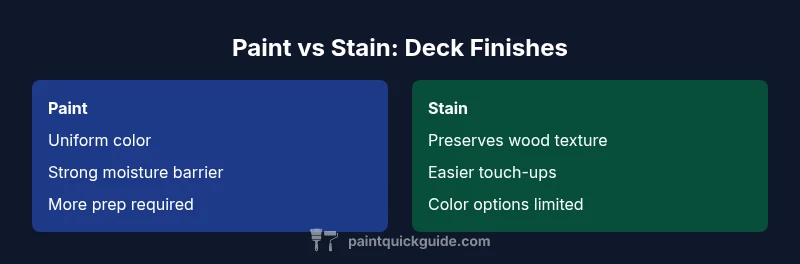
Choose based on aesthetic goals and maintenance tolerance: paint for bold, uniform color and added surface protection; stain for preserving wood texture and easier touch-ups.
Paint suits spaces where color and a solid barrier are priorities. Stain suits spaces prioritizing natural wood texture and lower initial prep. Climate, deck wear, and maintenance willingness should guide the final choice.
Your Questions Answered
Is paint more durable than stain for a deck?
Durability depends on climate and maintenance. Paint can offer a strong moisture barrier when properly applied, but its film can peel if boards swell or moisture gets trapped. Stain penetrates and breathes, reducing peeling risk but may require more frequent color refresh in sunny or humid conditions.
Durability depends on climate and maintenance. Paint provides a strong barrier with proper prep, but films can peel. Stain breathes and may need more frequent color refresh in sun or humidity.
Can I switch from stain to paint on an existing deck?
Yes, but prep is key. You must remove or abrade the existing finish, clean thoroughly, and prime before applying paint. The surface should be dry and sound to ensure adhesion and prevent cracking of the new paint layer.
You can switch from stain to paint, but prep is essential. Remove the old finish, clean, dry, prime, then paint.
Do I need primer on a deck if I paint?
Typically yes. A dedicated exterior primer improves adhesion, seals the wood, and helps achieve an even topcoat. Some paints are labeled as primer-plus-paint, which can simplify the process, but surface assessment determines if separate primer is necessary.
Yes, primer is usually recommended for outdoor paint to ensure adhesion and even color.
How long does paint or stain typically last on a deck?
Lifespan varies with climate and maintenance. Paint-coated decks can last several years with proper prep and re-coats; stains may require more frequent refresh to preserve color, especially in sunny or humid environments.
Lifespan depends on climate and maintenance; expect more frequent refresh for stain in sunny spots and longer intervals for paint with proper care.
Are there eco-friendly options for deck finishes?
Yes. Look for water-based stains or paints with low VOCs and durable finishes designed for outdoor use. Reputable brand choices emphasize non-toxic components and minimal environmental impact while maintaining performance.
There are eco-friendly, low-VOC stains and paints that perform well outdoors; read labels for safety and durability.
What maintenance steps extend deck finish life?
Regular cleaning, prompt addressing of moisture intrusion, and timely re-coats extend finish life. Inspect for peeling, cracks, or raised grain, and address issues before applying new coats to ensure adhesion and uniform appearance.
Keep the deck clean, fix moisture problems early, and recoat before wear shows for best results.
Quick Summary
- Assess deck wood type and existing finish before choosing
- Paint for bold color and surface protection; stain to preserve texture
- Prepare thoroughly—proper prep boosts finish longevity
- Consider climate and exposure to decide maintenance cadence
- Test a small area first before full application