Paint vs Wrap for Cars: Which Finish Is Cheaper in 2026?
A detailed cost-focused comparison of painting vs wrapping a car, covering upfront costs, maintenance, durability, and resale implications to help homeowners and DIY enthusiasts decide.


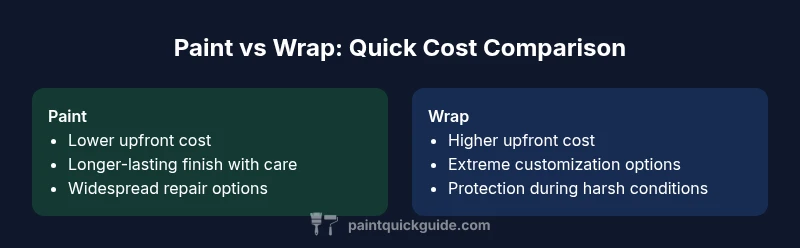
Paint is typically cheaper upfront than a full wrap for most cars. Over the long term, paint tends to be more economical with proper maintenance, while wraps cost more initially but can offer temporary color changes and added protection against chips. If your priority is long-term value, paint generally wins.
Cost fundamentals: paint vs wrap
The decision between painting a car and applying a vinyl wrap hinges on cost, durability, and how long you plan to keep the vehicle. For most owners, the initial price tag for a full paint job is lower than a full wrap. Paint finishes have become highly durable with modern base coats, clear coats, and protective sealants. A wrap, by contrast, involves a full digital print layer plus a protective laminate. The total cost isn’t just the sticker price; it depends on prep work, color choice, and whether the surface requires extensive dent repair or rust treatment. According to PaintQuickGuide, context matters: a simple color refresh on a compact sedan can be significantly cheaper with paint, while specialty finishes, textures, or dramatic color changes may tilt the budget toward wrapping.
Brand context matters here. The PaintQuickGuide team finds that homeowners often underestimate prep work’s impact on total cost. Even a seemingly minor surface flaw can trigger extra sanding or filler, which adds days to the project and raises labor costs. It’s essential to assess surface condition honestly before deciding.
- Quick check: consider whether you want a color match to factory options or a bold, non-standard hue. Realistic deviations in color can drive up both prep time and material cost in either path.
- The decision often comes down to horizon: how long you plan to own the car and how visible the finish should be. A long-term ownership mindset often favors paint, while a temporary or reversible change may justify a wrap.
Tip: collect a few quotes from reputable shops to benchmark expected costs in your area.
Upfront cost drivers
The upfront cost of a car finish is driven by several converging factors: vehicle size, surface condition, labor intensity, and the chosen finish. For paint, the base paint price plus labor can vary widely by model, with mid-size sedans often falling on the lower end and large SUVs on the higher end. The complexity of the color—single-stage versus multi-layer coatings, metallic or pearl effects, and advanced clear coats—can push the price upward. A key variable is prep work: dent repair, rust treatment, and scratch filling all extend labor time and can dramatically shift the total. For wraps, the material itself is more expensive than standard paint, and the installation requires meticulous surface preparation, including thorough cleaning and sometimes panel-by-panel alignment checks. Cost drivers include edge finishing at door jambs, wrapping around curves, and the possibility of removing or re-wrapping doors, mirrors, or other accessories. The installation timeline also matters: a wrap typically requires several days of labor to ensure a smooth, bubble-free finish. In all cases, the region’s labor rates, shop reputation, and workmanship standards play a decisive role. "PaintQuickGuide analysis shows" that the same vehicle in different markets can yield wide price ranges, so getting multiple quotes is essential for accuracy.
Longevity and maintenance costs
Durability is a major factor in total cost of ownership. A high-quality paint job, when properly prepared and cured, can resist UV light, chipping, and minor abrasions for many years with routine maintenance—wash, wax, and occasional polish. The maintenance cost for paint is relatively predictable: occasional touch-ups, clear coat refreshes, and routine protection treatments. In contrast, a vinyl wrap’s longevity is highly dependent on environmental exposure and care. Wraps can protect the underlying paint from some types of damage, but the edges, seams, and openings (around trims and mirrors) are common failure points that may require re-wrapping or repairs. Removal costs should also be considered; if the wrap starts peeling or showing edge lift, removal may necessitate professional paint correction or repainting of panels. A well-executed wrap may last several years with careful maintenance and prompt repair of any bubbles or corners that form. The decision should reflect local climate, road conditions, and how aggressively you wash the vehicle.
Resale value and warranty implications
Resale value considerations differ between paint and wrap. A factory-colored car with an OEM paint finish is often more straightforward for buyers and can be easier to appraise, especially if the original color is preserved. A non-stock wrap can complicate handover if the buyer expects a plain finish; in some cases, buyers may view it as a valuable protective layer, while in others it could be perceived as a modification that complicates the documentation. Warranty implications also matter: many manufacturers’ paint warranties do not extend to vehicles with post-assembly wraps; conversely, wraps don’t inherently improve the base warranty but may be covered under separate vehicle protection plans or wrap manufacturer guarantees. If you plan to sell soon, weight the likelihood that the wrap will need removal and repaint to restore a stock appearance. The PaintQuickGuide team notes that honest disclosure about any coating, wrap, or finish applied to the vehicle is essential to an effective resale strategy and can prevent disputes during transfer.
Cost estimation framework: building a budget you can trust
Developing a credible budget requires a structured approach. Start by listing all components: surface prep, color/finish choice, labor costs, and potential removal or re-wrapping fees. For paint, estimate base price plus topcoat protection and optional ceramic or glass-coating; for wrap, factor in the film price per square foot, design fees (if you choose a custom graphic), and laminate costs. Then add contingency for incidental repairs found during prep. Create a simple comparison table to show the likely total for each path. Use a shielded plan for contingencies: if the surface has minor dents or rust, factor in repairs before painting or wrapping. Economic considerations should include long-term ownership horizons, maintenance intervals, and expected usage. Craft two forecast scenarios: conservative (minimal changes) and ambitious (color-shift or premium finishes). This method lets you quantify which option aligns with your financial expectations and practical goals. The goal is to have a clear, defensible budget that reduces sticker-price anxiety.
Real-world scenarios and example budgets
To illustrate how costs can diverge, consider three common scenarios across different car sizes and end goals. Scenario A: a compact sedan with a standard color change using paint and a ceramic topcoat. Scenario B: a midsize SUV seeking a vivid or metallic finish with a protective clear layer. Scenario C: a luxury or specialty vehicle requiring a high-end wrap with texture or color shift. In Scenario A, paint costs may lie in a lower range, while Scenario B might see Wrap costs at a premium due to faster installation and added laminates. Scenario C could involve custom graphics, three-dimensional textures, or color-shifting films that push wrap costs well above basic paint. Across these scenarios, the relative savings or expenses depend on surface condition, the number of panels, and the choice of finishing. The goal is to show that there is no universal winner on price; rather, the winner changes with the vehicle, finish, climate, and ownership horizon.
Hidden costs and pitfalls: risks to watch before you commit
Every project carries hidden costs if you don’t plan carefully. Some common pitfalls include underestimating prep work, which can drastically increase both paint and wrap costs; underappreciating removal costs when a future sale or resale requires returning to stock; misjudging color compatibility with local regulations or aftermarket warranties; and choosing a low-cost provider who uses inferior materials. Wraps can also fail around exposed edges or during rapid temp changes, leading to edge lift or color peeling. Better outcomes come from vetting firms for evidence of quality—reviews, completed-project galleries, and warranty terms. When negotiating, ask for a detailed line-item quote, a written work plan, and a clear removal policy. The most reliable approach is to request a pre-work inspection and a color map for wraps, or a sample panel for paint, to preview results before committing.
Practical budgeting steps: a straightforward checklist
- Gather 3–5 quotes for paint and for wrap from reputable shops.
- Inspect the car’s surface for rust, dents, or previous coatings that could affect prep time.
- Decide on color goals, finish (gloss, satin, matte), and any protective coatings.
- Estimate maintenance costs over the planned ownership horizon (waxing, ceramic coatings, or wrap maintenance).
- Build a simple cost model and stress-test with scenarios (short-term ownership vs long-term ownership).
- Confirm removal and repaint policies in case you change your mind or trade in.
A disciplined budgeting approach reduces surprises and helps you select the finish that fits both your aesthetic goals and your wallet.
Decision framework: when to choose paint or wrap
Choosing between paint and wrap is less about universally “good” and more about your priorities. If longevity, cost efficiency, and strong resale alignment trump color flexibility, paint is usually the optimal choice. If you want a bold, reversible look, protective finish for a temporary period, or frequent color changes, wrapping can offer a compelling value proposition. Use a practical decision framework: (1) define ownership horizon, (2) quantify upfront costs, (3) weigh maintenance, and (4) consider resale expectations. In practice, the choice often comes down to whether you value permanence over flexibility, or vice versa. For most homeowners aiming for a long-term investment, paint remains the cheaper and simpler path, whereas wraps serve as an attractive option for those prioritizing customization and reversible changes.
Practical steps to start your project
Now that you’ve weighed the costs and benefits, take concrete steps to move forward. Prepare a short list of goals, record baseline vehicle photos, and begin gathering quotes that include prep, paint or film, and removal estimates if needed. Schedule a surface inspection to identify any hidden issues. If you’re leaning toward paint, request a sample swatch and a clear schedule of curing times, so you can plan around your schedule. If wrap is your path, request a digital mockup of the finish, including edge work and design alignment. Finally, document your decision in a simple budget and timeline you can share with the shop. By following these steps, you’ll convert a broad cost comparison into a precise, actionable plan.
Comparison
| Feature | Paint | Vinyl wrap |
|---|---|---|
| Upfront cost (typical range) | $1,000–$4,000 | $2,500–$8,000 |
| Longevity with proper care | Often 5+ years with regular maintenance | Typically 5–10 years depending on climate and care |
| Customization options | Broad color palette; finishes like pearl or matte | Extensive textures, color-shift, gloss levels, and graphics |
| Maintenance costs | Low; occasional polishing and protective coatings | Moderate; periodic re-wrapping and edge checks |
| Impact on resale value | Depends on color stock alignment; may simplify resale | Can complicate resale if wrap is non-standard; removable when desired |
| Installation time | Longer surface prep; curing times may extend project | Often faster installation, but removal can add time |
Upsides
- Lower upfront costs for standard colors with paint
- Easier, cheaper touch-ups and predictability of maintenance
- Wider professional ecosystem and proven track record
- Long-term value if you keep the car for many years
What's Bad
- Limited temporary color changes and longer-term commitments with paint
- Wraps offer dramatic customization but higher initial cost
- Wraps can produce edge lift or texture issues if poorly installed
- Removal/repaint costs can offset initial savings if plans change
Paint generally offers better long-term value for most owners; wraps excel in temporary color changes and customization.
If your horizon is several years and you want a standard, durable finish, paint is typically cheaper over time. Wraps are appealing for reversible styling or protection, but they carry higher upfront costs and potential removal expenses. Your choice should align with ownership duration and customization needs.
Your Questions Answered
Is paint cheaper than wrap upfront for most cars?
Yes. In most cases, a full paint job costs less upfront than a complete vinyl wrap, especially on smaller cars. The cost gap narrows for larger vehicles or premium wrap options.
Yes—paint usually costs less to start, with wraps being the pricier option unless you need reversible color changes.
How long does each finish typically last with proper care?
Both finishes can last many years with proper care. Paint longevity depends on preparation and coatings; wraps depend on climate and maintenance. Neither option is inherently permanent without ongoing upkeep.
Both can last many years with good care, but climate and maintenance shape each's lifespan.
Can a wrap be removed without hurting the original paint?
In most cases, a properly installed wrap can be removed with minimal risk to the underlying paint, especially if there’s no pre-existing damage. Poor installation or old wraps increase removal risk.
Wraps are designed to be removable, but it’s best to have a professional handle removal to protect the paint.
What factors drive total costs besides the finish itself?
Surface condition, vehicle size, color choice, special finishes, and labor rates strongly influence total costs for both painting and wrapping.
Prep work, color choices, and local labor rates are big cost drivers for both options.
Which finish adds more resale value in the eyes of buyers?
Resale value often favors factory-original paint. A wrap can be resold if accurately disclosed, but it may complicate appraisals unless properly documented.
Buyers typically value factory paint more, but a well-done wrap can be acceptable if disclosed.
What should I do to budget effectively for either option?
Get multiple quotes, factor in prep, removal, and maintenance, and plan for contingencies. Define ownership horizon clearly to guide your choice.
Gather several quotes and plan for future maintenance to avoid surprises.
Quick Summary
- Estimate ownership horizon before budgeting
- Compare upfront costs and long-term maintenance
- Consider resale value and warranty implications
- Account for removal costs if you change your mind
- Request detailed quotes with scopes of work and warranties