How to Remove Spray Paint from a Car: A Practical DIY Guide
Learn safe, effective methods to remove spray paint from your car without damaging the clear coat. Step-by-step DIY tips, tools, safety guidance, and aftercare to restore your finish.


To remove spray paint from a car, start by identifying the paint type and verifying the area is clear-coated. Begin with gentle options like soap and water, clay bar, and mild solvent on a small spot. For stubborn spray paint, use a dedicated automotive paint remover with minimal solvent, testing in an inconspicuous area. Avoid wire brushes and harsh abrasives on the finish.
What this guide covers
This guide explains how to remove spray paint from a car while protecting the finish. It outlines safe methods, the right cleaners, and when to seek professional help. You’ll learn to identify paint types, test in a discreet area, and choose the approach that minimizes risk to the clear coat. According to PaintQuickGuide, the key to success is choosing a method compatible with your finish and applying it gently.
Over the course of this guide you’ll see practical recommendations for different paint types, finishes, and environments. You’ll also find a simple, test-first mindset that minimizes risk and helps you decide when it’s wise to call a pro. PaintQuickGuide’s emphasis on controlled, evidence-based steps informs every tip and technique in this article.
Safety first: protect your finish and yourself
Working with solvents and abrasive tools requires care. Wear chemical-resistant gloves, eye protection, and operate in a well-ventilated area away from direct sunlight. Prior to any removal, wash the panel to remove surface dirt that could scratch the finish. Use masking tape to protect nearby trim, plastics, and chrome so you don't contaminate areas not intended for treatment. The goal is to avoid penetrating the clear coat and creating more damage than you started with.
Safety isn’t optional here—solvents can irritate skin and eyes, and fumes can accumulate quickly in enclosed spaces. Always work at a comfortable pace and keep a damp rag handy to wipe spills promptly.
Assess the paint type and surface finish
Spray paints can sit on different surfaces: some may bond to clear coats, others to bare metal. A light, non-porous finish like automotive lacquer can respond differently to solvents than enamel-based paints. Start by gently cleaning a small area, then observe how the surface responds to mild cleaners. If the paint lifts with little effort, proceed gradually; if you notice dulling or swirls, back off and reassess.
Understanding whether the paint is acrylic, enamel, or lacquer helps you select the safest solvent strategy and determines whether you’ll need polishing or a clear-coat refresh afterward.
Cleaning supplies and safe solvents
Keep a small set of tools handy: mild car soap, microfiber towels, a clay bar, and a selection of safe removers designed for automotive finishes. For stubborn spray paint on clear coats, consider a dedicated automotive paint remover meant for spot treatments, followed by a thorough wash. Avoid harsh solvents like straight acetone on fresh finishes; always test first.
Organize tools in a small kit so you can work efficiently without re-runs to the shed. A single, contained kit reduces the chance of cross-contamination between different chemical products and finishes.
Step-by-step overview for DIY removal
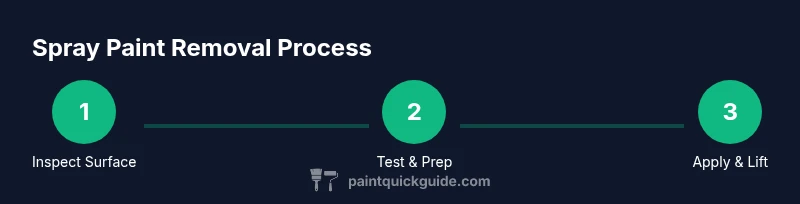
The DIY path balances effectiveness with safety. Start cool, work in shade, and test on a hidden area. You’ll progress through cleaning, softening, lifting, and finally polishing to restore gloss. This approach minimizes risk to the clear coat while removing most spray paint residues. As you practice, you’ll gain a better feel for how different paints respond to products and techniques. PaintQuickGuide Analysis, 2026 indicates higher success when steps stay controlled and user-friendly.
Step-by-step: detailed approach for a small area (1–2 square feet)
- Prep the area: Rinse and dry. Inspect for damage.
- Test a small area: Apply a tiny amount of remover to a cotton swab; wait 30 seconds; wipe away and observe. If finish is unaffected, proceed.
- Apply remover: Use a light, circular motion and a microfiber cloth; let it dwell for 30–60 seconds on light paints.
- Gently rub and lift: Use a clay bar or plastic scraper with low pressure; wipe clean.
- Rinse and repeat: Rinse thoroughly; re-evaluate.
- Finish with polish and sealant: Restore shine and protection.
tipTypeBlocksOnlyNoteBool messing?
Tools & Materials
- Mild car soap(pH-balanced, non-caustic formula for safe cleaning.)
- Water (warm, not hot)(For rinsing and dilution.)
- Microfiber towels(Multiple clean towels; avoid abrasive cloths.)
- Clay bar kit(For lifting embedded paint without scratching.)
- Dedicated automotive paint remover (spot treatment)(Choose one compatible with clear coats; follow label.)
- Isopropyl alcohol (70%)(Test spot only; not a primary remover.)
- Plastic scraper or soft pick(Use edge with a dull, non-metal edge.)
- Polishing compound(For refining after paint removal.)
- Wax or sealant(Protective barrier after finishing.)
- Masking tape(Protect trim and adjacent panels.)
- Chemical-resistant gloves(Protect skin from solvents.)
- Eye protection(Goggles or safety glasses.)
Steps
Estimated time: 60-90 minutes
- 1
Prep the area and protect the finish
Rinse the area with clean water and dry thoroughly. Mask surrounding trim and plastics with tape to prevent accidental contact with solvents. Wear gloves and eye protection, and work in a shaded, well-ventilated space.
Tip: Preparing a clean, protected zone reduces the risk of collateral damage. - 2
Test a small spot on inconspicuous area
Dab a small amount of remover on a cotton swab and apply to a hidden corner. Wait a brief moment, then wipe away. Check for finish changes before proceeding.
Tip: A positive test saves you from widespread damage. - 3
Apply remover and let it dwell
Apply a thin layer of the remover over the spray paint and allow it to dwell for 30–60 seconds (time depends on product). Avoid pooling; keep the area moistened but not saturated.
Tip: Do not rub aggressively during dwell to prevent scratching. - 4
Gently lift the paint
With a microfiber cloth, gently wipe in a circular motion to lift the paint. If lifting is slow, reapply a light coating and re-dwell briefly before trying again.
Tip: Use a clay bar for embedded edges to avoid abrasive contact. - 5
Rinse, re-evaluate, and repeat if needed
Rinse the area with clean water and inspect. If some paint remains, repeat steps 3–4 with patience. Stop if you see dulling or swirl marks.
Tip: Repeated, light passes are safer than a single aggressive pass. - 6
Finish with polish and sealant
Apply a gentle polish to restore gloss and remove micro-marring. Seal with wax or a paint sealant to protect the finish from future contaminants.
Tip: A protective layer helps prevent future adhesion of spray paint.
Your Questions Answered
Can I use household solvents to remove spray paint from my car?
Household solvents are generally not formulated for automotive finishes and can cause damage. Use automotive-safe removers and always test in a discreet spot before applying widely.
Household solvents are risky—stick to automotive-safe removers and test a small area first.
Will spray paint damage the car's clear coat?
If you remove spray paint promptly with gentle methods, the risk to the clear coat is low. Aggressive scrubbing or harsh chemicals can dull or scratch the finish.
A careful, test-based approach protects the clear coat from damage.
Is acetone safe to use on car paint?
Straight acetone is generally not recommended on automotive clear coats. It can soften or remove finishes; use automotive-safe removers and test first.
Avoid acetone on your car’s finish; opt for safer automotive products.
How long does removal typically take for a small area?
For a small area, expect a focused session lasting under an hour with careful steps. Larger spots may take longer and benefit from breaks between passes.
It usually takes under an hour for small patches, longer for bigger areas.
Should I wax after removal?
Yes. After removing the paint, polish to restore gloss and apply a protective wax or sealant to shield the surface from future damage.
Yes—polish and seal the area to protect it after removal.
When should I call a professional?
If the spray paint is deeply embedded, covers a large area, or you notice persistent finish damage, a professional refinishing or repaint may be the best option.
If in doubt or the area is large, a pro can ensure a proper finish.
Watch Video
Quick Summary
- Identify paint type and finish before starting
- Protect nearby trim and your skin with PPE
- Start with gentle removers and test spots
- Work slowly, cleanly, and test frequently
- Seal the surface after removal to protect it