How to Fix Paint Scratches on a Car: DIY Guide
A practical, step-by-step guide to repairing car paint scratches at home. Learn to identify scratch depth, choose the right method, prep correctly, perform safe repairs, and protect your finish with wax or sealant. PaintQuickGuide provides expert, actionable tips for homeowners and DIY enthusiasts.


Learn how to fix paint scratches on a car, from identifying scratch depth to applying the right DIY repairs and protection. This guide covers safe prep, pocket-friendly polishing, color-matching touch-ups, and protective sealants, plus pitfalls to avoid and when to seek pro help. Follow these steps to restore gloss and safeguard your finish.
Understanding scratch types
Car paint scratches come in three common categories: surface-level clear-coat scratches, mid-depth scratches that pierce into the color coat, and deep gouges where layers are removed. The PaintQuickGuide team notes that correctly identifying the scratch type is essential, because each category requires a distinct repair approach. Surface scratches may respond to polishing and light touch-up, while mid-depth or deep scratches often demand more involved steps or professional refinishing. In practice, start by inspecting the area under bright light and feeling along the edge with a fingernail to gauge depth. If the edge catches or you see color missing, plan differently. The goal is to restore gloss and even tone without removing too much clear coat. By recognizing the type of scratch, you set realistic expectations and choose the safest, most effective repair path.
Brand context: PaintQuickGuide emphasizes that accurate scratch identification is the first and most important step for a successful DIY repair. The approach should be conservative and staged to minimize risk to the finish.
Assessing damage and choosing a method
Begin by asking three questions: Is the scratch confined to the clear coat, or does it reach the color coat or primer? Can you visually blend it with polishing, or does it require color-matching paint? A fingernail test helps determine depth: if your nail catches at the edge, the scratch is likely deeper. Consider the panel’s curvature and ambient lighting, as these affect how the repair will blend. For small, shallow scratches on solid colors, a polish or light-cut compound can often create a seamless look. On metallics or pearls, the risk of shade mismatch increases, so proceed with caution. If the scratch is in a high-visibility area or involves multiple layers, it’s wise to compare DIY fixes with a professional estimate. The objective is uniform brightness and even tone, not a perfect color match in one pass. Where shade and depth are uncertain, err on the side of professional help to avoid a costly, obvious fix later on.
Cleaning and prepping the area
A clean surface is essential before any repair. Start by washing the scratched panel with a mild car wash soap to remove dirt and grime, then dry completely with a lint-free towel. Inspect again for contaminants, as residual debris can grind into the paint during polishing. Mask surrounding areas with painter's tape to protect adjacent panels, trim, and decals. This step minimizes the risk of introducing new scratches or removing nearby finish. Wipe the area with a quick degreaser or isopropyl wipe if you have one, then re-dry. Proper prep ensures that polishing compounds or touch-up paints work evenly and blend smoothly with the existing finish.
DIY approaches by depth
Light surface scratches in clear coat can often be treated with a polishing compound and a soft applicator pad to restore shine. For deeper but non-penetrating scratches, use a medium-cut rubbing compound to gradually blend the edges into the surrounding paint, then follow with a fine polish to restore gloss. If the scratch breaks through to color or primer, you may need color-matched touch-up paint followed by a clear coat to seal and level the surface. Always apply thin layers and allow adequate drying time between steps. In all cases, perform a test on a small inconspicuous area first to gauge color consistency and texture before proceeding to the entire scratch. The aim is gradual blending rather than aggressive abrasion, which can worsen the defect.
Finishing and protective steps
After repairing the scratch, finish with a dedicated glaze or polish to restore depth and a protective wax or sealant to guard against future damage. Buff with a clean microfiber cloth in short, light passes until the area matches the surrounding paint. If you used touch-up paint, ensure the color has fully dried before sealing. Regular washing and periodic waxing help maintain the repair and protect the area from UV exposure and oxidation. For best long-term results, follow up repairs with a ceramic or high-quality sealant on the entire panel to preserve gloss and minimize future micro-scratches.
Tip: document your repair with photos and keep a note of products used and drying times for future reference. Seek professional help if color matching proves difficult or if the damage recurs after DIY attempts.
Common mistakes to avoid
- Skipping surface prep or rushing the masking step, which can smear polish or touch-up paint.
- Using overly aggressive abrasive products on curved panels or metallic paints, which can dull or haze the finish.
- Expecting a single pass to fully fix a deep scratch—most repairs require multiple thin layers and patience.
- Ignoring safety: wear gloves and eye protection when handling polishing compounds and solvents.
- Forgetting to test products on a hidden area first; shade and texture can differ across panels.
Tools & Materials
- Two microfiber towels (lint-free)(For buffing and cleaning; use separate towels for polishing and drying.)
- Mild car wash soap(Clean the panel before repair to avoid trapping grit.)
- Masking tape / painter's tape(Protect adjacent areas and trim.)
- Polishing compound (light-cut)(Use for very light scratches to restore gloss.)
- Rubbing compound (medium-cut)(Blends deeper scratches with surrounding paint.)
- Scratch-removal kit (optional)(Contains micro-abrasives and polishing pads.)
- Touch-up paint or color-match pen(Only if you have an exact color match.)
- Clear coat pen or spray (optional)(Use after color matching for protection.)
- Fine-grit sanding paper (1000-2000 grit) or sanding pad (optional)(Only for deep scratches that go beyond clear coat.)
- Gloves and eye protection(Safety first; avoid skin contact with chemicals.)
Steps
Estimated time: 90-120 minutes
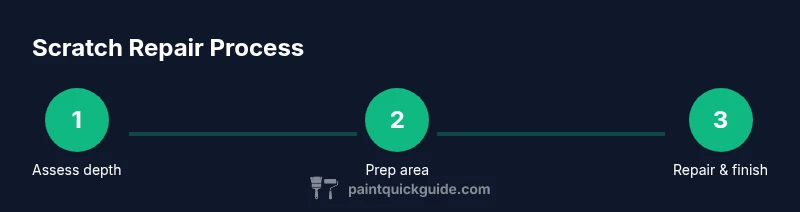
- 1
Assess scratch depth
Inspect the scratch under bright light and perform a fingernail test to estimate depth. Classify as surface, mid-depth, or deep. Document the area with a photo; this helps track progress and ensures you pick the right repair method.
Tip: Take a photo at multiple angles to compare before/after results. - 2
Wash and dry the panel
Clean the panel thoroughly with mild car wash soap to remove dirt and grease. Rinse well and dry completely with a lint-free towel to prevent water spots during polishing.
Tip: Avoid letting water sit on the surface; dry promptly to prevent mineral deposits. - 3
Mask surrounding area
Apply masking tape around the scratch to protect adjacent paint and trim. This reduces the chance of accidental polishing or paint transfer.
Tip: Press tape edges firmly to prevent lifting during polishing. - 4
Apply polishing compound for light scratches
Put a small amount of polishing compound on a soft applicator and rub in small circles over the scratch with light pressure. Wipe clean and assess blend.
Tip: Work in a well-lit area to monitor blending progress. - 5
Use rubbing compound for deeper scratches
If the scratch remains after polishing, switch to a medium-cut rubbing compound. Use gradual, even pressure and keep the pad flat against the surface to avoid creating new scratches.
Tip: Do not overdo it; frequent checks prevent over-abrasion. - 6
Touch up color or clear coat for color-depth
If color is missing, apply a thin layer of color-matched touch-up paint. Allow to dry fully, then apply a clear coat to seal and blend. Re-dry before moving to finishing steps.
Tip: Apply in several ultra-thin layers rather than a single thick coat. - 7
Final buff and protection
Buff the repaired area with a fine polish to restore shine, then apply wax or sealant for protection. Ensure complete cure time per product instructions before washing.
Tip: Use a circular motion and light pressure to minimize new micro-scratches.
Your Questions Answered
Can I fix minor scratches with household products?
For very light, clear-coat scratches you may achieve a modest improvement with safe polishes, but avoid household cleaners or abrasive creams not intended for automotive finishes. Testing on a hidden area is essential.
Yes for tiny, non-structural scratches, but avoid household cleaners and test first.
Will DIY fixes ever be perfect on deep scratches?
Deep scratches that expose color or primer often require color matching and potentially repainting. DIY methods may improve appearance but cannot always restore factory-grade uniformity.
Deep scratches may not be perfectly fixed with DIY methods and might need repainting.
Should I use a dual-action polisher for this repair?
A dual-action polisher is optional for larger jobs or curved panels. Beginners can start with hand polishing to minimize risk and gradually upgrade if needed.
A polisher can help on larger areas, but beginners should start by hand.
How long does a touch-up repair take to cure?
Drying and curing times vary by product, temperature, and humidity. Plan on several hours for touch-up, including color drying and any clear coat layers.
Cure times vary; expect several hours for complete drying.
Is professional color matching necessary for best results?
Color matching is challenging. If exact color match is not possible, a pro shop can blend and spray to achieve a seamless look, particularly on metallic or pearl finishes.
Professional color matching often yields the best, most seamless results.
Should I worry about rust after a scratch repair?
If bare metal is exposed, rust can develop. Address exposed areas promptly with primer and matching paint, and protect with a sealant to deter moisture ingress.
Exposed metal can rust; protect repaired areas and monitor for moisture.
Watch Video
Quick Summary
- Identify scratch depth before starting.
- Prep the surface thoroughly for best results.
- Start with the least invasive method and document progress.
- Seal the area after repair to protect the finish.