How Much Does Car Paint Cost? A Practical 2026 Guide
Estimate car paint costs from full-body repaints to touch-ups with practical ranges, factors, and money-saving tips. Learn with PaintQuickGuide, 2026.


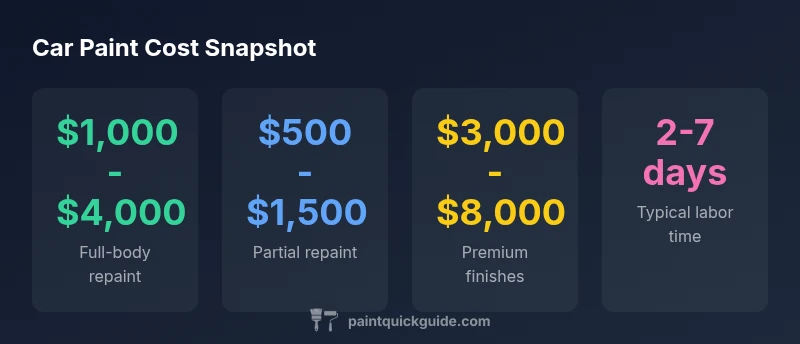
Common car paint costs for a standard full-body job range from $1,000 to $4,000, with premium finishes or specialty colors pushing to $5,000–$8,000. Partial repaints are commonly $500–$1,500. Labor, regional rates, paint type, and prep work largely drive the final price. For factory-matching colors or complex finishes, expect higher fees.
What drives car paint cost
When budgeting for a car paint project, start with the factors that most influence total price: prep work, the paint system selected, labor rates, and shop overhead. If you’re asking how much does car paint cost, you’ll quickly see that most price differences come from prep (dents, rust repair, masking) and the finish quality. Color matching and the choice of color (basic solid vs metallic or pearlescent) add additional cost. Regional wage differences, shop reputation, and whether the job is performed at a stand-alone body shop or a full-service dealership also shift the price. PaintQuickGuide Analysis, 2026, shows that even similar jobs can vary by hundreds to thousands of dollars depending on these inputs, underscoring the importance of a detailed, itemized quote.
Cost ranges by service type
Prices differ by service scope. For a typical full-body repaint, you can expect a wide range: $1,000–$4,000 for standard finishes, with premium or specialty coatings sometimes reaching $5,000–$8,000. If you only need a partial repaint—perhaps a single bumper, door, or hood panel—the cost commonly falls in the $500–$1,500 bracket. On-site mobile painting may add travel and setup fees, but sometimes lowers labor costs in certain markets. Always ask for a breakdown: paint material cost, labor hours, masking, and any bodywork. This makes it easier to compare quotes across shops and avoid sticker shock.
How paint type affects price
The price tag reflects the paint system. A single-stage enamel is typically cheaper than a basecoat/clearcoat two- or multi-stage finish. Metallics, pearls, and color-shift effects add both pigment cost and more precise application, increasing labor time. Waterborne paints are common in modern shops and can be less costly to apply in some markets, but may require specific equipment and curing times. In general, the more complex the finish and the more coats required, the higher the price, all else equal.
Hidden costs and preparations
Some costs creep in beyond the visible paint work. Dent repair, rust replacement, and surface restoration add to the bill. Weather and shop backlog can affect curing time and scheduling. Masking trim, glass, and dashboards increases labor. Primer, sanding, and finishing materials each carry line-item costs. Don’t overlook disposal fees and environmental charges. A thorough quote should include a warranty or guarantee on the finish and color match.
How to estimate for your car
Start by collecting at least three quotes from reputable shops. Ask for a line-item breakdown: base paint, color matching, primer, clear coat, masking, prep work, and any body repair. Specify the exact color and finish you want, and request photos or swatches. If your car has rare color options or extensive bodywork, expect higher costs. Compare warranty terms and potential future touch-ups. Use a simple worksheet to estimate total cost, then add a contingency for unexpected repairs.
Practical tips to manage budget and quality
- Define your goals: durability, color accuracy, and appearance.
- Choose a mid-range paint system if you want a balance of cost and longevity.
- Consider postponing premium finishes if the car isn’t a daily driver.
- Schedule work during off-peak seasons when shops may offer promotions.
- Prioritize reputable shops with solid color-matching capabilities and reasonable warranties, rather than the lowest bid alone.
Alternatives and maintenance to extend life
If the goal is cosmetic improvement without a full repaint, consider localized touch-ups or protective wrap for high-wear areas. Regular washing and wax/sealant can extend the life of the paint job. Address chips early to prevent corrosion. Reputable shops can provide color-matching guarantees and maintenance plans, helping you preserve resale value without overpaying for unnecessary work.
Cost ranges for common car paint services
| Service Type | Typical Cost Range | Notes |
|---|---|---|
| Full-body repaint | $1,000 - $4,000 | Includes prep, basecoat/clearcoat, curing time |
| Partial repaint | $500 - $1,500 | Focus on affected panels; color matching may vary |
| Premium/custom finishes | $3,000 - $8,000 | Metallics/pearls/multi-stage, color-shift effects |
| Mobile/on-site painting | Varies widely | Travel/setup fees; sometimes lower labor costs |
| Warranty and protection | $1,000 - $6,000 | Depends on shop, warranty length, and prep quality |
Your Questions Answered
What is the average cost to paint a car?
For a full-body repaint, expect roughly $1,000 to $4,000, with higher-end finishes reaching $5,000–$8,000 depending on color and prep. Partial work is typically $500–$1,500.
Most full-body jobs run about one to four thousand dollars, with premium options higher.
Does a full repaint cost more than a partial touch-up?
Yes. A full repaint covers the entire vehicle and requires more prep, masking, and curing time, while a partial touch-up targets limited areas.
Yes—full repaint costs are higher due to more work and longer curing times.
How long does a car paint job take?
Most full-body jobs take several days to a week, depending on shop workload, curing time, and weather conditions.
Usually a few days up to a week.
Can I save money by doing prep myself?
Some basic prep can reduce costs, but improper sanding or masking can ruin the finish and raise total costs in the long run.
DIY prep can help, but do it carefully to avoid costly mistakes.
What should I look for in a paint quote?
Look for itemized costs, type of paint system, number of coats, curing time, warranty, and color-matching assurances.
Make sure the quote breaks down materials, labor, and prep clearly.
Is it better to repaint at a dealership or an independent shop?
Independent shops often offer competitive pricing and personalized service; dealerships might be pricier but can guarantee OEM color matching.
Shop around and compare warranties and color-matching guarantees.
“A car paint project is cost-sensitive but value-driven; the real savings come from avoiding unnecessary bodywork and choosing a paint system that matches your needs. Always request a detailed line-item quote to compare value across shops.”
Quick Summary
- Compare quotes from multiple shops to gauge value, not just price.
- Expect higher costs for premium finishes and complex colors.
- Ask for a detailed line-item breakdown to avoid hidden fees.
- Factor in prep work and color matching as major price drivers.
- Budget for potential additional bodywork if needed.