Difference Between Paint and Wrap: Practical Guide
A detailed, analytic comparison of the difference between paint and wrap, covering application, durability, maintenance, cost, and best-use scenarios for cars and homes. Learn when to choose paint or wrap and why.


The difference between paint and wrap centers on durability, reversibility, and design flexibility. Paint provides a long-lasting, seamless finish, while a wrap uses vinyl film for rapid color changes, bold graphics, and easy removal. The choice depends on longevity needs, installation realities, and whether you want a temporary or permanent solution.
Definitions and scope
The phrase the difference between paint and wrap covers two distinct surface-finishing methods used on cars and homes. Paint is a liquid coating applied in layers that cures into a solid film, while a wrap is a pre-printed vinyl film applied over the surface. The PaintQuickGuide team notes that both aim to protect and beautify, but they behave very differently under sun, weather, and wear. Understanding these basics helps homeowners decide which path fits their project. For many readers, the question isn’t just aesthetics but long-term value and maintenance requirements. This article examines the difference between paint and wrap for cars and homes, with practical guidance based on real-world scenarios.
According to PaintQuickGuide, the difference between paint and wrap hinges on how the surface is treated, the expected lifespan, and how reversible or upgradable the finish is. This framing sets the stage for a deeper dive into application, performance, and value implications.
Application processes: prep, installation, curing
Paint requires surface preparation that includes cleaning, sanding as needed, primer application, base color, and a clear topcoat. Each layer serves a purpose: primer improves adhesion, base color provides pigment, and clear adds protection and gloss. Curing and drying times vary by product and climate, but patience is part of achieving a durable finish. Wraps begin with thorough surface cleaning and sometimes minor bodywork. A vinyl film is measured, cut, and laid onto the surface, then heat and pressure are applied with squeegees to remove air and ensure film conformity. Skilled installers can negotiate complex curves, edges, and gaps, which is why professional installation is common for wraps.
Proper substrate preparation is critical for both methods. Any contamination can cause adhesion failure in paint or edge lift in wrap. Paint removal can be more invasive than removing a wrap, especially on curved surfaces or textured materials. This reality makes the installation approach a major determinant of final results.
Aesthetic options and finishes
Paint offers an enormous palette of colors, shades, and sheens, from matte to high-gloss. It allows subtle color matching and is often chosen for uniform, long-lasting finishes. Wraps shine in bold color and graphics, including patterns, textures, and specialty finishes (matte, satin, gloss, or chrome-like effects). Wraps enable distinct branding or high-contrast designs for vehicles or feature walls with minimal prep beyond cleaning. Matching an exact paint color can be challenging if a supplier runs out or if color shifts occur with aging, while wraps can incorporate full-color graphics and printed textures, yet may degrade in high-wear zones where edges lift or creases form.
Brand and color stability vary. Paint color must be mixed and cured; wraps rely on film that may be damaged by sharp objects or heat exposure. Designers often weigh the aesthetic flexibility of wraps against the uniformity and timelessness of traditional paint.
Durability and longevity
Durability depends on environmental exposure, maintenance, and workmanship. Paint forms a continuous film that, when properly cured and protected with clear coats, resists chipping and fading, but can be compromised by UV exposure, moisture, and abrasion over time. Wraps are prized for their ability to protect underlying surfaces from minor scratches and curb damage, and they’re removable, which makes upgrading graphics or colors easier. However, wraps can peel and lift at edges if installed on highly curved surfaces or exposed to extreme heat, and certain environments can accelerate wear. Longevity is a function of material quality, installation quality, and ongoing maintenance.
For both options, preparation quality, surface cleanliness, and environmental exposure are major determinants of how long the finish will look good. The PaintQuickGuide team emphasizes that choosing the right material requires aligning expectations with environmental realities and maintenance commitment.
Maintenance and repair implications
Maintenance differs meaningfully. Painted surfaces benefit from regular cleaning with non-abrasive products and periodic polishing or waxing to preserve gloss and prevent staining. Damaged paint can be repaired with touch-ups or spot repainting, sometimes requiring blending to avoid color mismatches. Wrap maintenance centers on careful washing and avoiding sharp tools or abrasive cleaners that could scratch or lift edges. If damage occurs, a wrap can often be peeled away and replaced without impacting the underlying surface, which provides a distinct advantage for rapid styling changes. However, adhesive residue or edge lifting might require professional remediation. The choice between paint and wrap can hinge on how easy it is to repair or reconfigure in the future.
Cost and value proposition
Pricing dynamics for paint and wrap depend on project size, surface complexity, and the quality of materials. In general terms, a paint job involves material costs and labor that result in a durable, lasting finish, while wraps add the value of immediate style changes and easy upgrade options through removal and replacement. Wraps can be cost-effective for frequent color updates or branding needs, especially when the surface is large and repeatedly rebranded. Paint remains a strong, low-maintenance option for long-term color stability and uniform appearance. Consumers should weigh upfront costs against expected lifespan, maintenance, and potential future rework when evaluating the difference between paint and wrap.
Use-case scenarios: home painting vs car wrap
For residential interiors and exteriors, paint is often favored for its durability, color uniformity, and long-term value. Homeowners may rely on paint for traditional finishes and consistent color across walls, trim, and ceilings. Wraps are typically chosen for automotive applications or where rapid color changes and bold graphics are essential, such as branding on service vehicles or unique exterior accents. For homeowners considering a wrap on a feature wall or a vehicle, professional assessment helps determine surface suitability and expected return on investment. Paint QuickGuides’ methods emphasize measuring the desired lifecycle and design flexibility before committing to a path.
Common misconceptions and pitfalls
A common misperception is that wraps are damage-free or always easily removed. In reality, improper installation can cause edge lift or adhesive residue, complicating removal and surface prep for future finishes. Another misconception is that paint always lasts longer than wraps; in some cases, wraps held to high-traffic surfaces with proper maintenance can outperform in terms of functional downtime and upgradeability. It’s also important to understand color matching. Paint color systems can fade or shift slightly over time, while wraps may experience color fidelity issues if the film ages under UV exposure. Understanding these nuances helps readers avoid costly mistakes.
Decision framework: how to choose between paint and wrap
A practical decision framework starts with defining priorities: durability, design flexibility, removal needs, and maintenance willingness. If longevity, uniform appearance, and minimal ongoing maintenance matter most, paint is often the best fit. If the goal is rapid color changes, bold graphics, or easy removal for regular updates, wrap offers significant advantages. Assess surface type, environmental exposure, and your budget. Consult with professionals who can present you with a color-matching plan, material options, and a clear maintenance schedule. PaintQuickGuide’s guidance suggests a simple decision flow: (1) identify primary goal (durability vs design flexibility), (2) evaluate surface and exposure, (3) compare total cost of ownership, including maintenance and rework, and (4) choose based on the highest likelihood of satisfaction over the intended lifecycle.
Comparison
| Feature | Paint | Wrap |
|---|---|---|
| Application Process | Primer/base/clearcoat; curing time | Vinyl film installation; heat-activated; requires professional tools |
| Finish & Appearance | Solid color; uniform gloss/texture options | Full-color graphics; patterns; specialty finishes |
| Durability & Longevity | Long-lasting with proper care; susceptible to chipping or UV fade | Resistant to minor scratches; removable without repainting, edge lift possible |
| Maintenance | Regular cleaning; polishing; potential repaint for repairs | Gentle washing; avoid sharp tools; remove and replace if damaged |
| Cost & Value | Lower material disruption; longer lifespan with proper maintenance | Higher upfront cost; easy upgrades and reversibility |
| Removal/Upgrade | Repaint involved for color changes; damage may require blending | Easily removed and replaced; potential adhesive residue risk |
Upsides
- Provides durable, uniform finishes with good color fidelity
- Wraps offer rapid color changes and bold, customizable designs
- Removability of wraps adds upgrade flexibility without repainting
- Paint generally involves fewer ongoing maintenance decisions
What's Bad
- Higher upfront cost for wraps and potential edge lifting on complex surfaces
- Wraps require professional installation to minimize damage and adhesive issues
- Paint may require more downtime due to curing and repaint cycles
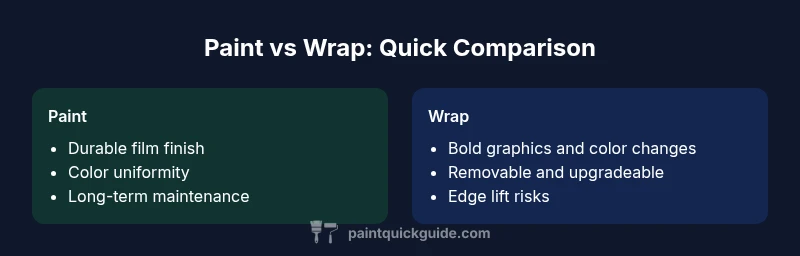
Paint is typically the more durable, lower-risk long-term choice for uniform finishes; wrap excels when rapid color changes and bold graphics are desired.
Choose paint for longevity and classic appearance. Choose wrap for fast styling, easy upgrades, and non-permanent color changes. Consider surface, usage, and maintenance willingness to decide.
Your Questions Answered
What is the main difference between paint and wrap for a car?
The main difference is that paint is a liquid coating that cures into a durable film, while a wrap is a removable vinyl film that covers the surface for color and graphics. Paint offers long-term durability; wraps offer flexible styling and easy removal.
Paint lasts longer as a finish; wraps let you change styles quickly.
Can a wrap be removed without damaging the underlying paint or surface?
In most cases, wraps can be removed without damaging the surface if they were properly installed and heat-treated. Improper removal or edge lifting can cause adhesive residue or minor surface damage that may require professional remediation.
If professionally installed, removal is usually clean.
Is wrap suitable for interior walls or only cars?
Wraps can be used on interior surfaces in some cases, but they are most common on vehicles and exterior features. For interior walls, traditional paint is usually more practical due to long-term durability and easier repair of surface imperfections.
Wrapping walls is less common; paint is often a safer interior choice.
Which lasts longer under sunlight and weather: paint or wrap?
Durability under sun and weather depends on materials and installation quality. High-quality paint with UV-resistant clear coats can last a long time, while wraps designed for outdoor use may resist fading and edges lifting better in some conditions, but both benefit from proper maintenance.
Both can last a long time with proper care, depending on conditions.
Can I change color quickly without a full repaint?
Yes, wraps allow rapid color or design changes without repainting, making them ideal for branding or seasonal updates. If you prefer a long-term color commitment, paint is better suited for a stable finish.
Wraps are great for quick color changes.
What maintenance practices extend either option’s life?
Regular cleaning with non-abrasive products helps both options. For paint, waxing or polishing can protect the surface; for wraps, avoid sharp objects near edges and follow manufacturer cleaning guidelines to prevent adhesive lift.
Keep surfaces clean and avoid harsh chemicals.
Quick Summary
- Prioritize longevity and uniform appearance when choosing paint
- Opt for wrap when you want bold graphics or rapid color changes
- Account for installation quality and surface suitability
- Factor in long-term maintenance and potential rework costs
- Use professional assessment to compare options before committing