Stain vs Paint for Deck: A Practical Comparison
Compare stain and paint for deck finishes to decide which protects wood best, preserves grain, minimizes maintenance, and fits your climate and style.


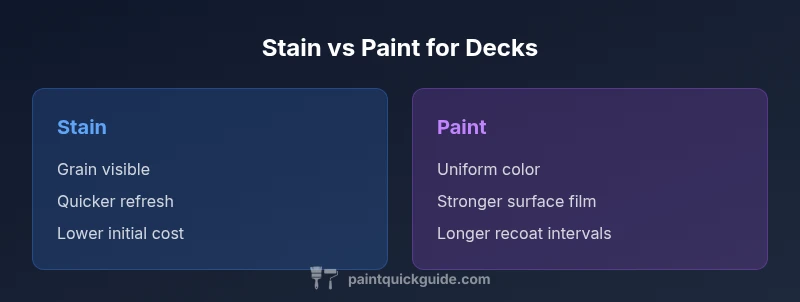
When deciding between stain and paint for deck finishes, the quick answer is to match your priority: stain excels at preserving wood grain and a natural look with easier touch-ups, while paint offers a uniform color, stronger surface protection, and longer intervals between coats in harsh weather. For most homeowners, stain vs paint for deck choices hinge on climate, maintenance tolerance, and desired aesthetic. Paint typically wins for durability in sun-exposed, high-traffic decks, whereas stain shines on rustic, wood-grain lovers who want quick refreshes.
Why the deck finish decision matters
Choosing between stain and paint for deck finishes is more than a color choice. It determines how your wood breathes, how well it sheds moisture, and how much effort you’ll invest in maintenance each season. The decision also influences the long-term look of your outdoor living space: a stain-washed deck preserves natural grain, while a painted surface hides grain but can create a bold, cohesive style. According to PaintQuickGuide, homeowners who treat a deck like an outdoor room must weigh aesthetics against protection and upkeep when evaluating stain vs paint for deck finishes. This framework remains relevant across wood types from cedar to pressure-treated pine, and it adapts to climates ranging from temperate coastal to arid inland. The PaintQuickGuide Analysis, 2026 emphasizes that your local weather, sunlight exposure, and foot traffic patterns should guide the choice between stain and paint for deck surfaces.
In the context of stain vs paint for deck finishes, it helps to start with a clear baseline: are you prioritizing color uniformity or grain visibility? Do you prefer quick refreshes with low prep or longer intervals between recoats with more extensive surface work? The answers shape whether stain or paint makes more sense for your deck in your home environment. For many DIYers and homeowners, this decision also influences budget, tools, and preparation time, so it’s worth laying out a practical plan before you buy.
wordCount: 0
Comparison
| Feature | Stain | Paint |
|---|---|---|
| Appearance and wood grain | Natural, visible grain with transparent or semi-transparent stains; some stains add color without full coverage | Solid color, hides grain for a uniform look |
| Protection against moisture | Penetrates surface to minimize surface moisture trapping with proper prep and maintenance | Forms a film on the surface that blocks moisture but can peel if prep is poor |
| UV resistance and color longevity | Color varies with pigment; granular fading may occur; staining tends to age gracefully with flexible coatings | Solid colors generally resist fading longer but may chalk or peel in extreme conditions |
| Maintenance frequency and touch-ups | Typically requires more frequent re-coats and spot touches; easier to refresh small areas | Longer intervals between coats when properly maintained; prep and sanding can be more involved |
| Application and drying complexity | Can be applied in milder conditions; sometimes needs pre-conditioning for blotching on certain woods | Requires thorough prep, even sanding, and complete curing before use |
| Best for | Preserving wood grain with quick, low-prep refreshes | Uniform color and maximum surface protection for high-traffic decks |
Upsides
- Preserves natural wood grain while adding color variation
- Easier and cheaper to refresh in small sections
- Wide range of stain tones and opacity levels
- Lower odor options and simpler cleanup
What's Bad
- Typically needs more frequent re-coats than paint
- Color options for wood grain may be limited and blotching can occur
- Stains can be less protective on very rough or split wood if not maintained
- Peeling is less common with stain, but protection can fade in extreme sun
Paint is generally better for long-term durability on high-traffic decks; stain is preferable for preserving grain and easy spot-refreshes.
If your priority is uniform color and maximum surface protection against weather, choose paint. If you value natural grain visibility and faster touch-ups, stain is the better option.
Your Questions Answered
Which lasts longer, stain or paint for a deck?
In general, paint provides longer-lasting surface protection against weather and wear, reducing the need for frequent coats in harsh climates. Stain often requires more frequent refreshing to maintain color and moisture control, but it can last well when applied to properly prepared wood and maintained regularly.
Paint tends to last longer in tough climates, while stain requires more frequent refreshes to keep color and protection intact.
Can I stain over a previously painted deck?
Staining over a painted surface is not recommended because it won’t penetrate well; you should sand or strip the old paint before applying stain. This ensures the wood surface can properly absorb the stain and deliver the intended color and grain visibility.
You generally need to remove the old paint before staining for best results.
Is stain better for pressure-treated wood?
Stain works well on pressure-treated wood when you choose a product formulated for exterior wood and follow proper prep. The goal is to seal the wood without clogging pores, allowing natural movement and grain to show through while providing moisture protection.
Yes, pigment options for PT wood help protect and show grain when applied correctly.
Which is easier for beginners?
Stain is often easier for beginners since it requires less sanding to refresh and can be re-applied in sections. Paint demands clean surfaces, thorough prep, and a consistent coat to avoid streaks and peeling.
Stain is usually easier for beginners due to simpler prep and refresh options.
Oil-based or water-based options — which to choose?
Water-based products are generally preferred for decks due to lower odor and quicker cleanup, while oil-based options can offer better penetration and longer life in some cases. Choose a product compatible with your wood type and climate, and always follow manufacturer recommendations.
Water-based options are popular for decks because they’re easier to clean and have lower fumes.
How should I plan recoats for deck finishes?
Plan recoats around the weather window and the finish type you chose. Stains often require annual refreshes in rough climates, while paints may extend to multi-year cycles if they remain intact. Always inspect for peeling or worn spots and address prep before recoating.
Keep an eye on wear spots and plan re-coats when the finish shows signs of wear.
Quick Summary
- Assess your climate before choosing stain or paint for deck finishes
- Stain preserves grain; paint hides grain but offers durable color
- Plan for maintenance cycles without overcommitting on tools
- Test products on a small area to preview performance
- Consult local pros for climate-specific recommendations