How to Make Paint Dry Faster: Practical Guide
Discover practical, safe ways to speed up paint drying without compromising finish. Learn about coating thickness, environment, airflow, and drying aids with step-by-step instructions for walls, furniture, and auto refinishing.


You can make paint dry faster by applying thin, uniform coats, controlling the room environment (temperature, humidity, and airflow), and using appropriate drying-friendly paints. Start with proper surface prep, then apply thin coats and maintain good ventilation, avoiding heavy layers that trap moisture or dust. Follow these steps for safe, faster drying.
How to Make Paint Dry Faster: The Science Behind Drying
Paint drying is a balance between solvent evaporation and film formation. When you learn how to make paint dry faster, you’re mainly accelerating evaporation while ensuring the film cures properly. This involves controlling coat thickness, ambient temperature, airflow, and humidity. By understanding these factors, homeowners and hobbyists can achieve a smoother finish with fewer repair attempts. Remember: the goal is not just quick dryness but proper curing to prevent future cracking or peeling.
Key factors that influence drying time
Drying time depends on coat thickness, air movement, and the ambient environment. Thinner coats dry much faster than thick layers because solvents escape more easily from a smaller film. Adequate cross-ventilation helps carry away moisture-laden air, while moderate temperature and controlled humidity prevent rapid surface drying that can trap moisture within the film. Paint chemistry also matters: water-based acrylics typically dry faster than oil-based finishes, but curing time differs. When you ask how to make paint dry faster, you must tailor your approach to the product you’re using and the space you’re painting.
Surface preparation matters: cleaner, drier surfaces dry faster and cure better
A pristine surface reduces the need for additional coats, which speeds up overall project time. Wipe down walls, remove dust, and let the surface dry completely before painting. Inadequate prep can trap moisture or dust under the film, extending drying time and compromising finish. For best results, use a clean, dry cloth or a mild degreasing solution if the surface is oily. This reduces moisture pockets that could slow drying and create imperfections. When you aim to make paint dry faster, consider this preparation as part of the overall plan.
Paint choice and finish: matching products to conditions
Choosing the right paint for your project is a major determinant of drying speed. Fast-drying acrylics or water-based formulations often dry quicker to the touch than oil-based options, especially in well-ventilated rooms. However, curing time can vary. For consumer projects, reading product data sheets and following thinning guidelines can yield a faster-drying film without sacrificing color and durability. If you’re working on a car or furniture refinishing, ensure the selected finish aligns with the required cure schedule and environmental constraints.
Practical techniques to speed drying safely
Thin coats and proper layering are the most reliable ways to shorten drying time. Use a high-quality brush, roller, or spray technique to apply a uniform, thin film. Between coats, maintain good airflow with fans positioned to encourage cross-ventilation, but avoid blasting air directly at the wet film. Keep the work area dust-free and shield from debris. If you need faster results, consider a heat source that your product tolerates, but never exceed manufacturer guidelines or place heat directly on the film. See step-by-step guidance for specific actions and timing.
Environmental controls: temperature, humidity, airflow
Environment is a major lever for drying speed. Maintain moderate air movement to remove evaporated solvents while avoiding drafts that cause uneven drying or dust deposition. Humidity should be managed to prevent condensation or prolonged moisture in the air, which slows drying. Temperature should be comfortable for the painter, but avoid hot spots that dry the surface too quickly and lead to cracks. When you learn how to make paint dry faster, you’ll balance airflow with product instructions and room conditions to optimize results.
Time management: wait times, recoat windows, and handling
Each product has a recommended recoat window; staying within this window helps prevent issues like lifting or skinning. Drying to touch is not the same as full curing; handle with care until the film has fully cured per product directions. Use a tack-free test to determine readiness and avoid placing furniture or vehicles on freshly painted surfaces too soon. This approach minimizes touch-ups and reduces the need for longer wait times later.
Troubleshooting: common drying issues and fixes
If paint seems to remain sticky or takes unusually long to dry, verify environmental conditions, surface preparation, and coating thickness. Dust or humidity fluctuations can slow drying and affect appearance. If color or sheen looks off after partial drying, a light scuff and recoat with a thinner layer may be necessary. By addressing these variables, you can minimize delays and achieve a consistent finish without compromising durability.
Quick-start drying plan: a practical, safe checklist
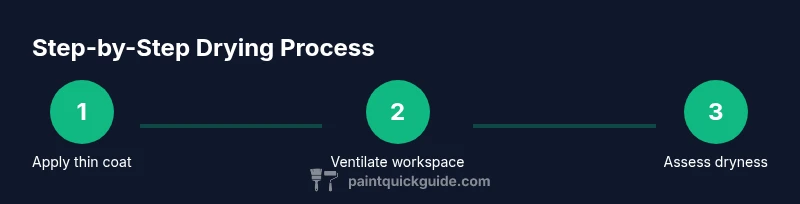
Begin with a clean, dust-free surface and a thin base coat. Set up cross-ventilation using a couple of fans, then apply additional thin coats as needed with adequate drying intervals. Introduce a dehumidifier if humidity is high and monitor the process. This plan helps you achieve faster drying while preserving color, gloss, and adhesion. The steps outlined here provide a practical path for both home painting and auto refinishing projects.
Tools & Materials
- Paint (selected type)(Choose formulation appropriate for surface and environment)
- Primer (optional but recommended)(Use only when needed for coverage or adhesion)
- Roller and brush set(Quality tools for even thin coats)
- Painter's tape(Mask edges before painting)
- Drop cloths or plastic sheeting(Protect floors and surroundings)
- Ventilation fans (2)(Position for cross-ventilation without blowing directly on wet film)
- Thermometer/hygrometer(Useful to monitor conditions)
- Paint thinner or flow improver (as directed)(Only if thinning is recommended by product data)
- Cleaning supplies(Rags, water, mild detergent for prep and cleanup)
Steps
Estimated time: 4-12 hours total, depending on conditions and coat count
- 1
Thin coats to recommended thickness
Begin with a consistency that allows the paint to settle evenly in a smooth, uniform film. Thinner coats dry faster and cure more evenly than heavy layers. Test a small area first and adjust your thinning according to the product guidelines. See the referenced diagram for ideal film thickness.
Tip: Avoid over-thinning; too thin a film can cause color or coverage issues. - 2
Prepare the space and set conditions
Open windows or create cross-flow with two fans placed to pull air across the surface. Keep the room at a stable, comfortable temperature and avoid extreme humidity. Adequate ventilation helps moisture escape and speeds drying without introducing dust.
Tip: Angle fans to move air across the wet edge rather than directly at it to prevent streaks. - 3
Apply coats with consistent technique
Use steady, even strokes to apply a uniform layer. Work in small sections to prevent overloading any single area. Overlapping strokes maintain film continuity and reduce buffing or smoothing delays later.
Tip: Keep tools clean to avoid dragging old film into fresh coats. - 4
Improve airflow strategically
Position a primary exhaust to remove evaporated solvents and a secondary near the drying area to create cross-draft without blowing directly on the wet film. This accelerates drying while reducing dust deposition.
Tip: Do not place heat sources directly on the painted surface. - 5
Control humidity and avoid condensation
If the space is humid, run a dehumidifier or air conditioner to reduce moisture in the air. Moist air slows evaporation and can lead to longer dry times or gloss issues. Conversely, avoid extremely dry conditions that cause surface tension and cracking.
Tip: Keep the film protected from rapid temperature shifts during the drying period. - 6
Check dryness and recoat readiness
Test a small, inconspicuous area for tackiness. If it feels dry to the touch but still soft in the deeper layers, delay recoat until fully cured. Follow the product’s guidance for recoat intervals to ensure adhesion.
Tip: Use the fingerprint test—light pressure should leave no imprint when truly dry. - 7
Finish with a safe curing plan
Protect the painted surface from dust, moisture, and contact until full cure. A properly cured film yields better durability and finish quality than rushing handling.
Tip: Keep pets and kids away from the project area during curing.
Your Questions Answered
Can using a fan speed up drying time?
Yes, a fan can speed up the drying process by moving evaporated solvents away from the surface. Position it to create cross-ventilation without blowing directly on the wet film to avoid dust and streaks.
Yes. A fan helps remove evaporated solvents and speeds up drying, as long as you avoid blowing directly on the wet surface.
Is it safe to use heat to dry paint faster?
Moderate heat can help drying, but direct heat on wet film can cause cracking or improper curing. Always follow the product’s directions and use low, indirect heat with adequate ventilation.
You can use gentle heat indirectly, but avoid direct heat on the paint and follow the product directions.
Will thinning paint speed up the drying process?
Thinning can reduce film thickness and speed drying, but must be done according to the product’s guidelines to avoid color changes or poor adhesion. Do not over-thin beyond recommended levels.
Thinning may help drying if allowed by the product guidelines, but don’t over-thin.
How do environmental conditions affect drying time?
Environmental conditions like airflow, temperature, and humidity significantly affect drying. A well-ventilated space with stable temperatures reduces drying time and improves film quality.
Airflow, temperature, and humidity play big roles in how fast paint dries and how well the film cures.
How can I tell when paint is dry enough to handle?
Look for a tack-free surface and perform a gentle touch test in an inconspicuous area. Full cure may take longer, depending on product and conditions, so avoid heavy handling until cured.
Check for a tack-free surface and test in a hidden area before handling.
Does spray painting dry faster than brushing?
Spray methods can speed application but drying time depends on film thickness and ventilation. Sprays often dry faster to touch due to thinner films but still require proper curing conditions.
Spray painting can dry faster to touch due to thinner films, but curing still depends on conditions.
Watch Video
Quick Summary
- Apply thin coats for faster drying and better curing
- Control environment: ventilation, temperature, and humidity
- Prep surfaces thoroughly to avoid moisture pockets
- Use appropriate tools and avoid direct heat on wet film
- Test dryness properly before handling or recoating