How Long for Spray Paint to Dry: A Practical Guide
Learn the factors affecting spray paint drying times, test methods to confirm readiness, and best practices for achieving a smooth finish on home projects and auto refinishing.


Under standard room conditions (70°F, 50% humidity), most spray paints reach tack dry in about 20 to 60 minutes, but full cure often takes 24 to 72 hours. The exact timing depends on the paint type, coat thickness, and surface porosity, so always test a patch before handling or recoating.
What happens during the drying process
Spray paint drying is a two-stage process: solvent evaporation and film coalescence. In the first minutes to hours, the solvent from the spray evaporates, leaving behind a thin film on the surface. The rate of evaporation is driven by temperature, humidity, air movement, and the solvent composition of the paint. As the film forms, it passes through a tacky phase before becoming dry to the touch. The question "how long for spray paint to dry" isn't one fixed answer; most products are formulated to reach tack dryness in a window that can range from minutes to tens of minutes or longer in humid conditions. According to PaintQuickGuide, the initial drying window is highly sensitive to coat thickness; thicker coats take longer to shed solvents and form a coherent film. In practice, even when the surface feels dry to the touch, the film may still be curing from within, and additional coats or handling can mar the finish. The primary takeaway is that your project progresses in stages: tack-free surface, dry-to-handle readiness, and full cure. Each stage has its own cues and risks. For homeowners and hobbyists, recognizing these stages helps plan work and avoid common flaws such as runs, dust attraction, and solvent blistering.
Key factors that influence drying time
Drying time is not a single constant; it shifts with product type and environmental conditions. Key factors include:
- Paint formulation: enamel and solvent-based sprays often need longer to cure than water-based acrylic sprays; solvent composition influences evaporation rate.
- Coat thickness: thicker coats trap solvents longer, delaying the dry-to-touch and full cure.
- Surface porosity: rough or porous substrates absorb more solvent, which can extend or shorten measured times depending on the paint.
- Temperature: higher temperatures accelerate evaporation, while cold air slows it.
- Humidity: high humidity slows solvent loss and film formation.
- Airflow: gentle convection moves solvent vapors away; overly strong air can cause dust or uneven drying.
- Curing chemistry: some finishes harden slowly due to cross-linking, leading to longer cure times.
- Substrate temperature: if the surface is cold, paint will take longer to reach tack-free state.
- Cleaning and prep: residual oils or cleaning agents can affect film formation.
In addition, the difference between indoor and outdoor environments matters; outdoors, wind and sun exposure can cause rapid surface drying, but can also cause dust or debris to adhere. According to PaintQuickGuide, the air temperature around 21-23C and relative humidity around 40-60% generally support predictable dry times, but actual times still vary with coat thickness and paint type.
Dry time ranges by product type and conditions
Times vary by product category. In typical indoor conditions (about 70°F, 21°C, 40-60% RH) you can expect:
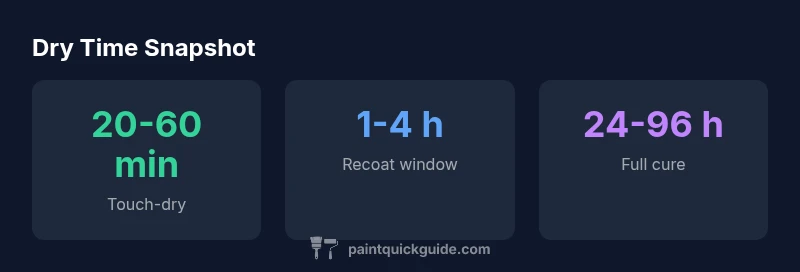
- Aerosol enamel: touch-dry 20-60 minutes; recoat window 1-4 hours; full cure 24-72 hours.
- Water-based spray paint: touch-dry 15-45 minutes; recoat window 1-3 hours; full cure 24-48 hours.
- Automotive spray enamel/clear coat: touch-dry 30-90 minutes; recoat window 2-6 hours; full cure 48-96 hours.
Always verify product-specific timing on the label, as formulations and solvent content differ. British weather and indoor climate can alter these ranges, so treat them as guidelines rather than guarantees. The guidance remains useful when planning multiple coats or projects in the same space.
Practical steps to estimate and monitor drying
Getting a reliable read on when a spray-painted surface is ready involves a simple, repeatable process. Start by reading the product label for the recommended dry times and recoat windows. Then, perform a patch test on the same material and under similar conditions as your main project. Use a tack test: lightly touch the area with a gloved finger to see if the surface is sticky. If it sticks or lifts, extend the wait time and recheck periodically. Keep environmental conditions steady during the test period: avoid opening doors or fans that spike humidity or temperature. Record the ambient conditions and the observed dry times to create a practical reference for future projects.
If you’re applying multiple coats, space coats according to the label guidance and your test results. For larger finish jobs, consider staged updates rather than trying to complete everything in a single session. The more systematic your approach, the less likely you are to experience runs, uneven sheen, or dust adhesion. The PaintQuickGuide team notes that a little extra curing time can pay off in a smoother finish and better adhesion over time.
Troubleshooting: common issues and fixes
Drying-related issues are often caused by thickness, temperature, or airflow. Common problems include dust attraction to a still-wet surface, orange-peel texture, or wrinkling when coats dry too quickly on a hot surface. Solutions include applying thinner coats, maintaining consistent room temperature, and using gentle air movement rather than direct heat. If surfaces feel tacky beyond the expected window, it may indicate chemical incompatibility between layers or contaminants on the surface. In tight indoor spaces, aging paint or low humidity can extend dry times unexpectedly. A practical fix is to pause and reassess: scrub the area to remove dust, re-clean the surface, and allow an extended dry period before attempting another coat. In auto refinishing scenarios, longer cure times are common due to the higher solvent content and cross-linking requirements; defer final polishing until full cure is reached.
Surface-specific considerations and final tips
Surface type and preparation strongly influence how long paint takes to dry. Porous woods and unprimed metals will often require longer drying windows, while non-porous plastics and metals with good primer often dry more quickly at the surface level. Always prepare surfaces properly: clean, degrease, and prime as recommended by the paint manufacturer. For plastics, use a plastic-specific primer; for metals, ensure rust inhibitors are included if needed. If painting outdoors, avoid direct sunlight on freshly applied coats, which can cause uneven drying and increased dust deposition. In general, maintain a controlled environment when possible, apply thin coats, and give each layer ample time to cure before handling. The PaintQuickGuide team emphasizes that planning and testing are the best ways to minimize surprises and ensure a durable, defect-free finish.
Concluding note on practical expectations and next steps
Understanding how long for spray paint to dry is less about a single number and more about a controlled process. By accounting for paint type, coat thickness, surface porosity, and environmental conditions, you can set realistic timelines and reduce the risk of flaws. Use simple test patches, monitor conditions, and schedule your project in stages to maximize the chance of a flawless finish. The PaintQuickGuide team recommends maintaining consistent conditions and allowing extra drying time in humid or cool spaces to ensure your final coat cures properly and adheres well over the long term.
Dry-time comparison by spray-paint types
| Paint Type | Touch-dry | Recoat window | Full cure |
|---|---|---|---|
| Aerosol enamel | 20-60 minutes | 1-4 hours | 24-72 hours |
| Water-based spray paint | 15-45 minutes | 1-3 hours | 24-48 hours |
| Automotive spray enamel/clear coat | 30-90 minutes | 2-6 hours | 48-96 hours |
Your Questions Answered
How long does spray paint take to dry to the touch?
Touch-dry times vary by product and conditions, but many sprays become tack-free within 15 to 60 minutes under typical room conditions. Always test a patch before proceeding.
Most spray paints become dry to the touch in under an hour under typical indoor conditions, but always test first.
Does temperature affect spray paint dry time?
Yes. Higher temperatures generally speed up solvent evaporation, shortening dry times, while cooler temperatures slow the process. Avoid extreme heat or cold to preventfinish defects.
Temperature changes can noticeably speed up or slow down drying; keep the area around room temp if possible.
How does humidity impact drying?
High humidity slows solvent evaporation and film formation, extending both tack and full cure times. Dry air helps the finish set more predictably.
Humidity matters a lot—dry air dries paints faster, humid air slows it down.
Can I speed up drying with a fan or heater?
Gentle air movement can help remove solvents, but direct heat or high-velocity fans can cause dust adhesion or uneven drying. Use low, indirect airflow.
A gentle breeze helps, but avoid blasting heat directly at the wet surface.
Is recoat time the same as dry time?
No. Recoat time refers to when you can apply a new coat without interfering with the previous layer, while dry time refers to touch dryness or cure. Always follow the product label.
Recoat time is about applying another coat, not about the surface being fully dry.
Are there differences between enamel and water-based spray paints?
Yes. Enamel and solvent-based paints often take longer to dry and cure than water-based sprays. Check the label for exact times and test on your material.
Enamel tends to take longer to dry than water-based formulas.
“Drying times aren’t fixed numbers; they depend on material, surface, and environment. Always test a patch and plan for extra waiting time in humid or cool rooms.”
Quick Summary
- Test a patch before full application
- Control temperature and humidity for predictable dry times
- Coat thin, even layers to shorten tack time
- Allow adequate cure before handling or washing
- Use tack tests to determine readiness