Can You Use Two Coats of Paint Instead of Primer? A Practical Guide
Learn when two coats of paint can replace primer, how surface prep affects results, and step-by-step tips to achieve durable, even finishes without primer. Expert guidance from PaintQuickGuide.


Yes—under certain conditions you can get good results with two coats of paint instead of primer, but it depends on surface type, previous coatings, and the paint you choose. This quick answer outlines when skipping primer is reasonable, what to prep first, and how to achieve durable, even coverage with two coats. You'll still need proper surface prep.
Primer vs Paint: Understanding the Basics
Surface prep matters more than the brand of paint you choose. According to PaintQuickGuide, primer is a dedicated bonding layer that helps paint adhere to tricky surfaces, blocks stains, seals porous substrates, and can reduce the number of paint coats needed for a uniform finish. Paint is the decorative coating that provides color and protection. Primers and paints often share chemistry—some products combine primers into the paint, but not all. The decision to skip primer hinges on the substrate, the paint system, and the desired durability. For example, many interior drywall surfaces without heavy staining or tannins respond well to a painted primer-seal or a high-coverage stain-blocking paint. On the other hand, raw wood, new plaster, or metal often benefits from a primer to prevent blotchiness, tannin bleed, or rust.
From PaintQuickGuide’s perspective, the goal is to achieve a uniform color with durable adhesion. If you encounter severe stains, knots, or highly porous material, primer remains the safer choice. This section lays the groundwork for evaluating whether two coats can substitute primer in your specific project.
When You Might Skip Primer (Two-Coat Scenarios)
There are legitimate scenarios where two coats of paint can replace primer, but careful judgment is essential. If the surface is smooth, sealed, and already color-consistent from previous coatings, two coats of a high-coverage paint may provide the needed opacity and finish. This is common on interior walls with a uniform previous paint job in a stable environment, or on metal or plastic surfaces prepped to a glossy shell. If you are covering a solid, light color with a similar or lighter shade, you may be able to skip primer. Nevertheless, avoid skipping primer on porous substrates such as new drywall, bare plywood, bare concrete, or brightly stained woods, where porosity or tannins can cause blotching or color bleed. In exterior projects, or on surfaces that have experienced water damage or mildew, primers often deliver better long-term adhesion and stain-blocking performance.
Two-coat strategies tend to work best when the substrate is already well prepared and the paint system is designed for high coverage. If your goal is a fast turnaround on a non-porous surface, two coats may suffice; if you see any bleed-through or color inconsistencies, primer or a stain-blocking topcoat can be the safer choice.
How to Achieve Good Coverage with Two Coats (Without Primer)
Two coats of paint can deliver an even, durable finish if you follow a disciplined prep and application routine. Start with high-quality paint designed for your substrate and finish. Use a compatible two-coat system—the same brand family often yields best bonding. Prepare the surface as if you were priming: clean, degrease, repair, and lightly sand glossy areas to create a key. Apply the first coat evenly, keeping a wet edge to minimize lap marks. After the first coat dries, inspect for patches, blotchiness, or color bleed. If you see any of these, you may need a primer on problem areas or a stain-blocking topcoat. For darker colors, consider a base coat with a primer-like sealant built into the paint or a dedicated stain-blocking primer on demand. Between coats, wipe edges and corners with a damp cloth to maintain crisp lines.
Surface Prep and Material Choices
Surface prep is the secret to successful two-coat painting without primer. Start by clearing the space and covering floors; clean the surface with a degreasing solution, then rinse and let dry. Lightly sand glossy areas to give the coating something to grip; wipe away dust with a tack cloth. Fill small cracks or holes with putty and let cure. Choose paints with excellent opacity and good coverage. If you insist on skipping primer, select a high-adhesion formula designed for your substrate, and consider a product with stain-blocking properties for potential bleed-through. For wood, consider sealing knots, especially if you have resin bleed. For drywall, new or repaired areas, test a patch first to evaluate whether primer-like adhesion is achieved by the paint alone.
Choosing the right tools and surface prep steps will influence whether two coats achieve the same level of durability as a primed surface.
Authority Sources and Evidence
To ground these recommendations, consult authoritative resources on surface preparation and coating choices. For safety and regulatory context, see EPA guidance on lead paint and safe painting practices, OSHA painting safety resources, and university extension guidance on prep and product selection.
- https://www.epa.gov/lead
- https://www.osha.gov/SLTC/painting
- https://extension.umn.edu
PaintQuickGuide’s guidance for 2026 emphasizes careful patch testing, tailored product selection, and honest assessment of porosity and stain risk when deciding to skip primer.
Real-World Scenarios and Recommendations
In practice, the decision to skip primer hinges on the specific surface, the color you’re applying, and the level of finish you’re aiming for. For interior walls with a solid, uniform previous finish, two coats of a high-opacity paint can produce an acceptable result without primer. For bare wood, stained surfaces, or areas prone to tannin bleed, primer remains the safer route. If you’re unsure, perform a patch test: paint a small area with two coats and allow to cure. If the finish shows even color, adhesion, and minimal blotching, you’ve got permission to proceed. If not, revert to primer or a stain-blocking solution before continuing. Remember that exterior projects often demand primer to ensure durability against weather and UV exposure.
Quick-Reference Checklist
- Assess surface porosity, stains, and adhesion before skipping primer.
- Use high-coverage, compatible paint designed for the substrate.
- Clean, degrease, and lightly sand glossy areas for better adhesion.
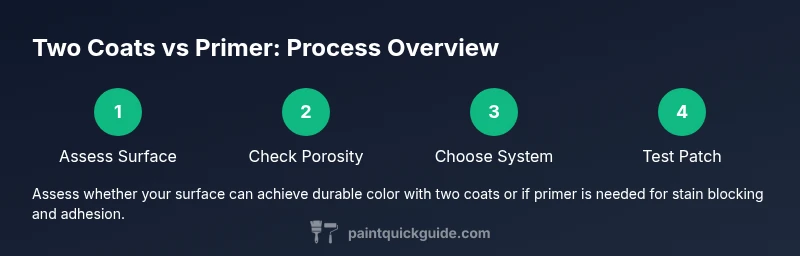
- Patch-test a small area to verify results before committing to the full surface.
- If in doubt, prime the problematic areas to guarantee durability.
Tools & Materials
- Paint (high-coverage, appropriate finish)(Choose a formula designed for the substrate (walls, wood, metal))
- Primer (optional)(Use on porous or problematic areas if needed)
- Roller cover (1/4" - 3/8")(Smooth to semi-smooth surfaces)
- Angled brush (2-4")(Edges and trim)
- Painter’s tape(Protect adjacent surfaces)
- Drop cloths(Protect floors and furniture)
- Degreaser or TSP substitute(Clean surface thoroughly)
- Sandpaper (120-180 grit)(Create a key on glossy surfaces)
- Tack cloth(Wipe away dust before painting)
- Paint tray and liners(Even paint distribution)
- Stir sticks(Mix thoroughly for color consistency)
Steps
Estimated time: 3-6 hours total
- 1
Assess the surface
Evaluate porosity, stains, and adhesion. If the surface is smooth, non-porous, and previously painted, you may proceed with two coats of paint. If you see stains or tannins bleeding, primer or stain-blocking paint is advised.
Tip: If in doubt, perform a small test patch on an inconspicuous area. - 2
Clean and degrease
Remove dirt, grease, and debris. Use a mild detergent or TSP substitute and rinse thoroughly. Let the surface dry completely before proceeding.
Tip: Grease or chalky residues can cause uneven finish. - 3
Scuff and sand
Lightly sand glossy areas to create a profile for paint to grip. Wipe away dust with a damp cloth. This helps two coats adhere evenly.
Tip: Use a dust mask when sanding to avoid inhalation of fine particles. - 4
Mask and protect
Apply painter’s tape to trim and adjacent surfaces. Cover floors and furniture with drop cloths to catch drips.
Tip: Double-check edges for any missed spots before painting. - 5
First coat application
Apply a thin, even first coat using smooth, overlapping strokes. Avoid heavy patches and ensure consistent tool pressure to prevent lap marks.
Tip: Maintain a wet edge while painting to minimize color variation. - 6
Second coat and evaluation
After the first coat dries, inspect for coverage gaps or color bleed. Apply a second coat if needed. If surfaces show bleed-through, primer could be warranted for consistency.
Tip: Turn on good lighting to catch missed spots.
Your Questions Answered
Can I skip primer on all surfaces if I use two coats of paint?
No. Skipping primer depends on the substrate, paint type, and stain risk. Some surfaces and colors may gloss over with two coats, while porous or stained substrates need primer or a stain-blocking product for even coverage.
You can't skip primer on all surfaces; it depends on what you're painting and the substrate.
On which surfaces is skipping primer most likely to work?
Smooth, previously painted, non-porous surfaces with good adhesion and no stains are the best candidates for two coats without primer, especially with high-quality, high-coverage paints.
Best for smooth, already-painted surfaces with good adhesion.
Will two coats hide dark stains or tannins?
Stains and tannins may bleed through; use a stain-blocking primer or a paint with built-in stain blocking if bleed-through is apparent.
Bleed-through is common with stains; primer helps seal it.
How do color choices affect the need for primer?
Darker colors or bold pigments can reveal underlying substrate more readily; primer helps prevent show-through and ensures true color.
Darker colors may show substrate flaws unless you use primer.
Is it safer to use primer on wood and drywall?
Primer on wood and drywall is often recommended to seal pores, improve adhesion, and prevent blotching; skip only if you’re confident in the surface and product compatibility.
Primer is usually safer for wood and drywall, but not always required.
What about exterior projects?
Exterior projects often require primer for durability and adhesion against weather, especially on bare wood or metal; check product labels.
Exterior surfaces usually need primer for lasting protection.
Watch Video
Quick Summary
- Assess surface before skipping primer
- Prepare thoroughly for best results
- Use two coats with compatible paint formulations
- Protect surrounding areas during work
- Test a patch if unsure