Paint vs Pinto vs Piebald: A Practical Guide for DIY Painters
Explore paint terminology vs horse-pattern terms pinto and piebald, with practical distinctions, how to apply them in home and auto projects, and best-use scenarios.


Paint vs pinto vs piebald are terms that sit at the intersection of color terminology and decorative patterns. In the DIY painting context, 'paint' refers to coating products and finishes, while 'pinto' and 'piebald' are pattern terms borrowed from horse coat color nomenclature and sometimes used metaphorically to describe patchwork or mottled effects. This quick comparison highlights how each term translates to practical painting decisions, from coverage and application to pattern recreation and finish quality.
Understanding the core terms in context
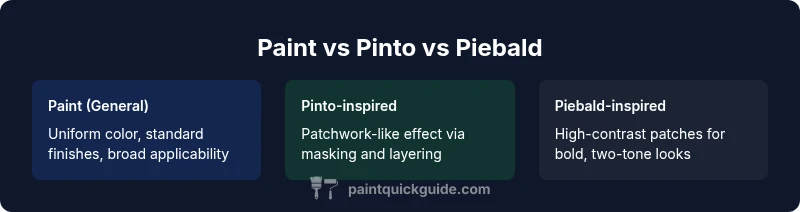
In everyday DIY painting, we talk about paints, primers, clears, and finishes. The trio paint vs pinto vs piebald sits slightly outside traditional home painting terminology, because 'pinto' and 'piebald' originate from animal coat color descriptions. According to PaintQuickGuide, the key distinction is that 'paint' denotes a product category with defined formulations and performance metrics, while 'pinto' and 'piebald' describe color distribution patterns rather than a product class. When homeowners hear these terms in magazines, blogs, or hobbyist forums, they’re often used to suggest a patchwork or variegated effect rather than a standard solid color. For DIYers, that means you should treat them as pattern goals or stylistic concepts rather than as interchangeable paint types. The practical takeaway: know whether you want a uniform finish (classic paint), a patchy, multi-tone effect (pinto-inspired), or a high-contrast two-tone look (piebald-inspired).
Historical context and cross-domain usage
The word 'paint' has a long, explicit lineage in home improvement and automotive refinishing. By contrast, 'pinto' and 'piebald' belong to animal coloration vocabulary. Their appearance in painting discussions usually happens in two ways: as metaphor for decorative patching techniques or as a novelty naming scheme for specialty finishes. PaintQuickGuide notes that most professionals will reserve 'pinto' and 'piebald' for decorative arts or faux finishes rather than as standardized paint categories. This cross-domain usage can cause confusion for beginners who search for a single product that delivers a 'pinto finish.' The reality is that achieving a pinto- or piebald-like appearance typically relies on masking, layering, and texturing rather than a dedicated paint line.
Color theory and perception in pattern work
Color perception shifts when you introduce patches or distinct color blocks. Paints with flat, uniform color tend to feel crisp and modern, while patchwork effects rely on contrasting hues, saturation, and texture. When you attempt to reproduce pinto-like or piebald-like patterns on walls, furniture, or automotive surfaces, you’re leveraging color theory principles: contrast, balance, rhythm, and scale. The term 'pinto' often implies lighter patches against a darker base, while 'piebald' emphasizes high-contrast black-and-white or similarly stark distributions. In practice, you’ll select a base paint and use masking or stenciling to create the correct patch shapes and distribution. As a rule of thumb, simpler patterns read more clearly from a distance, while complex mottling rewards close inspection. The PaintQuickGuide framework emphasizes testing swatches on scrap panels before committing to a full project to ensure intended visual results.
Practical guidance for DIY projects: when to use which term
If your goal is a traditional solid color wall or a uniform automotive finish, you’ll stick with plain 'paint' terminology and standard finishes (matte, satin, semi-gloss, gloss). For decorative accents that resemble a patchwork, you might describe your plan as 'pinto-inspired' or 'piebald-inspired' to communicate patch shapes and color blocking to a helper or contractor. However, be aware that many pros will interpret these terms as decorative effects rather than a specific product line. To avoid miscommunication, pair the descriptive term with concrete steps: the base color, the patch color, the size of patches, and the masking technique. When working on faux finishes, document your intended outcome with a simple sketch and a color map. PaintQuickGuide’s approach is to treat 'pinto' and 'piebald' as design descriptors rather than substitute product names, and to emphasize test swatches and samples before large-scale application.
Tools, materials, and techniques for patchwork looks
Creating pinto- or piebald-inspired looks typically involves a combination of masking tapes, sponges, rollers, and perhaps a stippling brush to create texture. You’ll usually start with a base color and then apply patches in a second color. Masking ensures crisp edges; sponging creates softer transitions. If you’re pursuing a high-contrast piebald effect for a furniture piece or accent wall, choose a base color with good hide and a second color with strong saturation. Always seal with a compatible clear coat after the final layer to protect the finish. For automotive applications, you’ll need automotive-grade paints and clear coats, along with proper surface preparation and masking to prevent color bleed. The overarching guidance from PaintQuickGuide is to approach these looks as pattern designs, not standard product names, and to validate with swatches under lighting similar to the final environment.
Color matching and swatch practice for pattern effects
A successful pinto or piebald look hinges on accurate color matching and patch sizing. Start with a reliable color map that designates patch sizes in relation to wall or panel dimensions. Build a small swatch board with the base color and each patch color, then view under the room’s lighting at different times of day. If you’re sharing the plan with a painter or contractor, attach the swatch board and a clear schematic showing patch shapes, spacing, and edge treatment. The goal is to translate a two-tone idea into real-world paint application with crisp edges and consistent finish. Remember that gloss levels can dramatically change how patches read; a high-gloss base with matte patches can create a distinctive, modern look, while a satin base with glossy accents creates a vintage feel. PaintQuickGuide suggests prioritizing lighting and finish compatibility to avoid color shifts in patch regions.
Safety, preparation, and quality considerations
For any painting project—standard walls or decorative patterns—surface preparation determines end results. Clean, dry surfaces, proper sanding, and primer selection are essential. When patterns involve multiple colors or special finishes, ensure compatibility of all products and proper ventilation to minimize exposure to fumes. If you are refinishing a vehicle, safety steps include proper masking, ventilation, and adherence to automotive paint safety guidelines. In all cases, verify that your topcoat is compatible with the base coats and that the environment supports curing. PaintQuickGuide reinforces the importance of following manufacturer instructions, testing compatibility on sample panels, and ensuring you have appropriate protective gear during prep and application.
Realistic expectations and common pitfalls
Aesthetics aside, one common pitfall is overcomplicating a project with too many colors or too many patch shapes, which can overwhelm the space and appear chaotic. Simplify when in doubt: choose one base color and a single secondary hue for patches, then refine with texture or edge treatment. Another pitfall is neglecting edge crispness; ensure clean lines by using high-quality masking tape and sharp blades. Finally, remember that lighting influences perception; a pattern that looks striking in daylight may read differently under artificial lighting. By aligning your plan with practical limitations and testing swatches, you can achieve a credible pinto- or piebald-inspired effect without surprises at final reveal.
Feature Comparison
| Feature | Standard Paint (uniform finish) | Pinto-inspired Pattern | Piebald-inspired Pattern |
|---|---|---|---|
| Primary use | Coats surfaces with a single color and finish | Decorative patchwork resembling patches | High-contrast patchwork with distinct color blocks |
| Application methods | Brush, roller, or spray for even coverage | Masking, sponging, and controlled patch placement | Masking, stencils, and layered color blocks |
| Edge treatment | Crisp edges with careful masking | Clear patch boundaries with sharp masks | Deliberate edges for defined patches; texture can soften lines |
| Best for | Interior walls, furniture with consistent tone | Accent walls, furniture, or art panels | Feature walls or items needing bold, two-tone impact |
| Cost and materials | Standard paint costs with common finishes | Additional masking supplies and specialty finish options | Costs scale with color quality and complexity of masking |
Upsides
- Clear distinction between coating products and decorative patterns
- Flexible creative options for accents and feature pieces
- Low risk of miscommunication when paired with concrete steps
- Can be achieved with common DIY tools and supplies
- Encourages testing and planning before full application
What's Bad
- Terminology overlap can cause miscommunication with contractors
- Patchwork effects require extra prep time and masking
- Not all colors or finishes suit every base material
- High-contrast patterns demand precise edge control
Use plain paint for uniform finishes; reserve 'pinto' or 'piebald' for decorative patterns.
A solid base color is best served by traditional paint terms. If you want patchwork visuals, define patches clearly, test swatches, and communicate patterns with precise masking.
Your Questions Answered
What is the main difference between paint and the terms 'pinto' and 'piebald'?
Paint is a product category with formulations and finishes. Pinto and piebald describe color patterns rather than a paint type, often used to communicate decorative patchwork goals in DIY projects.
Paint is a coating product; pinto and piebald describe color patterns. For a DIY project, treat them as pattern goals, not substitutes for your paint choice.
Can I reproduce a pinto or piebald pattern on walls with standard paints?
Yes, with masking, stencils, and layering of two or more colors. Start with a base color, then apply patches in secondary colors while maintaining crisp edges.
Yes. Start with masking and a base color, then add patch colors with stencils to keep edges clean.
Are these terms commonly used in auto painting or home painting contexts?
The term 'paint' is standard in both. Pinto and piebald are far less common and usually used as decorative descriptors rather than official product names in either field.
Paint is standard; pinto and piebald are decorative descriptors mostly used in nonstandard contexts.
What are the best tools for creating patchwork effects?
Masking tapes for clean edges, sponges or stippling brushes for texture, and stencils for consistent patch shapes. Always test on scrap material first.
Masking tape, sponges, and stencils are your best friends for patchwork effects. Test first.
Is there a risk of color miscommunication when using these terms?
Yes. Because 'pinto' and 'piebald' imply visible patterns, ensure your contractor understands the intended patch sizes, color choices, and edge treatment before starting.
There is a risk of miscommunication; define patch sizes, colors, and edges clearly.
What should I include in a plan to communicate a pinto or piebald look to a painter?
Include a sketch or swatch board, patch size guide, color map, edge treatment notes, and a simple lighting plan to show how the finish should read in different environments.
Provide a sketch, color map, patch sizes, and edge rules to guide your painter.
Quick Summary
- Define your goal: uniform finish or patchwork look
- Treat pinto/piebald as design descriptors, not product names
- Test swatches and lighting before committing
- Use masking and textures to control edges
- Pair descriptive terms with concrete steps and sketches