Is Paint the Same as Stain? A Practical Comparison
A detailed, data-driven comparison of paint vs stain for walls, furniture, and decks, covering finish, durability, maintenance, color options, and application tips to help homeowners decide which coating is right for their project.


Is paint the same as stain? Not really. According to PaintQuickGuide, they differ in chemistry, finish, and how they protect surfaces. Paint forms a solid, opaque film that seals the substrate, while stain penetrates wood and enhances grain with varying opacity. The choice shapes durability, maintenance, and the final look for walls, furniture, decks, and trim.
Is paint the same as stain? Defining the terms
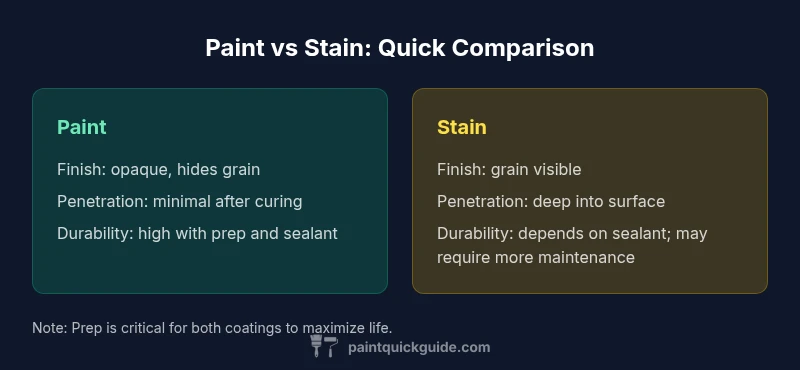
In common home projects, homeowners ask if paint the same as stain. The short answer is no. Paint and stain are fundamentally different products. Paint is a film-forming coating that sits on the surface and provides an opaque color that hides the wood grain or drywall texture. Stain, by contrast, is designed to penetrate the surface and highlight the natural grain. This difference shapes everything from appearance to maintenance.
From a chemistry standpoint, paint contains pigments suspended in binders that cure into a continuous film. Stain uses pigments or dyes in an penetrating base that allows the substrate to breathe. Because of this formulation, paints tend to be more durable against moisture, abrasion, and scuffs after proper prep, while stains rely on sealants and topcoats for long-term protection. For exterior wood, this distinction matters: stain is often chosen to preserve grain while offering UV protection with a sealant; paint provides a more uniform, washable surface.
For interior walls, paint is typically chosen for color uniformity and washability; stain is rarely used on drywall but can be beneficial for accent pieces or decorative projects on wood, where the grain is part of the design aesthetic. In practice, the decision hinges on the look you want, the surface you cover, and the maintenance you are prepared to perform. In short, there is a meaningful difference between paint and stain, and understanding that difference helps you select the right coating for each project.
2nd paragraph not used? punctuation meant for readability
Comparison
| Feature | Paint | Stain |
|---|---|---|
| Finish/appearance | Opaque film that hides grain and texture | Transparent to semi-transparent; grain visible and texture preserved |
| Penetration | Minimal penetration after curing; forms a film | Penetrates the substrate to some depth |
| Durability and protection | Typically more durable with proper prep and sealing | Generally less durable; requires sealant/topcoat for protection |
| Color options | Wide, uniform color range; easy color matching | Fewer opaque colors; rich tones through translucency |
| Best surfaces | Walls, trim, metal, masonry with primer | Bare wood, decks, and furniture where grain should show |
| Maintenance | Longer repaint intervals with proper prep | More frequent maintenance for UV and wear without sealant |
| Application tools | Brush/roller; cleanup varies by formulation | Brush/rag/cloth; often easier to refresh or reapply on wood |
| Cost/coverage mindset | Higher upfront cost but longer life in protected surfaces | Lower upfront cost with potentially more frequent refreshes |
| Look goal | Bold, solid color and smooth finish | Natural grain emphasis with color depth |
Upsides
- Provides durable, washable finishes for high-traffic areas
- Paint offers full color coverage and smooth, uniform surfaces
- Stain preserves natural wood grain and breathability on wood surfaces
- Both options can be tinted or customized to match decor
What's Bad
- Stain often requires more maintenance and re-sealing for longevity
- Paint can crack or peel if prep is poor or substrate moves
- Stain may offer less color control and can fade unevenly without proper UV protection
- Paint may obscure architectural grain on wood surfaces if not chosen carefully
Paint generally delivers longer-term durability and more uniform color for walls and high-traffic areas; stain excels when grain visibility and natural wood texture are the priority.
Choose paint for a durable, easy-to-clean finish with a wide color palette. Choose stain when you want to showcase grain and texture, especially on wood surfaces. Consider climate, substrate, and maintenance willingness to decide which coating best fits the project.
Your Questions Answered
Can you put stain over paint?
Stain over a painted surface is generally not recommended because paint forms a film that resists penetration. If you must, you would need to fully strip or sand the surface to allow the stain to adhere properly.
Stain over paint is usually not a good idea; you’ll likely need to remove the paint first to get a durable finish.
Is stain a better option for exterior wood?
Stain is commonly chosen for exterior wood to highlight grain and allow moisture movement. It’s often paired with a protective sealant, and reapplication is part of maintenance in sunny or wet climates.
For exterior wood, stain is a popular choice when you want grain visibility and easier maintenance. Remember to recoat as weather demands.
How long does paint last compared to stain?
Durability depends on preparation and environment. In many cases, exterior paint lasts longer between repaints than stain, but performance varies with surface and climate.
Durability varies by surface and climate; paint often lasts longer, but proper prep and sealing are key.
Can drywall be stained or only painted?
Drywall is typically painted. Stain is not recommended for drywall because it won’t absorb well and can look uneven. Use a high-quality interior paint for walls.
Drywall should usually be painted, not stained.
What factors should drive my choice between paint and stain?
Consider surface type, desired look, exposure (sun, moisture), maintenance willingness, and budget. Use a simple framework: surface, look, durability, and upkeep.
Think about what you want to see (look), where it’s applied (surface), and how much upkeep you’re willing to do.
Quick Summary
- Define the goal: opacity versus grain visibility
- Prep thoroughly for best performance with either coating
- Choose paint for walls and trim; choose stain for wood surfaces
- Factor climate and maintenance into the long-term plan
- Budget and timing influence coating choice and repaint cycles