How Big of a Sample for Paint Match: A Practical Guide
Learn how big of a sample for paint match should be, plus testing, lighting, and documentation tips to achieve a reliable color across walls, furniture, or automotive projects.


Goal: determine an appropriate sample size for paint match and test it under neutral lighting for reliable color results. This guide covers practical sample sizes for home and auto projects, how to compare swatches accurately, how to prepare test patches, and ways to document results so your final finish looks consistent across surfaces.
Understanding how big of a sample for paint match matters
Color perception is not fixed; it shifts with lighting, surface texture, and the surrounding colors. A sample that is too small can miss subtle undertones and grain, leading to a mismatch when the finished coat is applied. Conversely, a very large sample can be wasteful and may exaggerate texture or board tone that isn’t present on the final area. The PaintQuickGuide team emphasizes that the goal of sampling is to capture the true color under realistic conditions, not to chase a perfect numeric shade. By thinking about sample size early, you improve the odds of a consistent finish across walls, cabinets, or a car panel. When you ask yourself how big of a sample for paint match, you’re balancing practicality, waste, and accuracy. The PaintQuickGuide analysis suggests that using representative sources and testing in consistent lighting yields the most reliable results, especially for tricky neutrals and deep hues.
Factors that influence sample size
The ideal sample size is influenced by several factors. First, lighting matters: natural daylight reveals true color, while incandescent or LED can shift warmth or coolness. Second, the substrate matters: white or pale primers are easier to match than dark or tinted bases. Third, the finish (sheen) affects perception; a matte finish appears different from a high-gloss surface even with the same pigment. Fourth, surface texture can skew color readings—smooth panels reflect evenly, while rough textures create micro-variations. Fifth, the scope of the project matters: a color checked on a small patch may diverge when applied across a larger area. Finally, the source of the reference (chips, spray-outs, or a test patch) influences accuracy—the more relevant the reference, the more reliable the result.
Practical guidelines you can start with
- Use multiple reference sources: collect color chips from the manufacturer and a close shade from your paint store. This gives you a spectrum to compare rather than a single reference.
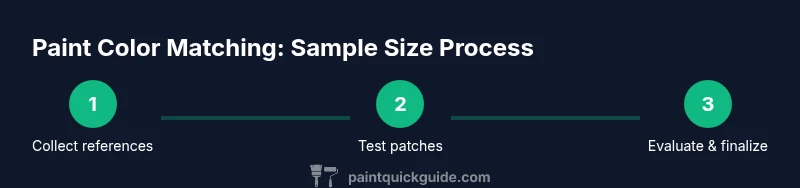
- Start with a patch the size of a postage stamp and supplement with a spray-out patch on primer to gauge depth and finish. This avoids wasting material and helps you see how the color sits on real film.
- Test under daylight and under a color-balanced lamp to simulate different environments; color can shift dramatically with lighting.
- Label each patch with the source, shade, and date; maintain a simple log to prevent mixing up references.
- Don’t rely on shade name alone—compare numeric codes or chips visually against the patch.
- Use a neutral primer or base coat when testing to prevent color bias from the underlying surface.
How to prepare and test the sample
Begin by cleaning the surface to remove oils and dust, then apply a uniform primer or a base coat that matches your project. Collect color swatches or chips and prepare a test patch that mirrors the final finish you intend to use. Apply a small test area, wait for it to dry under the same environmental conditions, and then compare to your references under neutral light. If the patch looks off, adjust the formula or try a nearby shade, repeating the spray-out process until you achieve a close match. Document what you tested and why so you can reproduce the result later.
Common mistakes and how to avoid them
Common mistakes include testing under artificial or colored lighting and assuming a patch on drywall will look the same on wood or metal. Always test on the same type of substrate and in the same environment as the final surface. Avoid rushing the drying/curing phase, and don’t mix shades from different brands without adjusting base factors. Finally, skip the documentation and you’ll struggle to reproduce results if the lighting or substrate changes later.
When to seek professional color matching
If your project involves metallic, pearlescent, or multi-stage finishes, color-matching becomes more complex. In automotive refinishing or high-end interiors, professionals use calibrated instruments and controlled lighting to ensure an exact match. For very large color decisions or critical applications, a pro color-matching service can save time and ensure consistency across multiple surfaces. Remember, professionals can also provide a finish swatch that you can compare on-site before committing to a full coat.
Tools & Materials
- Color matching swatches / paint chips (from multiple brands)(Gather several shade options to compare against)
- Small test paint samples (unopened cans or touch-up bottles)(Label with shade and source)
- Primer and compatible base coat(Match the final project base as closely as possible)
- Brushes/Rollers for patch application(Small brush for patch edges, foam roller for larger patches)
- Cleaner (rubbing alcohol) and lint-free cloths(Clean the surface before testing)
- Sanding block or fine grit paper(Optional if surface needs smoothing)
- Clear coat (optional for automotive or high-gloss finishes)(Use only if you test gloss depth)
- Lighting with color-balanced bulbs or access to daylight(Consistent lighting is crucial for evaluation)
- Notepad or digital log(Record shade codes, batch numbers, and results)
Steps
Estimated time: variable
- 1
Set up workspace and surface
Create a clean, well-lit area. Lay down drop cloths and ensure you can access daylight or a color-balanced lamp. A stable setup prevents sample contamination and lets you compare patches reliably.
Tip: Keep all materials within arm’s reach and designate a testing zone separate from the project area. - 2
Gather multiple reference samples
Obtain several chips from different sources to compare against. This helps you see tonal differences and avoid fixating on a single shade.
Tip: Label each reference with its source and shade number to avoid mix-ups. - 3
Clean the test surface
Wipe the area with a lint-free cloth and rubbing alcohol to remove oils. A clean surface ensures test patches behave like the final coat.
Tip: Avoid leaving residues that could affect gloss or texture. - 4
Apply a primer/base patch
If the project requires a base, apply a neutral primer or the first base coat you expect to use. This creates a consistent starting point for the color test.
Tip: Use light, even strokes to avoid pooling. - 5
Create test patches from references
Apply patches that mirror the intended coating thickness and finish. Keep patches small but large enough to compare under lighting conditions.
Tip: Space patches to prevent color bleed or mixing. - 6
Allow patches to dry under the same conditions
Let the patches cure as you would the final coat. Drying conditions influence color depth and sheen.
Tip: Do not rush drying with heat sources; maintain ambient temperature. - 7
Compare under neutral lighting
Evaluate patches side-by-side with references. Rotate lighting and observe from different angles to catch undertones.
Tip: Take a photo under lighting and compare with original references. - 8
Adjust and retrace if needed
If a match is not close enough, tweak the shade and create a spray-out patch again. Repeat until you reach a near-perfect balance.
Tip: Document adjustments so you can reproduce the result. - 9
Document results and plan final mix
Record shade numbers, base, and patch outcomes. Use this documentation to guide the final coat on the actual surface.
Tip: Prepare a final test plan for the full area before committing.
Your Questions Answered
What is the recommended sample size for color matching?
There isn’t a universal size; start with a patch the size of a postage stamp and supplement with a larger spray-out patch on primer to gauge depth and finish. Always test with multiple references and under neutral lighting.
Start with a small patch, then add a larger spray-out patch on primer to gauge depth and finish, using multiple references under neutral lighting.
Can I use car paint swatches for wall painting color matching?
Car paint swatches are not always representative of wall paints due to different binders and finishes. Whenever possible, use the same base system and finish as your project, or consult a color-matching guide or professional.
Car swatches aren’t always a good match for walls because of different finishes; use the same base system and finish when possible.
Should sheen be matched along with color?
Yes. Sheen changes how light interacts with color, affecting perceived shade. Always test both color and finish level (matte, eggshell, satin, gloss) to ensure consistency.
Yes—sheen matters. Test both color and finish to keep consistency across surfaces.
How many samples should I take for a single project?
Take multiple samples from the main reference chips and at least one test spray-out on the actual substrate. This helps account for substrate variations and lighting differences.
Take several references and one test spray-out on the real surface to account for variations.
Is lighting important for color matching?
Lighting is critical. Evaluate under daylight and a balanced artificial light to reveal undertones and ensure the match holds in different environments.
Lighting is crucial—check under daylight and balanced artificial light.
When should I seek professional color matching services?
If the project involves metallics, pearls, or large areas where exact color is non-negotiable, a professional color-matching service can prevent costly reworks. They also provide standardized swatches for consistency.
Consider professional services for metallics or large areas to avoid costly errors.
Watch Video
Quick Summary
- Understand that lighting and surface texture greatly influence color perception.
- Use multiple references and patch types to improve match accuracy.
- Test patches under neutral light and document results for reproducibility.
- Consider sheen and finish; color depth changes with gloss.
- Seek professional help for metallic or pearl finishes or large-area color decisions.