Do Paint Expire? A Practical Guide to Shelf Life
Learn if paint expires, how long unopened vs opened cans last, storage tips to extend life, and when to discard. A practical PaintQuickGuide overview for homeowners and DIYers.


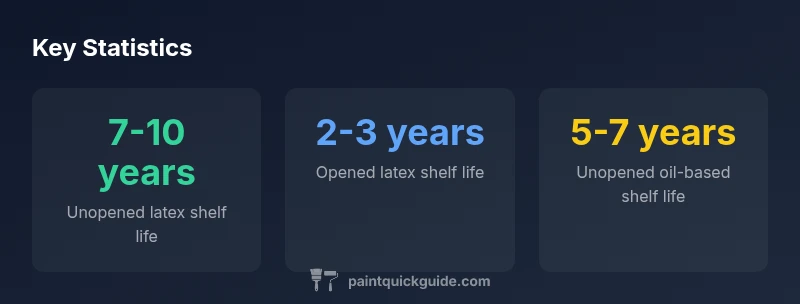
Paint does expire, though unopened cans store longer than opened ones. Unopened latex paints typically last about 7-10 years; opened latex often loses quality after 2-3 years. Oil-based paints usually keep for 5-7 years unopened and 1-2 years once opened. Storage conditions matter: cool, dry, tightly sealed containers extend life. These ranges vary by brand and pigment.
Do Paint Expire? Quick Reality Check
The short answer is yes—paint can lose performance over time, especially after the can is opened. For homeowners and auto refinishing hobbyists, understanding the basic rules helps prevent wasted product and subpar results. The PaintQuickGuide team emphasizes that expiry isn’t a single date but a set of conditions: product type, storage, and exposure to air. By recognizing these factors, you can decide when to reuse, recycle, or discard a can. This article uses general ranges to guide decisions, with the understanding that exact life spans vary by brand and formula. If you question whether your paint is still good, run a quick consistency test and check for obvious signs of degradation before you begin a project.
Shelf Life by Paint Type: Latex, Oil, and Enamels
Paint chemistry matters. Latex (water-based) paints typically have longer shelf lives unopened than waterborne enamels or specialty finishes. Oil-based paints tend to hold up longer unopened, but once opened, they degrade faster due to oxidation. Enamels and specialty coatings may have their own quirks—some rely on solvents that evaporate and thicken over time. Always consult the label for specific guidance and consider how you intend to use the paint. In general, unopened cans last the longest; opened cans lose quality as air and moisture intrude.
Storage That Extends Life: Temperature, Light, and Sealing
Correct storage is half the battle. Keep cans in a cool, dry place away from direct sun. Store upright to prevent sediment settling or heat buildup, and ensure lids are snugly sealed to minimize air ingress. Temperature swings and high humidity accelerate separation and thickening. If you don’t have a perfect storage closet, at least keep the can away from garages where temperature fluctuates and moisture is common. Use a storage cabinet or a dedicated painted-storage bin if possible.
How to Test Old Paint Without Guesswork
If you’re unsure whether paint has expired, perform a simple, low-risk test. Start with visual inspection for skin formation, separation, or mold. Shake a small amount vigorously and look for uniform remixing with no lumps. Open a small amount and run a thin-line test on a disposable surface to assess color, texture, and flow. A strong, pungent odor or a sour smell is a clear sign to discard. If you cannot regain a smooth, even consistency after mixing, it’s safer to replace.
Car Paint and Specialty Coatings: Extra Caution Needed
Automotive paints and clear coats behave differently due to resin systems and catalysts. Opened car paints can show separation and viscosity changes faster, and some automotive products require specific storage conditions and shelf-life data from the manufacturer. When in doubt, consult the technical data sheet for your exact product and adhere to safety guidelines for solvents and fumes.
Practical Disposal and Reuse Options
Not all old paint must go to the landfill in a single container. If the paint is still usable, consider using it for touch-ups or small projects. If the product shows signs of spoilage, dry it out following local guidelines (e.g., cat litter or concrete) before disposal. Many communities offer household hazardous waste collection for leftover liquids. Reuse and proper disposal help reduce waste and environmental impact.
Common Mistakes to Avoid
Avoid deciding based solely on the “use by” date; storage conditions matter. Do not rely on a single test to declare a can good or bad. Do not mix old paint with new; this can ruin both. Finally, never store paints in unventilated spaces or near heat sources, where fumes can accumulate and safety risks rise.
Quick Guide for Home Projects and Small Batches
For typical home projects, purchase only what you can use within a reasonable time frame, such as a few gallons for walls and trim. Label cans clearly with color and date opened. Keep a small sample mix for quick touch-ups and maintain clean, sealed containers to maximize the service life of your paints.
Shelf-life estimates by paint type
| Paint Type | Unopened Shelf Life | Opened Shelf Life | Storage Notes |
|---|---|---|---|
| Latex | 7-10 years | 2-3 years | Store upright, cool, dry |
| Oil-based | 5-7 years | 1-2 years | Keep cap closed, ventilated area |
Your Questions Answered
Do paint cans expire even when unopened?
Yes. Unopened cans have the longest shelf life, with latex around 7-10 years and oil-based around 5-7 years under proper storage. Look for date codes on the can and store in a cool, dry place.
Yes. Unopened cans last longest, typically seven to ten years for latex and five to seven years for oil-based coatings when stored properly.
How can I tell if latex paint has expired?
Check for separation, thickening, unpleasant odor, or pigment changes. If stirring does not restore a smooth, creamy consistency, discard. A sour smell or mold also means disposal.
Look for separation, a lumpy texture, and a strong odor. If it won’t remix smoothly, it’s time to discard.
Can I reuse dried-out paint?
Dried-out paint generally isn’t usable for finishing coats. If a small amount still flows after stirring strongly, you might test in a small area, but plan to replace for most projects.
Usually not worth reusing; if it still flows after thorough mixing, you can test a small patch, but replace for best results.
Does car paint have shelf life after opening?
Yes. Automotive paints follow general shelf-life rules but can be more sensitive to air exposure and catalysts. Refer to the product’s data sheet and store in a ventilated, cool area.
Car paints open to air can degrade quickly; always check the manufacturer’s sheet and store properly.
What storage conditions maximize paint life?
Keep each container closed, upright, in a cool, dry place away from direct sun. Avoid temperature extremes and humidity spikes that accelerate separation and thickening.
Store paint upright, tightly closed, in a cool dry spot away from sun and heat.
Is there a way to extend the life of old paint?
Limited. Some paints can be revived with proper mixing and thinners per the label, but many are best replaced when they show signs of spoilage or thickening.
Sometimes you can revive it, but don’t push it—when in doubt, replace.
“Life span of paint hinges on product type and storage. Unopened cans last longest, while opened cans degrade faster; always follow manufacturer guidelines.”
Quick Summary
- Store unopened cans in a cool, dry place.
- Tightly reseal opened cans and use within the recommended window.
- Test old paint before use: shake, examine, and pour a sample.
- Discard paint with strong odor, curdled texture, or mold.