How Long Is Paint Good For? A Practical Shelf-Life Guide
Find out how long paint stays usable, how storage affects shelf life, and how to test and extend the life of latex and oil-based paints for home and auto projects. PaintQuickGuide analyzes shelf life ranges and storage best practices for 2026.


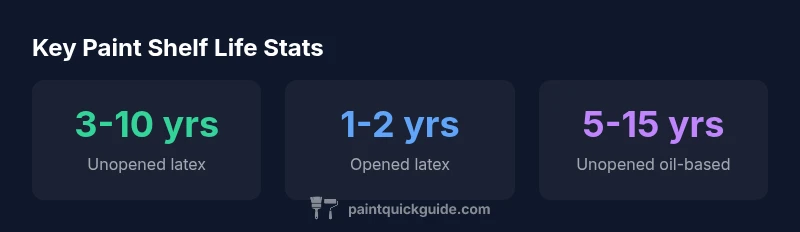
When asked how long is paint good for, the short answer depends on type and storage. Unopened cans usually stay usable for several years, while opened cans decline in quality more quickly. For latex paints, unopened shelf life is typically 3-10 years and opened about 1-2 years; oil-based paints often last 5-15 years unopened and 2-3 years opened, assuming proper sealing and a cool, dry storage space. PaintQuickGuide emphasizes that storage conditions largely determine these ranges.
Understanding Paint Shelf Life
Paint shelf life is a practical measure of how long a can remains usable without compromising performance, odor, texture, or color. For homeowners asking how long is paint good for, the answer hinges on formulation, packaging, and storage conditions. The PaintQuickGuide team notes that unopened cans tend to hold up longest, while once-opened cans are more prone to drying, skin formation, and pigment separation. In real-world terms, expect a range rather than a single date: latex paints can stay usable for several years if kept in a cool, dry space, whereas oil-based paints may hold longer unopened but will deteriorate faster once opened. Treat shelf life as a function of chemistry and environment—two factors you can control with simple habits.
Unopened vs Opened: How The Story Changes
The key difference between unopened and opened paint is exposure. Unopened cans shield pigments, binders, and preservatives from air and moisture. Once a lid is breached, evaporation, contamination from brushes, and exposure to humidity can accelerate spoilage. Knowing this helps answer the common question how long is paint good for after breaking the seal. In general, unopened latex paints are safest in the 3-10 year window, while opened latex shrinks toward the 1-2 year range. Oil-based paints extend longer when unopened (roughly 5-15 years), but opened oil-based cans typically settle into a 2-3 year range. PaintQuickGuide’s data emphasizes the importance of re-sealing promptly and storing in optimal conditions.
Shelf Life by Paint Type: Latex, Oil, and Specialty
Understanding shelf life requires breaking down by paint type. Latex or water-based paints are most sensitive to moisture and temperature swings after opening, but unopened latex can endure longer than many expect. Oil-based paints often tolerate longer storage when unopened due to their resin systems, yet once opened they are prone to skin formation and sediment. Specialty paints (enamels, chalk paints, and high-solid formulations) can vary widely, so always check the label. PaintQuickGuide notes that the best practice is to store all paints upright, with lids tightly sealed, in a climate-controlled area to maximize usable life.
Storage Essentials That Extend Your Paint's Life
Storage is the silent currency of shelf life. Keep cans in a cool, dry place away from direct sunlight, heat sources, and freezing conditions. Maintain a consistent temperature, ideally between roughly 50-85°F (10-29°C), to slow down chemical changes. Always clean the rim before resealing to prevent contamination, and label cans with the date opened. A stable environment and meticulous handling can add months or even years to a can’s usable life, which is why many DIYers follow a simple rule: better storage equals better results.
How to Test Paint Before Use
Before you load a brush, test old paint to confirm usability. Start with a visual inspection for clumps, skin on the surface, or color separation. Shake or stir thoroughly to reblend pigments; if lumps persist or the paint has a strong sour or rancid odor, discard it. For latex, a thin, even consistency and no grit are good signs; for oil-based paints, a smooth texture without a persistent odor indicates readiness. If in doubt, perform a small test patch on scrap material to verify color and application.
Reviving and Reusing Old Paint Safely
Old paint can sometimes be revived, especially latex formulations, by thorough stirring, straining to remove lumps, and adding a compatible thinner or conditioner if needed. Avoid mixing new paint with suspect leftovers, and never use paint with a sour odor as a primer or topcoat on living spaces. For any old paint, perform a test coat to confirm color match and consistency. If separation is heavy or the formula looks compromised, it is safer to replace.
Disposal and Responsible Cleanup
When paint nears the end of its usable life, follow local disposal guidelines. Do not pour liquid paint down drains. For small amounts, air-dry latex paints in an open can, reuse hardening products with household waste guidelines, or drop off at a household hazardous waste facility if available. Oil-based paints require more caution and may need to be taken to a proper hazardous waste site. Always consult local regulations and dispose of paint responsibly to protect the environment.
Quick Reference Lifespans by Type (data table preview)
In practice, you’ll see that latex and oil-based paints have different tendencies for longevity both unopened and opened. The table below summarizes typical ranges and should be used as a quick guide when planning a project or cleanup.
Common Mistakes That Ruin Paint Lifespan
Common errors, such as leaving lids loose, storing in extreme temperatures, contaminating paint with water or brushes, and mislabeling cans, can drastically shorten usable life. Always reseal tightly, store in a stable environment, and keep a separate container for used tools to avoid cross-contamination. By avoiding these mistakes, you’ll maximize your paint investment and reduce waste.
Shelf life ranges by paint type (typical values; variations apply by brand and storage).
| Paint Type | Unopened Shelf Life (years) | Opened Shelf Life (years) | Storage Tips |
|---|---|---|---|
| Latex / water-based | 3-10 | 1-2 | Cool, dry place; reseal tightly; gentle mixing before use |
| Oil-based / alkyd | 5-15 | 2-3 | Original can; upright storage; avoid freezing temperatures |
| Chalk paints | 2-5 | 1-2 | Keep lid on; store away from humidity; mix before use |
| Acrylic enamel | 3-7 | 1-2 | Seal tightly; climate-controlled area; shake before use |
Your Questions Answered
How long is paint good for after opening?
For latex paints, expect about 1-2 years if kept sealed and stored properly. Oil-based paints typically last 2-3 years opened. Always test a small patch before committing to a full project.
Latex paints stay good for about one to two years after opening; oil-based paints about two to three years, if sealed and stored well.
Can old paint be revived?
Some old latex paints can be revived with thorough mixing and straining. If the texture remains gritty, or the odor is strong or off, discard. Always test on a scrap surface first.
You can sometimes revive latex with mixing and straining. If it smells off or looks bad, discard and avoid using it on important projects.
Does freezing ruin paint?
Frequent freezing can ruin latex paints by causing emulsion separation. Oil-based paints tolerate cold better but can still degrade if repeatedly frozen. If thawed and clumpy, discard after testing.
Freezing can ruin latex paint; oil-based paints handle cold a bit better but still should be tested before reuse.
Is there a difference between interior and exterior shelf life?
Both interior and exterior paints follow similar opened and unopened lifespans, but climate and exposure can shorten opened life for exterior paints more quickly. Storage still matters for both.
Interior and exterior paints have similar unopened lifespans, but outside conditions can shorten opened life.
How should I store paint to extend life?
Store cans in a cool, dry place away from sunlight, with lids tightly sealed. Label opened dates and avoid temperature extremes. A stable environment can significantly extend usability.
Keep paints in a cool, dry place with the lid tight—light and heat ruin shelf life.
What about spray paints?
Spray paints have shelf life similar to liquid paints when unopened. After opening, avoid moisture and extreme temperatures. Test before use and dispose of old cans if the valve or propellant seems compromised.
Spray paints follow the same general rules—check the label and store well before use.
“Proper storage and careful testing are the most reliable ways to maximize paint shelf life. Even long-lasting formulas can degrade quickly if exposed to heat, moisture, or air.”
Quick Summary
- Store paint upright in a cool, dry place.
- Unopened latex lasts longer than opened cans.
- Follow label guidance; storage conditions matter most.
- Test paint before use if it’s been stored for a while.
- Dispose of old paint responsibly per local rules.