How Big Is a Quart of Paint? Size, Coverage, and Planning
A practical guide to quart-sized paint: volume, coverage, and how to estimate quantities for walls, trim, and small projects. Learn typical coverage, factors that affect yield, and budgeting tips for home DIY painting.


What does a quart measure in practical terms?
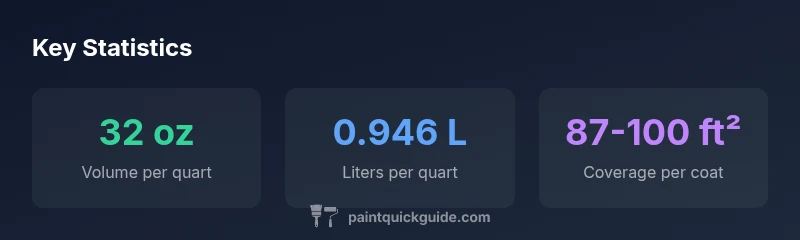
According to PaintQuickGuide, how big is a quart of paint starts with the definition: a quart is a US liquid measure equal to 32 fluid ounces, or about 0.946 liters. In plain terms, a quart is enough for small intervals, including a single doorway or a few accent walls. For interior walls, one coat of standard latex paint on a smooth, primed surface typically uses most of a quart, though color changes, multiple coats, and primers can increase consumption. The quart size is a convenient balance—large enough to cover significant areas but compact enough to handle and store. For DIYers, this size can support a mid-sized project such as a single-bedroom repaint or several trim details.
The unit’s practicality extends beyond sheer volume: it helps you estimate costs, manage leftovers, and plan touch-ups without overbuying. If you’re measuring a wall that needs two coats, you’ll often buy two quarts for that room, rather than a single gallon and risk excess leftovers. Remember that your concrete plan benefits from clarifying the exact scope before you shop.
How much area can a quart cover? Coverage guidelines
Typical interior latex paints promise about 350-400 square feet per gallon on smooth, primed walls. To translate to a quart, divide by four—roughly 87-100 square feet per coat. This rule-of-thumb helps with planning: a small to mid-size bedroom (about 144-180 square feet wall area) may require two quarts for two coats. If your walls have heavy texture, previous dark colors, or higher sheen, coverage can drop toward the lower end. It’s also worth noting that matte finishes can sip more paint than flat or eggshell surfaces. For projects with ceilings and trims, expect slightly different usage as trim areas often require extra coats and precise cutting in.
In practice, start with a nominal estimate, then adjust after a first pass. If you can borrow a gallon-sized can to test a wall section, you’ll have a clearer sense of actual coverage for your space.
Factors that affect coverage per quart
Several variables determine how far a quart will go. Surface texture is a primary driver: rough plaster, popcorn ceilings, or heavy drywall texture increases absorptive surface area, reducing coverage per quart. Porosity matters: new drywall and untreated wood soak up paint more quickly than sealed surfaces. During color changes, especially from dark to light, more coats may be necessary, increasing quart requirements. Paint type and sheen also play a role; higher-gloss finishes can require more careful, even application, which sometimes translates into more paint over a broader area. Primers add protection against bleed-through but add to overall paint use. Finally, environmental factors such as humidity and temperature can affect dry time and film formation, indirectly influencing how efficiently a coat goes on.
How to estimate quart requirements for a project
- Measure the wall area: multiply length by height for each wall, then add up all walls. Subtract areas for doors and windows. 2) Decide how many coats you’ll apply and whether you’ll primer first. If changing colors or going from dark to light, plan for extra coverage. 3) Use a per-coat coverage figure: for interior latex, approximate 87-100 square feet per quart per coat. 4) Calculate needed quarts: (total wall area) ÷ (coverage per quart) × (number of coats). Round up to ensure you have enough and to account for waste. 5) Consider extras: a little extra for touch-ups, spills, and future repairs. 6) If you’re unsure, test a small wall first and adjust your quantities accordingly.
Practical tips for saving and measuring quart quantities
- Buy a little extra to account for waste and future touch-ups. - Mix paint from multiple cans to ensure color consistency across the space. - Label cans with room names and dates to avoid mix-ups. - Use the quart for trims and accent walls to maximize its utility. - Store unopened cans upright in a cool, dry place to preserve color and consistency.
Common mistakes when calculating paint quantities
- Underestimating texture or porosity, leading to undersupply. - Not accounting for doors, windows, and trims in wall area. - Ignoring peeling surfaces or unprimed patches, which can skew coverage. - Assuming one coat is enough for bold color changes. - Ignoring can size differences and misjudging how many cans equal a gallon.