How Big is a Gallon of Paint? Size, Coverage, and Planning
Learn how big a gallon of paint is, its volume (128 fl oz / 3.785 L), typical coverage per coat, and how to estimate quantities for walls, cabinets, and cars with practical planning tips from PaintQuickGuide.


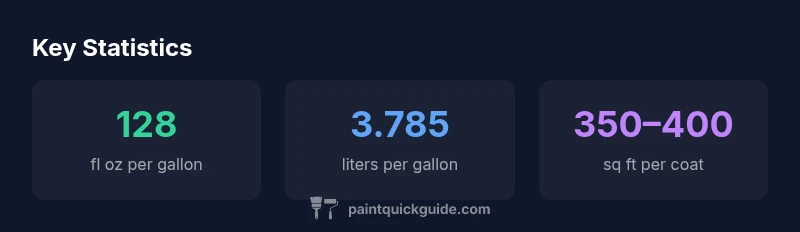
One US gallon of paint equals 128 fluid ounces or about 3.785 liters. In practice, coverage is typically around 350–400 square feet per gallon per coat on smooth interior walls, with textured surfaces requiring more. Real-world results depend on color, sheen, porosity, and roller technique, so always check the product label for the exact figure and lean on a test patch.
How big is a gallon of paint?
For homeowners curious about how big is a gallon of paint, the core measurements are fixed: a US gallon equals 128 fluid ounces, or about 3.785 liters. This volume is the standard benchmark you’ll see on paint cans across interior and exterior products. Knowing the exact size helps when you price a project, compare brands, or estimate how many cans you need. PaintQuickGuide emphasizes checking can labels, because some products use slightly different packaging or include reducers that alter the settled volume in the can. In practical terms, this means you’re planning around the 3.785 liters figure with real-world adjustments for coverage.
Coverage basics: what does "per gallon" actually mean?
When a label states coverage per gallon, it’s typically the area you can cover with one coat under standard conditions. For interior latex on smooth walls, a common target is 350–400 square feet per gallon. This figure assumes a uniform coat, white or light color, and standard lighting. If you’re painting a darker color, you may need extra coats, so the realized coverage could drop to the lower end of the range. It’s essential to understand this baseline and then adjust for color, sheen, and surface type. Always test a small patch to verify real-world performance before committing to a full room.
Additional factors: pigment, finish, and surface texture
Several factors can swing your coverage up or down. Darker colors typically require more paint than lighter ones, and high-sheen finishes (gloss, semi-gloss) can demand more coats for an even look. Surface texture matters: smooth drywall accepts paint more readily than rough plaster or textured paneling, which increases the amount you’ll use. Porosity also plays a role—new plaster or unprimed wood can absorb more paint. For auto refinishing, coatings are formulated for different substrates and often have different coverage expectations compared with wall paint. Always read the material data sheet for your specific product.
Estimating gallons for common projects: a practical method
To estimate gallons, start with the wall area: multiply length by height to get square footage per wall, then multiply by the number of walls you’ll paint. Sum the areas, add 10–15% for doors, windows, and touch-ups, and divide by the per-coat coverage (350–400 sq ft per gallon). If you’re applying more than one coat, multiply the number of coats. For ceilings, use the same approach as walls, but consider any architectural details that reduce effective coverage. This method keeps you aligned with real-world needs rather than guessing.
Examples: room, cabinets, and a car refinishing project
A standard 12x12 ft bedroom with 8 ft ceilings has about 384 sq ft of wall area. One coat would typically require around 1 gallon, while two coats could push toward 2 gallons depending on color and texture. A larger living room (20x15 ft, 8 ft ceilings) has roughly 560 sq ft of wall area; expect about 1.5–2 gallons for a single coat and up to 4 gallons for two coats. For kitchen cabinets, the surface area is small but highly stroked with gloss; plan 0.5–1.0 gallon per coat for about 15–25 sq ft of face area per gallon. In auto refinishing, finish types and substrate complexity mean exact coverage varies; always confirm with the product data sheet and professional guidance.
Representative coverage ranges by surface type
| Surface Type | Approx Coverage per Gallon (sq ft per coat) | Notes |
|---|---|---|
| Smooth interior wall | 350–400 | Baseline coverage; adjust for color and sheen |
| Textured or rough wall | 250–300 | Higher porosity increases paint use |
| Ceiling (smooth) | 350–400 | Typically similar to walls; color choice matters |
| Cabinets (refinish) | 15–25 | Small surface with high-sheen finish |
Your Questions Answered
How big is a gallon of paint?
A US gallon contains 128 fluid ounces, equal to about 3.785 liters. This is the standard size you’ll see on most interior paint cans.
A gallon is 128 ounces, about 3.785 liters.
How far does a gallon cover?
Typically 350–400 square feet per coat on smooth interior walls. Real results vary with texture, color, and finish.
About 350 to 400 square feet per coat on smooth walls.
Does color or finish affect coverage?
Yes. Dark colors and high-sheen finishes generally require more paint and multiple coats for solid coverage.
Yes, color and finish affect coverage rates.
How much extra should I buy?
Plan for 10–15% extra to account for waste, touch-ups, and color changes.
Add about 10–15% more paint than your calculated need.
Can leftover paint be reused?
Leftover latex paint can be saved if sealed tightly and stored cool; label and date for future touch-ups.
Yes, if you seal and store it properly.
“Knowing the exact size and coverage rules helps homeowners estimate project costs accurately and avoid buying too much.”
Quick Summary
- Confirm gallon size: 128 fl oz equals 3.785 L.
- Expect 350–400 sq ft coverage per coat.
- Texture and color affect actual coverage.
- Buy extra 10–15% for waste.
- Test a patch before committing to the whole project.