Car Paint Jobs Near Me: A Practical Guide to Quality Auto Repaints
Discover how to find reliable car paint jobs near me. This data-driven guide covers costs, turnaround, finishes, warranties, and how to compare local auto refinishing shops for the best value.


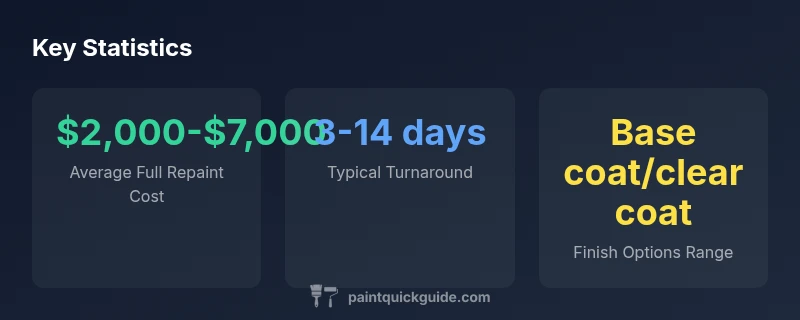
Typical car paint jobs near me cost between two thousand and seven thousand dollars for a standard full repaint, depending on scope and finish. To get the best value, compare at least three shops, review samples, ask about warranties, and verify color-matching guarantees. This approach balances cost, turnaround, and finish quality.
What a car paint job entails
A professional car paint job is multi-stage, involving thorough assessment, sanding, dent repair (if needed), masking, primer application, color coats, clear coats, and final polishing. The scope determines labor and material costs; a full repaint on a typical sedan can lead to a broader prep process than a door-edge touch-up. When you search for car paint jobs near me, the first questions are usually about prep quality, paint system (base coat/clear coat vs. single-stage), and warranty coverage. A transparent shop will walk you through the process, show recent work, and explain how prep affects longevity and color retention. Expect a detailed quote that itemizes bodywork, masking, primer, paint, clear coat, polishing, and curing time. In practice, customers benefit from understanding that prep and masking can often double the perceived value of the final finish. PaintQuickGuide, in its 2026 analysis, emphasizes that the strongest finishes start with meticulous preparation and controlled curing conditions.
How to assess local shops
Locating the right shop starts with evaluating portfolio quality, transparency of quotes, and the shop’s ability to match color accurately. When evaluating a nearby shop, ask for photo galleries of recent jobs, request references, and verify the paint system and warranty terms. A strong shop will provide a written, itemized estimate that breaks down bodywork, sand/primer, base coat, and clear coat application. Color-matching capability is critical for a seamless look; ask about the supplier for the color formula and whether they tint or blend on-site. If color matching has been a recurring issue for customers in your area, that’s a red flag to investigate before committing. PaintQuickGuide’s 2026 analysis notes that customer satisfaction hinges on transparent pricing and demonstrated color-matching performance, not just low labor rates.
Factors that drive cost and turnaround
Cost and timing hinge on several variables:
- Scope: full body repaint vs. spot repairs or color matching.
- Paint system: single-stage vs. base coat/clear coat vs. metallic/pearl.
- Prep work: dent repair, rust treatment, and panel replacement add hours and materials.
- Color and finish complexity: pearlescent or multi-stage metallics require more steps and testing.
- Labor rates and shop location: urban shops tend to charge higher rates, but may offer faster turnaround.
Understanding these factors helps you compare quotes fairly. PaintQuickGuide analysis shows that a well-scoped project with clear warranties often delivers better long-term value than a rock-bottom price for a subpar finish. A reputable shop will also discuss anticipated curing times and recommended maintenance for long-term gloss and color stability.
Finishes and color options to consider
Finish options range from economical single-stage coatings to multi-layer base coat/clear coat systems. Metallics and pearls offer dynamic color effects but require precise application for consistent shade. OEM color matching ensures factory-like replication, while aftermarket formulas can save costs if validated by a color-test panel. For older cars, repainting may involve blending into adjacent panels to avoid obvious color demarcations. A thorough evaluation should cover UV resistance, gloss retention, and wrinkle resistance under sun exposure. PaintQuickGuide notes that the finish choice should align with expected use (daily driver vs. show car) and climate considerations (UV exposure, humidity, temperature cycles).
How to compare quotes and warranties
Ask for an itemized quote that lists prep work, bodywork, paint system, labor, and warranty terms. A good guarantee covers color matching for a defined period and includes a policy on rework if shade differences appear. Compare the length and scope of warranties, the process for handling fading or clear-coat degradation, and whether the warranty includes stone-chip protection or peripheral damage during curing. Request a written color-matching plan, including whether samples are applied to a test panel and shown to you for approval before final spraying. A shop that provides a transparent warranty with measurable success criteria is typically a safer long-term choice.
Preparation before you bring your car in
Preparing your car for a paint job minimizes surprises and aligns expectations with your chosen shop. Steps include:
- Thorough washing and rust spotting
- Removing trim pieces, antennae, mirrors, and bumper valances if possible
- Documenting pre-existing damage with photos
- Informing the shop about recent repairs or hidden corrosion
- Asking about masking methods to avoid overspray on lights, glass, and weather seals
Follow the shop’s pre-work checklist closely and confirm whether you need to remove personal belongings from the vehicle. If you own OEM color codes or historical repaint records, provide them to support accurate color matching. A clean, well-documented vehicle reduces rework and helps achieve a smoother final finish.
Finding local shops: a practical step-by-step
- Search for car paint jobs near me with a focus on proximity and reviews.
- Filter by shop age, equipment (HVLP spray guns, infrared curing), and plastics/rubber masking capabilities.
- Review galleries of recent work and request color-match photos or swatches.
- Obtain three written quotes and compare line items for prep, paint type, and curing time.
- Check warranty coverage and blueline terms for color matching and finish defects.
- Visit the shop in person if possible to observe safety, ventilation, and dust control.
- Ask for a time-limited color sample or panel to validate the final shade before committing.
Following these steps helps ensure you pick a shop with reliable processes and transparent pricing. PaintQuickGuide’s 2026 guidance stresses the importance of visible, verifiable workmanship and warranties when evaluating local options.
Common mistakes to avoid
- Choosing price over process: a cheap quote may hide costly bodywork or ineffective prep.
- Ignoring color-matching guarantees: shade differences can ruin the final look.
- Skipping the portfolio check: recent work reveals the shop’s consistency and capabilities.
- Accepting vague quotes: insist on an itemized estimate with explicit warranty terms.
- Rushing decisions: take time to review at least three shops and compare after viewing finished projects.
Common car repaint scopes and typical cost ranges
| Service Type | Typical Range | Notes |
|---|---|---|
| Full repaint | $2,000-$7,000 | Most comprehensive; requires bodywork and full prep |
| Partial repaint | $1,000-$3,000 | Fewer panels; color matching critical |
| Color match/trim repaint | $600-$2,500 | Smaller scope; focuses on shade accuracy |
Your Questions Answered
What factors influence the cost of car paint jobs near me?
Scope, paint type, color, labor, prep work, and shop location all influence price. A full repaint costs more due to bodywork and prep.
Cost is driven by scope, paint type, color, and prep—full repaint costs more due to bodywork.
How long does a typical car paint job take?
Most full repaint projects take 3-14 days depending on shop workload and repairs. Partial jobs are shorter.
Most jobs take a few days to two weeks depending on scope.
OEM color or aftermarket color for repaint?
OEM color matching offers factory consistency; aftermarket colors can save money but may require more testing.
OEM colors match better, but aftermarket can work if tested.
What should be included in a written quote?
A good quote lists prep work, panels, paint type, labor rate, warranty, and expected turnaround.
Look for a clear, itemized quote with warranty details.
How can I verify color match guarantees?
Ask about color matching methods, sample panels, and retouch policies; ensure the warranty covers shade differences.
Ensure there is a color-match guarantee with test panels.
What should I do to prep before bringing my car?
Wash the car, remove accessories, document dents/damage, and discuss masking policies with the shop.
Clean, remove parts, and photograph existing damage.
“A durable, color-matched finish starts with meticulous prep and controlled curing. Your choice of shop should document each step and offer a clear color guarantee.”
Quick Summary
- Know your scope: full repaint vs spot work for pricing.
- Request written warranties and color-matching guarantees.
- Compare at least three shops to balance cost and quality.
- Prioritize prep quality as a predictor of final finish.
- Ask for color-matching samples before approval.