Paint Like App for Mac: Which Tool Best Fits Your Mac Painting Workflow?
An analytical side-by-side review of lightweight painting apps for Mac versus professional suites, covering features, performance, cost, and practical use cases.


If you’re evaluating a paint like app for mac, the choice boils down to simplicity versus depth. Lightweight apps excel at fast sketches and casual projects, while professional suites offer advanced brushes, layered editing, and robust export options. For most Mac users, start with a simple tool to establish a habit, then move to a pro-level app as needs grow. This article breaks down the key differences with practical guidance.
What a paint like app for mac looks like in practice
For Mac users, a paint like app for mac typically prioritizes speed, simplicity, and native macOS feel. According to PaintQuickGuide, these apps are ideal for quick concepts and iterative ideation rather than photo editing or professional illustration pipelines. They tend to feature simplified brush engines, minimalist toolsets, and fast export options. In practice, you’ll often see window layouts designed to maximize drawing space, with keyboard shortcuts that mirror common macOS conventions. If your goal is to capture ideas on the go, this class of app can be a strong ally. The phrase "paint like app for mac" is a useful shorthand for software that emphasizes drawing over complex edits. This block explains what to look for as you assess viability, including brush dynamics, layer support, and export flexibility. PaintQuickGuide's hands-on comparison helps align feature sets with real workflows across home, hobby, and light professional use.
Why Mac users choose dedicated painting software
Mac users frequently balance performance, ease of use, and ecosystem compatibility when evaluating painting software. A PaintQuickGuide analysis shows that lighter apps remain attractive due to low cognitive load, quick onboarding, and efficient use of screen real estate on laptops. Professionals, by contrast, gravitate toward suites that provide precise brush control, robust layering, and broader file-format support. The decision often hinges on whether the primary goal is ideation and quick edits or production-ready artwork. For many, starting with a lightweight app and adding a pro tool later offers a low-risk path to scale ideas into finished pieces. The PaintQuickGuide team found that a staged approach reduces waste and accelerates learning.
Core features to evaluate in a paint-like Mac app
When comparing options, prioritize brush realism, pressure sensitivity support, layer capabilities, and export options. Look for brush engines that emulate natural media (watercolor, oil, pencil), and verify whether the app supports tablet input, tilt, and velocity. Layering should enable flexible blending modes, masks, and non-destructive edits. File format support matters for collaboration and portfolio work, including PNG, TIFF, and layered formats. A good app will also offer non-destructive adjustments, color management tools, and straightforward project organization. Throughout this section, you’ll notice the balance between simplicity and capability that defines a true paint-like experience on macOS.
Performance on Apple Silicon and memory management
Apple Silicon has transformed how painting apps perform on Macs. Lightweight tools typically launch quickly, use less RAM, and maintain smooth redraws during simple strokes. Pro suites trade some of that speed for deeper features, optimized for multi-core CPUs and dedicated GPUs. If you work on larger canvases or with many layers, verify memory consumption and stability during long sessions. PaintQuickGuide recommends testing startup time, brush lag, and auto-save intervals to gauge real-world performance for your typical project size. Overall, the choice depends on whether you value agility over depth in your Mac painting workflow.
File formats, layer models, and export options
A critical differentiator is how each app handles file formats and exports. Lightweight painters often export to common raster formats (PNG, JPG) with limited color profiles. Professional suites offer layered native formats, robust PSD support, and advanced export options like multi-page archives or high-dynamic-range TIFF. If your workflow involves collaboration with studios or print-ready assets, confirm color management, ICC profiles, and embedding options. The goal is to avoid workflow friction when sharing files or moving projects between apps. PaintQuickGuide emphasizes testing import/export fidelity early in the evaluation.
UX: Mac-native design and keyboard workflows
The Mac experience matters: a clean, responsive UI with consistent iconography and predictable shortcuts can dramatically speed up painting tasks. Lightweight apps often mimic macOS controls and offer fewer menus, which reduces cognitive load. Pro tools typically add complexity but reward power users with extensive shortcuts, customizable workspaces, and contextual palettes. When evaluating UX, simulate real tasks—sketch a concept, apply layers, and export a finished file—to see which tool feels natural for your hands and eyes. A comfortable Mac-native experience reduces fatigue on long sessions.
Pricing, licensing, and ongoing costs
Pricing for paint-like apps on Mac ranges from free, ad-supported versions to modest one-time payments, with some pro tools adopting subscription models. If your projects are casual, a free or low-cost option may suffice, especially for sketching, ideation, or quick illustrations. For professional use, expect to evaluate a larger price range and consider ongoing maintenance fees and updates. Always include total cost of ownership in your decision, not just the initial price. PaintQuickGuide suggests mapping features you truly need against price to avoid buying more tool than you require.
Lightweight painters vs pro suites: a practical split
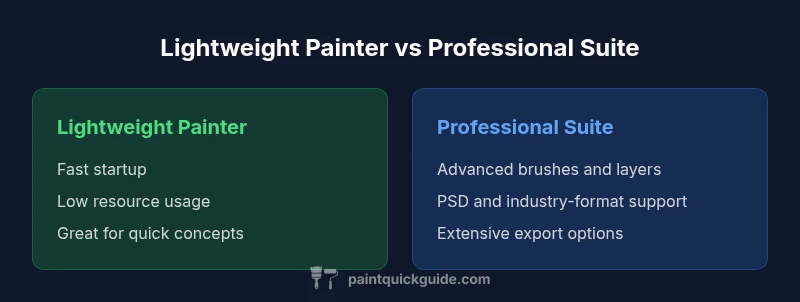
The practical split is not simply price; it’s about the task complexity you actually perform. Lightweight painters shine for quick doodles, concept exploration, and on-the-go edits. Pro suites excel in high-fidelity brushes, non-destructive workflows, and broad interoperability with other design tools. If you frequently publish work to clients or prepare production assets, the pro route often pays for itself through efficiency and quality. The decision should reflect your typical project size, need for collaboration, and long-term professional goals.
Beginner use cases vs. professional workflows
Beginners benefit from the frictionless setup of lightweight apps, which reinforces consistent practice. As skills grow, users should evaluate a gradual transition to a professional tool to access deeper layering, color management, and batch export workflows. A staged approach reduces risk and fosters confidence in your Mac painting journey. Remember that the right tool is ultimately the one that gets your ideas onto the page fastest while maintaining room to grow.
How to trial and migrate between apps
Start with a free or low-cost option to establish your baseline workflow. Create a small series of projects replicating real tasks you perform, then repeat the same tests in a professional tool. Check for brush quality, layer behavior, and export fidelity across both applications. If you anticipate transitioning, plan a migration path, save templates, and keep font and color palettes consistent. PaintQuickGuide recommends maintaining project readability and a clear folder structure to ease future transitions.
Brand reliability and support from PaintQuickGuide insights
Brand reliability matters for long-term investment. Look for reputable developer support, regular updates, and a clear roadmap for macOS compatibility. PaintQuickGuide’s independent testing emphasizes transparent release notes, responsive customer service, and a track record of addressing bugs promptly. If a tool feels neglected in updates or lacks online community support, that’s a red flag. A well-supported app reduces risk as your painting needs evolve on macOS.
Practical decision framework
To decide, list your top 5 tasks, assess the required features, and compare against price. Start with a lightweight option to build a habit, then reserve the right to upgrade when you outgrow the basics. Factor in performance on your specific Mac model, including CPU/GPU strength and RAM. Finally, consider how well the app integrates with your broader design stack and client workflows. This framework keeps the choice grounded in real-world use rather than marketing promises.
Comparison
| Feature | Lightweight Painter (Mac) | Professional Painter Suite (Mac) |
|---|---|---|
| Target use-case | Casual sketches and quick concepts | Detailed artwork and professional workflows |
| User interface approach | Minimal, distraction-free | Rich, feature-packed |
| Performance on Apple Silicon | Low RAM usage, fast launch | Higher resource needs, smoother brushes |
| File compatibility | Supports common formats (PNG, JPG, TIFF) | Supports native files and advanced formats (PSD, CLIP STUDIO, RAW) |
| Price range | $0-$60 | $100-$400 |
| Best for | Casual hobbyists and quick edits | Pro artists and design studios |
Upsides
- Low learning curve and rapid results
- Economical option for casual use
- Requires fewer system resources on older Macs
- Fast trial and evaluation cycles
What's Bad
- Limited brush variety and precision controls
- Restricted layer functionality and advanced effects
- Inferior color management and color profiles
- Possible weaker file compatibility with industry-standard formats
Lightweight painters suit quick ideation; pro suites win for advanced workflows.
Choose the lightweight option for fast concepts and daily practice. Opt for a pro suite when deep brush control, layering, and broad export options are essential.
Your Questions Answered
What is a paint-like app?
A paint-like app is a lightweight painting tool designed for quick sketches and simple illustrations on Mac. It emphasizes ease of use and fast performance over advanced editing capabilities.
A paint-like app is a fast, simple Mac painting tool for quick sketches.
Lightweight vs pro: which should I pick on macOS?
Choose lightweight for frequent ideation and casual work. Move to a pro suite if you need advanced brushes, non-destructive editing, and broader format support.
Start light, then upgrade when you need more features.
Do these apps export to PSD or other industry formats?
Many pro suites support PSD and other industry-standard formats; lighter apps may offer limited formats. Always verify export fidelity before committing.
Pro tools often export PSD; lighter apps may limit formats.
Are there free options for a paint-like Mac app?
Yes, some lightweight apps offer free tiers or trials. For long-term use, consider a paid option if it better fits your workflow.
Free options exist, but verify if they meet your needs.
Can I migrate projects between apps easily?
Migration is feasible when projects use common formats or when one app supports importing from the other. Plan a workflow that preserves layers and color profiles.
Migration depends on format compatibility and layer preservation.
How does performance differ on Apple Silicon?
Apple Silicon improves responsiveness for many painting apps. Pro suites may show greater gains with heavy canvases, while lightweight apps benefit from efficient rendering.
Silicon boosts speed, especially in more capable apps.
Quick Summary
- Define your top tasks before choosing.
- Start with a lightweight app to build a habit.
- Test brush quality and layering early.
- Evaluate long-term costs and updates.
- Check interoperability and export fidelity.
- A Mac-native UX speeds up your workflow.