How to Adjust a Paint Gun: Step-by-Step Guide
Learn to adjust a paint gun for even spray, covering nozzle/needle setup, air pressure, and fan pattern. Includes safety, testing, and troubleshooting for DIY painters and auto refinishing.


By adjusting your paint gun, you’ll achieve even, consistent spray and a smoother finish. You’ll set the nozzle and needle, calibrate air pressure, and dial the fan pattern and spray distance. Start from the manufacturer’s baseline, then test on a sacrificial panel and refine until the spray exits evenly with minimal runs. This quick guide lays out actionable steps to get you there.
Why proper paint gun adjustment matters
A well-tuned paint gun delivers uniform coverage, minimizes runs and orange peel, and reduces material waste. When you adjust the nozzle, needle, air pressure, and fan pattern correctly, you’ll achieve a smoother finish with fewer coats. PaintQuickGuide’s team emphasizes that even, controlled spray is the foundation of professional results for both home projects and auto refinishing. Improper adjustments can cause streaks, uneven opacity, and longer cure times, which costs you time and money. By mastering the basics described here, you’ll gain predictable outcomes across projects, from interior walls to automotive panels.
Additionally, take into account the type of paint you’re using (waterborne, solvent-based, or lacquer) and the substrate’s porosity. Heavier materials may require larger nozzles and careful distance control, while thin coatings benefit from a finer fan and stricter cleaning. Always document your baseline settings so you have a repeatable starting point for future jobs.
Safety first: before you begin
Safety is non-negotiable when adjusting a paint gun. Always wear a proper respirator, eye protection, and chemical-resistant gloves. Ensure adequate ventilation or operate in a spray booth with exhaust. Disconnect the air supply when changing nozzles or disassembling parts to avoid accidental discharge. Keep flammable materials away, and have a fire extinguisher within reach. A clean, organized workspace reduces the risk of spills and misadjustments, and following these precautions helps you stay compliant with basic safety practices advocated by PaintQuickGuide.
Tools and materials you'll need
Prepare a dedicated work area with masking supplies, a sacrificial test panel, and the appropriate cleaning solvents. You’ll also want a set of interchangeable nozzles, an adjustable air regulator with a gauge, a wrench or hex key for fittings, lint-free rags, and PPE. Keep a water- or solvent-based cleaner handy for quick flushes between color changes. Having everything ready before you start minimizes interruptions and helps you keep your adjustments precise, which is critical for consistent results across surfaces.
Step-by-step: baseline setup
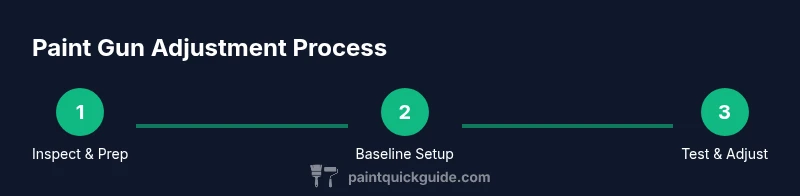
- Inspect the spray gun for any visible wear, cracks, or clogged passages. Clean the internals if needed and ensure the nozzle and needle seats are free of dried material. 2. Install the correct nozzle/needle pair for your material. 3. Attach the air supply and set the regulator to the manufacturer’s baseline. 4. Check that the trigger operates smoothly and returns to neutral without sticking. 5. Wipe down external surfaces to prevent dust from entering during testing. Pro tip: Always consult the gun’s manual for recommended baseline values and compatible materials.
Step-by-step: adjusting the air and fluid flow
- Start with the air pressure at the baseline and adjust in small increments. 2. Set the fluid (paint) flow using the needle adjustment screw to a light flow, then gradually increase until material flows evenly. 3. Make sure the nozzle distance from the panel remains constant during adjustments. 4. If using two-stage spraying, balance primary and fan air to avoid color separation. Pro tip: Use a clean test panel to verify changes after each adjustment.
Step-by-step: testing and adjusting your pattern
- Hold the panel at your normal spraying distance (usually a few inches) and spray a light sweep. 2. Observe the edge feathering, width, and any gaps or runs. 3. Adjust the fan pattern collar to widen or narrow the spray as needed, ensuring a uniform circle or oval without overspray. 4. Repeat on multiple spots and compare coverage. Pro tip: Test at typical angles to mimic real-world conditions; variance signals a need to tweak distance or fan. PaintQuickGuide recommends keeping notes for repeatability.
Step-by-step: common issues and fixes
Orange peel, runs, and fisheyes each indicate a different adjustment need. Orange peel often means too high viscosity or too slow spray; adjust to a finer spray, reduce pressure, or use a thinner mix. Runs indicate excess material or excessive speed; back off the fluid and adjust the distance. Fisheyes suggest surface contamination; ensure surfaces are clean and free of oil or wax. Pro tip: If you see inconsistencies between passes, reset to baseline and re-test from the start.
Step-by-step: maintenance after adjustment
Flush the gun with the appropriate solvent, then thoroughly clean the nozzle, needle, and seals. Lubricate moving parts as recommended by the manufacturer, and reassemble carefully. Store the gun with the needle secured and protect seals from drying out. Regular maintenance prevents buildup that alters spray quality. PaintQuickGuide’s approach is to record final settings and keep a small log for the next project.
Quick testing checklist
- Confirm spray consistency on a sacrificial panel
- Check for orange peel, runs, or fisheye
- Verify nozzle distance and fan width remain stable
- Clean and reassemble after adjustments
- Document final settings for future jobs
Tools & Materials
- HVLP spray gun(Choose a model compatible with your material (latex, enamel, or automotive coatings).)
- Interchangeable nozzles and needles(Have multiple sizes available for different viscosities.)
- Air regulator and gauge(Set baseline and track adjustments accurately.)
- Compressed air source(Ensure clean, dry air; use filters if possible.)
- Wrench/hex keys(For fitting adjustments and nozzle changes.)
- PPE: respirator, goggles, gloves(Protective gear is essential in all paint environments.)
- Cleaning solvents and lint-free rags(Flush between colors and remove residue.)
- Sacrificial test panel(Used to dial in spray without wasting project panels.)
- Masking supplies and drop cloths(Protect surfaces from overspray during setup.)
- Touch-up bottle and color isos(Optional for color-matching tests.)
Steps
Estimated time: 60-90 minutes
- 1
Inspect and prep the gun
Check gaskets for wear, clean passages, and ensure trigger action is smooth. Remove any dried material and verify the air inlet is clear. This prevents misadjustments caused by internal clogging.
Tip: Always unplug or disconnect air supply before disassembly. - 2
Install correct nozzle/needle
Select the nozzle/needle pair appropriate for your material and desired finish, then snugly secure them. Improper fit can cause leaks and uneven spray.
Tip: Keep spare nozzles clean and stored in a sealed container. - 3
Set baseline air pressure
Attach the regulator and set the baseline pressure to the manufacturer’s recommended starting point. This creates a stable reference for all subsequent adjustments.
Tip: Use a reliable gauge and verify pressure at the gun inlet. - 4
Set baseline fluid flow
With the trigger released, adjust the fluid control to a light, even flow. You want enough paint to cover but not drip or pool.
Tip: Avoid forcing fluid; small increments yield better control. - 5
Tune the fan pattern
Move the fan pattern collar to create a smooth, even spray width. A wide, flat pattern often indicates too much air, while a narrow pattern may require nozzle changes.
Tip: Test on scrap before moving to the actual workpiece. - 6
Test on sacrificial panel
Spray on a panel at your typical working distance and angle. Look for uniform texture, no dry spots, and consistent color.
Tip: Keep notes of distance and pattern for repeatability. - 7
Dial in the final pattern
Fine-tune speed, distance, and pattern until you achieve even coverage with minimal orange peel. Avoid excessive passes that can build up texture.
Tip: Turn in small increments and re-test each time. - 8
Confirm performance on corners
Spray at multiple angles to ensure consistent coverage on edges, crevices, and flat areas. These areas are often where issues show first.
Tip: Use stencils or masking to isolate test zones. - 9
Flush and clean after use
Flush with solvent appropriate for your paint, then clean the gun thoroughly. Remove residual material to prevent clogging and corrosion.
Tip: Dry and inspect seals before storage. - 10
Document final settings
Record your final nozzle size, air pressure, and fluid flow for future jobs. Consistency saves time and improves repeatability.
Tip: Label with date and job type in your log.
Your Questions Answered
What is the first thing to adjust on a paint gun?
Begin with the nozzle/needle size and the baseline air pressure. These form the reference point for all subsequent tweaks. Always consult the manual for the manufacturer’s recommended starting settings.
Start with the nozzle and baseline air pressure. Those are your reference points for any tweaks.
How do I test the spray pattern effectively?
Spray a light pass on a sacrificial panel at your typical working distance. Observe for even texture, uniform edges, and absence of dry spots. Adjust the fan and distance as needed and re-test until results are consistent.
Spray a light pass on a sacrificial panel at your normal distance; adjust until it looks even.
Can I use the same settings for interior and exterior painting?
Baseline settings can be similar, but you may need different nozzles and viscosity for different coatings and substrates. Always test on a representative panel before committing to a job.
You can start with the same baseline, but test on a sample for each coating and adjust as needed.
What safety precautions are most important when adjusting a paint gun?
Work in a well-ventilated area, wear a respirator, goggles, and gloves. Keep flammable materials away and ensure the air supply is off when changing nozzles or cleaning parts.
Ventilate the area, wear protective gear, and disconnect air before maintenance.
How do I know when adjustments are finished?
You’re done when you achieve consistent coverage with no defects across standard test areas and you can reproduce the same results on subsequent panels.
When you can reproduce even coverage reliably on test panels, you’re finished.
Watch Video
Quick Summary
- Start with manufacturer baseline values.
- Test on sacrificial panels and record results.
- Adjust nozzle, air, and fan in small increments.
- Address issues (orange peel, runs, fisheyes) with targeted changes.
- Maintain and document settings for repeatability.