Paint vs Paint 3D: A Practical Comparison
A detailed comparison of the difference between Paint and Paint 3D, contrasting 2D editing with basic 3D features to help homeowners and hobbyists choose the right tool for simple tasks and lightweight 3D projects.


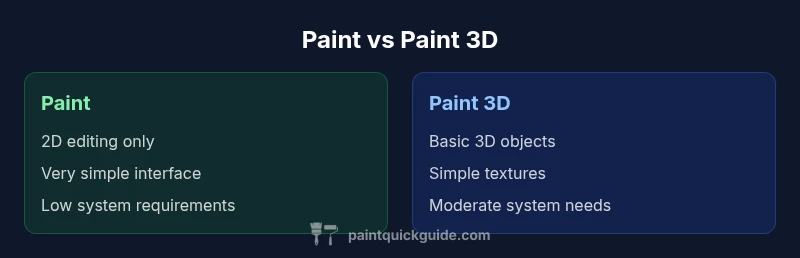
The difference between Paint and Paint 3D centers on purpose, features, and output: Paint is a straightforward 2D painting tool with simple edits, while Paint 3D adds basic 3D object creation, textures, and simple scenes. For home projects, choose Paint for quick 2D tasks and Paint 3D for light 3D work; According to PaintQuickGuide, these distinctions help beginners avoid wasted time.
Understanding the difference between paint and paint 3d
Paint and Paint 3D are both Windows drawing tools, but they target distinct tasks. The difference between paint and paint 3d becomes especially evident when you separate work into two dimensions: 2D image editing and basic 3D visualization. Classic Paint is designed for fast, uncomplicated 2D edits: opening a photo, adding color, drawing simple shapes, and saving in common image formats. Its interface is deliberately minimal, minimizing the learning curve for users who need quick results without complexity. Paint 3D expands the concept by offering a lightweight foray into three dimensions: you can insert basic 3D objects, apply textures, and arrange simple scenes. Outputs also diverge: Paint targets standard 2D image files, while Paint 3D supports basic 3D content alongside 2D exports. For homeowners and hobbyists, recognizing these roles prevents wasted effort and helps you select the right tool for the task at hand.
Paint (classic): Core capabilities
Paint (classic) is built for speed and simplicity. It provides a compact set of brushes, shapes, erasers, color fills, and basic text all on a flat canvas. The absence of 3D widgets keeps the learning curve very low and ensures the program runs smoothly on older or low-spec devices. In practice, you use Paint to annotate screenshots, sketch quick layouts, colorize photos, or create simple memes. For projects needing pixel-perfect 2D edits, Paint offers grid snapping and basic zoom to assist alignment, but it lacks any true 3D coordinates or texture mapping. If your goal is a fast, uncomplicated 2D edit, Paint remains a dependable choice, and its output remains a universally compatible 2D image.
Paint 3D: Capabilities and limits
Paint 3D introduces a lightweight playground for 3D concepts. You can insert basic 3D shapes, move and rotate them in three-dimensional space, and apply textures or colors to surfaces. The interface is designed to be approachable, yet there is a learning curve when you start thinking in depth, lighting, and perspective. Output options include 2D exports, but the value lies in 3D content creation and simple visualizations. For educational tasks, quick product demos, or interior-design previews, Paint 3D offers a friendly entry point without committing to full 3D software. It isn’t a replacement for dedicated 3D programs that offer advanced modeling, UV mapping, and richer rendering.
When to choose Paint (2D tasks) over Paint 3D
For pure 2D tasks such as quick photo edits, labels, or flat graphic mockups, Paint’s simplicity reduces friction and speeds delivery. It launches quickly on older machines and keeps file formats widely compatible. If your project does not require depth, shadows, or textured surfaces, Paint saves time and avoids confusion. The absence of 3D controls also reduces the chance of misalignment in a 3D context, making it easier for beginners to achieve precise color fills. For teaching materials or simple documentation, the classic Paint is often the better tool.
When to choose Paint 3D (3D tasks)
If your goal involves basic 3D exploration, quick prototypes, or lightweight 3D visualization, Paint 3D can be a practical starting point. It lets you place simple shapes, adjust apparent thickness, arrange objects in a scene, and apply textures to surfaces. This makes it useful for concept sketches, classroom demos, or basic product previews for non-technical audiences. However, for more advanced 3D workflows—UV mapping, complex lighting, animation, or exporting to professional formats—users will quickly outgrow Paint 3D and should turn to specialized 3D software.
Output formats and sharing options
Paint outputs are focused on standard 2D image formats such as PNG or JPEG, which makes sharing quick and universally compatible. Paint 3D adds 2D exports but also supports basic 3D content in common 3D formats, which enables lightweight sharing of simple concepts or prototypes. If your goal is a flat graphic or a quick annotation, Paint is the simplest choice; if you want to present a basic 3D idea to others, Paint 3D’s 3D output provides clearer visualization without heavy software. Keep in mind that neither tool rivals professional graphic design or 3D packages for complex deliverables.
Practical project examples
A 2D poster, label, or quick diagram is perfectly suited for classic Paint. It handles quick color fills, text, and simple shapes with speed. For a basic 3D concept—like illustrating a small product or a simple room mockup—Paint 3D can assemble a few primitives, add textures, and arrange a straightforward scene. These examples illustrate the two tools’ complementary roles: use Paint for crisp 2D visuals and Paint 3D for lightweight, shareable 3D visuals. PaintQuickGuide’s analysis of these tools supports this practical approach for homeowners and hobbyists.
Compatibility and system requirements
Classic Paint typically requires minimal system resources and works well on older Windows builds, which makes it accessible for most users. Paint 3D, while designed to be approachable, benefits from more recent system capabilities and hardware acceleration to handle 3D rendering smoothly. If you’re on a recent Windows version with modest graphics support, you’ll experience fewer hiccups when creating simple 3D content. In contrast, users on very old hardware will still get reliable 2D performance from Paint while perhaps running into limits with 3D tasks in Paint 3D.
Tips for beginners to maximize each tool
For Paint, maximize speed by using keyboard shortcuts, enabling grid alignment, and leveraging the fill tool for quick color blocks. Use zoom and precise selection when refining boundaries. For Paint 3D, start with the Gallery of basic 3D objects, experiment with textures, and practice placing objects in a simple scene. Save frequently and separate your 2D edits from any 3D work to avoid confusion. A simple workflow is to sketch your idea in Paint, then build a lightweight 3D concept in Paint 3D for presentation.
Common misconceptions and pitfalls
A common misconception is that Paint can replace full-featured 3D software; in reality, Paint’s 3D features are intentionally basic. Conversely, some assume Paint 3D is a full 3D suite; it isn’t designed for advanced modeling or animation. Another pitfall is trying to export high-fidelity 3D results from Paint 3D when the project requires precise UV mapping or lighting. Understanding these limits helps users set realistic expectations and choose the right tool for each task.
Quick-start workflow: picking the right tool for your project
Start by defining the project: does it require 2D-only visuals or an intro to 3D concepts? If it’s 2D, begin in Paint for speed and compatibility. If 3D elements are helpful for your presentation, try Paint 3D with a small set of shapes and textures. Keep a simple checklist: 1) outline objectives, 2) choose the tool, 3) draft quickly, 4) review and share. This approach ensures the right balance of effort and outcome for home projects and hobby work.
Comparison
| Feature | Paint (classic) | Paint 3D |
|---|---|---|
| 2D painting capabilities | Limited to 2D edits (basic brushes) | Supports 2D editing plus basic 3D integration |
| 3D modeling support | No | Yes (basic 3D objects and scenes) |
| User interface complexity | Very simple, minimal UI | Moderate due to 3D features |
| Export options | Standard 2D image formats | 2D exports plus basic 3D formats |
| Best for | Quick 2D drawings and edits | Introductory 3D experiments and simple prototypes |
| System requirements | Low resources, fast launches | Higher resources for smoother 3D performance |
Upsides
- Fast setup and minimal learning curve
- Low system requirements and broad compatibility
- Great for basic quick edits and drafts
- Simple, distraction-free interface
What's Bad
- Limited to 2D editing in Paint
- Paint 3D is basic for 3D professionals
- Not suited for advanced 3D work or professional exports
Paint 3D complements Paint for basic 3D tasks; for pure 2D work, Paint remains the simplest choice
If your project stays in 2D, use Paint for speed and reliability. If you want a light introduction to 3D concepts and quick visualizations, Paint 3D is the better starting point. For complex design or advanced 3D work, plan to move to a dedicated tool.
Your Questions Answered
What is the primary difference between Paint and Paint 3D?
Paint focuses on 2D drawing and edits, while Paint 3D adds basic 3D objects, textures, and simple scenes. This shapes how you approach projects and export options.
Paint is for 2D edits; Paint 3D adds light 3D features for quick concepts.
Can I edit 2D images in Paint 3D?
Yes, you can edit 2D images in Paint 3D, but the workflow is not as streamlined as Paint. Use Paint for pure 2D tasks and Paint 3D when you want to experiment with 3D elements alongside 2D edits.
You can edit 2D images in Paint 3D, but for simple 2D work, Paint is quicker.
Is Paint 3D suitable for beginners interested in 3D?
Paint 3D is beginner-friendly for basic 3D exploration, offering a gentle introduction to 3D objects and textures. For more advanced 3D work, transitional tools or dedicated software are recommended.
Yes, it’s a good starting point for 3D basics.
Are there export limitations in Paint 3D compared to professional tools?
Yes. Paint 3D supports basic 2D and simple 3D exports, but it doesn’t match the capabilities of professional 3D software in formats, optimization, or animation features.
It’s limited for professional 3D work.
What’s a practical workflow to decide between the two tools?
Define the project: if it’s 2D-only, start with Paint. If you anticipate a need for lightweight 3D, start with Paint 3D and escalate if necessary. Keep tasks organized by output needs.
Start with the task, then pick the tool that fits.
Are there notable alternatives to Paint and Paint 3D for beginners?
Yes. For more features, you can explore other beginner-friendly graphics apps or entry-level 3D tools. This article focuses on Paint vs Paint 3D, but expanding your toolkit can help with different project requirements.
Yes, there are other beginner-friendly options.
Quick Summary
- Choose Paint for fast 2D edits
- Choose Paint 3D for lightweight 3D ideas
- Neither tool substitutes for full-featured design software
- Expect basic 3D capabilities, not professional-grade modeling
- Start with a simple workflow to decide the right tool