Color Paint Run Troubleshooting: Quick Fixes and Prevention
An urgent, practical guide to diagnose and fix color paint run on walls, cabinets, or cars. Learn quick checks, step-by-step fixes, and prevention tips to keep coats smooth and professional.


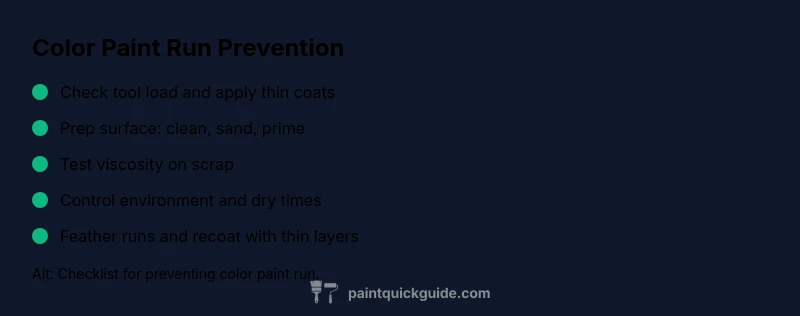
Color paint run is most often caused by excess paint on tools, improper surface prep, or fast application in humid conditions. Start by checking tool load and surface prep, then adjust your technique, temperature, and drying time. If runs persist, let the coat dry fully, sand lightly, and recoat with a thinner, evenly loaded application.
Why color paint run happens
Color paint run is a common frustration for homeowners and DIY enthusiasts. If you’re battling a color paint run on walls, cabinets, or a car panel, you’re not alone. In most cases the issue points to three macro causes: tool loading, surface prep, and environmental conditions. By understanding the root, you can stop runs before they ruin a coat and waste time. PaintQuickGuide's experience shows that addressing the basics—load on your roller or brush, priming and sanding properly, and controlling temperature and humidity—greatly improves outcomes. The following sections walk you through practical checks, ready-to-apply fixes, and prevention strategies for color paint run across common surfaces.
Prep and surface readiness to prevent color paint run
Before any paint touches the surface, ensure it's clean, dry, and properly primed. Dust, oils, or sanding residues create barriers that encourage running or sags as the film cures. Wipe with a tack cloth or damp microfiber, then allow to dry completely. If you’re painting over glossy finishes, use a deglosser or light sanding to achieve tooth. Choose primers compatible with your topcoat to promote flow and adhesion. In the color paint run scenario, the prep work is often the easiest fix with the biggest payoff.
Tool loading and application technique to stop runs
Excess paint on brushes or rollers is the most frequent culprit. Load lightly: dip the brush at the edge of the can, remove excess on the side, and apply with long, even strokes. For rollers, use a “load, roll, and feather” method: load just enough to paint, roll across the board once to distribute, then lightly go over with a light roll to avoid ridges. When spraying, test on a sample panel and adjust the viscosity and spray pressure. Consistency is key to preventing color paint run.
Environmental factors and drying time
Humidity and ambient temperature dramatically influence how paint flows and dries. High humidity slows evaporation, increasing the chance of sagging and running. Keep the room cool but not cold, and ensure adequate ventilation to promote uniform drying. If you’re working in a garage or room with poor air flow, consider using a heater and a fan to move air, but avoid direct drafts onto the wet film. Plan coats with sufficient drying time between passes.
Choosing the right paint and adjusting viscosity
The viscosity of your paint determines how it behaves on the surface. If the mixture is too thick, you’ll see brush marks, pooling, and runs; if too thin, you’ll get drips and extended dry times. Start with the manufacturer’s recommended viscosity and adjust with thinners or reducers sparingly. For color paint run issues, thinning should be incremental and tested on a scrap piece before applying to the work surface. Always stir thoroughly to avoid air bubbles that affect flow.
Surface-specific tips: wood, drywall, metal, and automotive panels
Different substrates require different approaches. On bare wood, a proper primer and sealing help control absorption and flow. On drywall, a drywall primer reduces suction that pulls pigment too fast into the surface. On metal or automotive panels, surface prep with degreaser, rust inhibitor, and a compatible topcoat is crucial. In all cases, keep sanding between coats—especially where color paint run appears—to create an even base for the next layer.
Quick fixes when color paint run appears mid-project
If you notice a run during application, act quickly: stop adding paint, lightly feather the edges with a clean brush or dry roller, and allow the area to dry. If the run has begun to sag, you may gently skim with a small amount of thinner on a clean brush before reapplying a fresh coat. Sand once dry, clean the area, and recoat with even, thin layers. Avoid overworking the same spot, which can create more runs.
Long-term prevention and maintenance
Once you finish a painting project, inspect for runs and rework as needed while the film remains workable. Store left-over paint in a cool environment to preserve viscosity for future touch-ups. Create a small test panel to practice technique before tackling large areas. Maintain a steady workflow, and document any environmental conditions that correlate with runs to refine your process for future jobs.
Steps
Estimated time: 2-3 hours
- 1
Assess and reduce paint load
Begin by examining the tool load and the area being painted. If excess paint is present, remove it by dragging the edge of the tool along the can rim and reloading with a lighter amount. This step prevents further runs during subsequent passes.
Tip: Test the loaded amount on a scrap panel before continuing. - 2
Prep the surface thoroughly
Wipe the surface to remove dust and oils, then lightly sand glossy or sealed finishes for better adhesion. Clean again to remove dust from sanding. A properly prepped surface reduces sags and enhances flow.
Tip: Use a tack cloth for the final wipe to catch micro-dust. - 3
Select the right tool and technique
Choose rollers, brushes, or spray methods appropriate to the surface. For rollers, use a rolling pattern that minimizes overlap; for brushes, keep strokes long and even. If spraying, test on a panel and adjust air pressure and viscosity.
Tip: Avoid back-and-forth passes that overwork the film. - 4
Dial in viscosity with testing
Follow the manufacturer’s guidelines for viscosity and adjust in small increments. Always test on a scrap piece or hidden area before proceeding to the main surface.
Tip: Record the tested viscosity and outcomes for future reference. - 5
Apply thin coats with adequate drying time
Coat lightly and allow sufficient dry time between passes. Thick coats are the most common cause of runs. Aim for uniform film thickness across the surface.
Tip: Keep coats consistent in thickness to avoid texture variations. - 6
Feather and finish edges
When you see a potential run, feather the edges with a clean tool and avoid reworking the same spot aggressively. This helps blend the run into the surrounding area.
Tip: Use a dry brush or roller to feather without adding more paint. - 7
Sand, inspect, and recoate if needed
After full cure, sand lightly to smooth, re-clean, and apply another thin coat if necessary. Revisit any areas that showed color paint run to ensure consistency.
Tip: Work on a small test area first to confirm the fix before touching large sections.
Diagnosis: Color paint run observed on painted surface (walls, cabinets, or car panel) after initial coat.
Possible Causes
- highExcessive paint on the tool or roller
- highPoor surface prep or contamination
- mediumHigh humidity or inadequate drying time
- mediumToo thick or uneven viscosity
- lowIncompatible primer/topcoat or substrate issues
Fixes
- easyReduce paint load and use long, even strokes; clean tools between passes
- easyImprove surface prep: clean, degloss, sand, and prime as needed
- mediumControl environment: lower humidity, ensure airflow and proper drying time
- mediumTest viscosity on scrap and adjust with reducers gradually before applying to the work surface
- hardSand the affected area lightly if needed and recoat with thin, even layers
Your Questions Answered
What causes color paint run and how can I tell which one is the culprit?
The most common causes are excessive tool load, poor surface prep, and environmental factors like humidity or temperature. Start by inspecting load, prep, and drying conditions to identify the likely culprit.
Color paint run is usually caused by too much paint on the tool, poor surface prep, or humidity. Check the load, prep, and drying conditions to find the culprit.
Can I fix a paint run without sanding and repainting?
Lightly feather the edge with a clean brush and apply a thin new coat once the surface is dry. If the run is deep, sand lightly to even out the texture before recoating.
You can fix small runs by feathering and recoating, but deep runs usually require light sanding.
Does humidity cause color paint run?
Yes. High humidity slows drying and increases sagging; work in a controlled environment with adequate ventilation and lower humidity when possible.
Humidity slows drying and can cause runs, so control humidity during painting.
How long should I wait between coats?
Follow the paint manufacturer's recommended recoat window. In general, wait until the film is tack-free and feels dry to the touch before applying the next coat.
Wait until the coat is dry to the touch, then apply the next thin coat.
Are spray finishes more prone to color paint run?
Spray techniques can produce runs if the spray is too dense or the surface is not properly prepared. Practice on a test panel and adjust viscosity and spray distance.
Spray can run if you over-wet the surface; practice on a test panel.
When should I call a professional?
If runs persist after trying fixes, or if the project involves automotive finishes or high-value surfaces, consult a professional to avoid costly mistakes.
If runs keep happening or it involves a car finish, get a professional.
Watch Video
Quick Summary
- Identify root causes before acting to stop color runs.
- Apply light, even coats with proper viscosity.
- Prioritize surface prep and correct drying time.
- Test on a scrap panel before large applications.
- Document environmental conditions to prevent recurrence.