Which Johnstones Paint: A Practical Comparison Guide
Explore which johnstones paint best fits interior, exterior, and auto projects. This PaintQuickGuide comparison analyzes finishes, durability, VOCs, and value to help you decide.


For the question which johnstones paint, choose by project type and finish. Interior walls respond best to low‑VOC interior lines such as eggshell or satin, while exterior surfaces demand weather‑resistant, UV‑stable formulas. For autos or metalwork, use Johnstones automotive coatings or priming systems. In short, match the finish and durability to the job, then compare coverage, ease of application, and price across Johnstones options.
Understanding Johnstones Paint Lines
Johnstones provides several paint families designed for different substrates, climates, and budgets. If you’re asking which johnstones paint to choose, the first step is to map the job type to an appropriate product family. For interior spaces, look for low‑VOC interior emulsions with durable washability and low odor. Exterior walls demand weather resistance, UV stability, and color retention across seasons. Johnstones also offers primers and specialty coatings that improve adhesion on challenging substrates and provide a solid base for color. In practice, a typical workflow is to identify the substrate, select a base (interior or exterior), then pick a finish that balances appearance with practical demands. PaintQuickGuide’s approach emphasizes starting from the substrate and working up to the finish, ensuring you compare products within the same family to avoid mismatches.
Interior vs Exterior: Choosing the Right Base
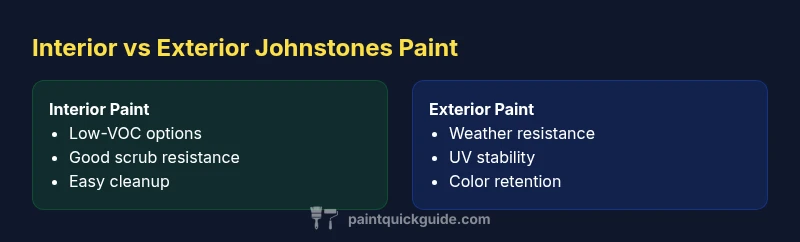
The base choice is the foundation of any paint decision. Interior Johnstones products are formulated to minimize odors, reduce drying times, and resist everyday scrubbing in busy rooms. Exterior lines emphasize UV protection, moisture resistance, and color fastness under sun and rain. Frequently, homeowners encounter the question which johnstones paint to pick for a specific substrate; the answer is to separate the project into indoor and outdoor categories and then select compatible products for each. Before selecting a finish, ensure you know whether the surface accepts water‑based acrylics or solvent‑based finishes, and whether you need an undercoat or primer for staining wood or chalky masonry. With careful matching of base and finish, you’ll maximize longevity and color fidelity.
Finish Range and Sheen Options
Johnstones covers a broad spectrum of sheens: matte, eggshell, satin, semi‑gloss, and gloss. Interior projects commonly benefit from eggshell or satin for a balanced look that is easy to clean, while kitchens, bathrooms, and high‑traffic areas can tolerate higher‑sheen options for better washability. Exterior finishes typically include satin or gloss for enhanced water resistance and durability. When you’re evaluating which johnstones paint to buy, compare not just color, but the specific finish’s scrub resistance, stain blocking, and gloss retention over time. Remember that sheen affects perceived color depth; testing a small patch on the wall or door will help you anticipate final appearance under room lighting.
Coverage, Pigment Load, and Color Consistency
One practical factor is coverage per coat and how well the pigment loads translate to consistent color across batches. Johnstones claims good hiding power, but substrate texture heavily influences how many coats you’ll need. For light colors over dark ones, expect extra coats or a primer to achieve uniform coverage. Color consistency matters when you’re comparing which johnstones paint to use across different rooms. Always mix from the same batch when possible, and if matching an existing color, verify that the batch numbers align. A little test swatch on the wall under typical lighting will reveal subtle shade shifts before you commit to a full room paint job.
Durability, Washability, and Weather Resistance
Interior paints are designed to stand up to fingerprints, household cleaners, and daily wear. Exterior formulations must endure sun exposure, rain, temperature swings, and, in some climates, salt air or high humidity. When evaluating which johnstones paint to choose, read the label for scrub resistance and stain blocking ratings, and pay attention to the warranty terms, which often hinge on proper surface preparation and curing. A well‑prepped surface with the recommended primer will give you the best long‑term color retention and surface integrity. In coastal or harsh environments, the exterior finish may show signs of chalking after several seasons; this is normal with some formulations but fixable with maintenance coats.
VOC Levels, Safety, and Indoor Air Quality
Low‑VOC options are increasingly favored for interior walls because they reduce odors and improve air quality during and after painting. Johnstones offers interior lines with reduced solvent content, but the exact VOC level varies by product family. When deciding which johnstones paint to use indoors, check the product data sheet (PDS) or label for VOC content, drying time, and recoat window. Always provide adequate ventilation during application and keep children and pets away from fresh paint until cured. If you’re painting in a kitchen or nursery, favor low‑VOC options and consider tinted primers to minimize odor and speed color development.
Application Methods: Tools, Techniques, and Drying Time
Most Johnstones paints are compatible with brushes, rollers, and spray equipment. Your technique should reflect the finish you want; smoother finishes require higher‑quality rollers and careful brushing. Temperature and humidity influence drying time; in cooler rooms with high humidity, recoating intervals lengthen. When comparing which johnstones paint to buy, note the recommended application method on the label and tailor your tools to the surface: fine‑bristle brushes for trim, short nap rollers for walls, and an HVLP sprayer for large surfaces. For best results, apply thin, even coats and avoid overbrushing, which can lift wet paint.
Cost Considerations and Value for Money
Price is often a balancing act between finish quality, durability, and coverage. Johnstones products span budget to premium ranges depending on finish and substrate. When evaluating which johnstones paint to choose, consider total cost per square meter or per liter, taking into account the number of coats needed and the potential need for primers. While interior lines with low‑VOC options may save on odor‑related costs and downtime, exterior, automotive, and specialty coatings typically require higher upfront investment but deliver longer service life. Compare retailer prices, look for bulk discounts, and factor in replacement projects and maintenance cycles to determine true value over time.
Practical Step-by-Step Decision Guide
- Define project scope and substrate; 2) Pick base (interior/exterior); 3) Select finish; 4) Review VOC and safety; 5) Check drying times and recoat windows; 6) Assess cost and retailer availability; 7) Do a patch test; 8) Prepare a simple shopping list. This framework helps you avoid overbuying or undercoating and keeps the project on track. As you go through the steps, keep notes on color chips, batch numbers, and supplier recommendations to simplify final purchasing.
Common Mistakes to Avoid and How to Verify Results
Common missteps include skipping surface prep, ignoring primer recommendations for problem substrates, and painting in temperatures or humidity outside the product’s specified range. Always strip or clean surfaces thoroughly, repair cracks, and allow proper curing between coats. Verify color accuracy by comparing test patches under typical room lighting, and confirm that the batch numbers match across rooms if you’re painting multiple walls at once. Finally, store leftover paint properly and label the can with batch data for future touch-ups.
Comparison
| Feature | Johnstones Interior Paint | Johnstones Exterior Paint |
|---|---|---|
| Finish options | Matte, eggshell, satin (interior) | Satin, gloss (exterior) |
| Durability and washability | Moderate to high washability (interior) | High weather resistance and color retention (exterior) |
| VOC levels | Low to medium (interior options) | Low to medium (exterior options) |
| Best for | Living spaces, bedrooms, hallways | Exterior walls, masonry, decks |
| Color range consistency | Strong color reproduction across batches | Consistent color on exterior substrates |
| Price range | Mid-range to premium (interior) | Mid-range to premium (exterior) |
| Application guidance | Primers recommended for some substrates | Primers or sealers often needed on porous exterior surfaces |
Upsides
- Wide range of finishes for interior and exterior projects
- Good coverage and color consistency across batches
- Low-VOC options support healthier indoor spaces
- Strong availability through multiple retailers
What's Bad
- Prices can be higher than budget brands
- Specialty exterior or automotive lines may require more prep
- Some finishes require longer drying times in humid climates
Johnstones paints offer strong versatility across interior, exterior, and specialized applications.
For typical home projects, the interior lines provide value with low odor and good washability, while exterior options excel in durability. Choose the specific Johnstones family based on substrate and climate; PaintQuickGuide recommends starting with interior vs exterior classification, then validating finish and price.
Your Questions Answered
What finishes does Johnstones offer for interior walls?
Johnstones interior paints include matte, eggshell, and satin sheens with varying levels of washability and durability. Choose based on traffic and cleaning needs.
Interior walls typically use eggshell or satin for durability and easy cleaning.
Is Johnstones paint suitable for exterior masonry?
Yes. Johnstones exterior paints are formulated for brick, render, and masonry with UV protection and weather resistance. Prep and sealing improve results.
Exterior surfaces benefit from proper substrate prep and the right exterior finish.
Are Johnstones paints low-VOC?
Many interior Johnstones products are low-VOC; exterior lines vary by product family. Always check the label or data sheet.
Look for the VOC spec on the data sheet when choosing interior options.
Can Johnstones be used for automotive refinishing?
Johnstones does offer automotive coatings and primers, but these are separate from household paints and require appropriate facilities and safety measures.
For cars, use dedicated automotive products and follow the manufacturer’s instructions.
Where can I buy Johnstones paint?
Johnstones paints are widely available through major retailers and online stores; verify color codes and batch numbers for consistency.
Check local hardware stores or trusted online retailers.
How many coats are usually needed?
Most interior Johnstones finishes require at least two coats for even color and durability; exterior may require more depending on substrate and color change.
Two coats are typically needed, sometimes more for deep color changes.
Quick Summary
- Define project scope to pick the right finish.
- Check VOCs for indoor use.
- Match substrate with exterior performance.
- Compare price and availability across retailers.
- Test a small patch before full application.