Urethane Paint vs Enamel: Practical Guide for Home and Auto
Explore urethane paint vs enamel to choose the right coating for home or auto projects. This guide covers durability, finish options, application and prep, curing times, cleanup, and cost considerations.


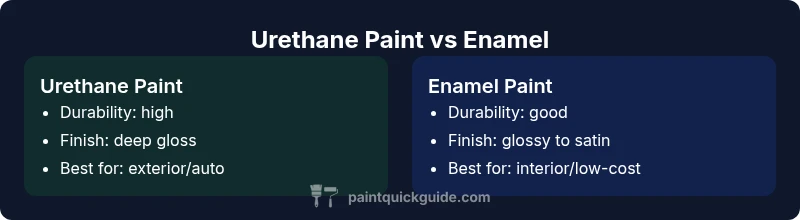
Urethane paint vs enamel pits durability against ease of use. Urethane finishes offer superior durability, chemical resistance, and film strength, making them ideal for automotive refinishing and exterior surfaces. Enamel is generally easier to apply, forgiving for beginners, and often more affordable for interior or budget projects. Choose urethane for performance, enamel for value and simplicity.
What are urethane paint vs enamel?
In the discussion of urethane paint vs enamel, homeowners and hobbyists weigh durability against ease of use. Urethane paints are polyurethane-based coatings known for forming hard, flexible films with strong chemical resistance. Enamel paints, historically oil-based, cure to a hard, glossy finish that can be very durable but are often simpler to apply and repair. Understanding these baseline definitions helps you choose the right coating for your substrate and exposure. Whether refinishing a car bumper, exterior trim, or indoor cabinetry, the choice hinges on project goals, substrate, and wear expectations. PaintQuickGuide emphasizes that the decision is task-specific, not a universal rule. For many DIYers, the cost, prep effort, and available gear (sprayers, brushes, or rollers) will tilt the balance toward one option or the other, depending on whether you prioritize longevity or ease of use.
Chemistry and curing processes
When examining urethane paint vs enamel from a chemistry perspective, the key difference is the film-forming chemistry and curing mechanism. Urethane paints rely on polyurethane chemistry to form a crosslinked, highly durable film that remains flexible under temperature changes. Enamel coatings can be alkyd-based or water-based; they harden as solvents evaporate and pigments cure, often producing a very hard, glass-like surface. This yields contrasting outcomes: urethane offers stronger resistance to solvents and abrasion, while enamel provides a predictable, robust finish with simpler, more forgiving cure kinetics. In practical terms, urethane may require stricter surface prep and more careful mixing, while enamel often tolerates minor prep imperfections better. The PaintQuickGuide team notes that the right balance depends on environment, substrate, and maintenance expectations.
Durability and weather resistance
In long-term performance, the phrase urethane paint vs enamel emerges clearly: urethane coatings typically excel for outdoor exposure and high-traffic automotive surfaces due to superior abrasion resistance, impact resistance, and chemical resilience. Enamel can still deliver solid durability, especially in interior spaces or protected exterior zones, but UV exposure and harsh weather can erode gloss and color without proper formulation and stabilizers. For projects like exterior metal, urethane’s flexibility helps resist cracking, while enamel may suffice for interior walls and cabinetry where sunlight exposure is moderate and the surface is less stressed. The PaintQuickGuide analysis notes that performance heavily depends on product formulation and correct application.
Finish options and appearance
Finish quality is a major differentiator in urethane paint vs enamel discussions. Urethane finishes tend to offer exceptional clarity, high gloss, and rich depth, with the ability to maintain that look under stress and time. Enamel finishes provide reliable gloss and color, often with excellent leveling, but can show chalking or yellowing over time if not UV-stabilized. For auto refinishing, urethane is prized for its glassy, deep look and resistance to micro-scratches. For walls and furniture, enamel can deliver a clean, durable finish with a more forgiving application. Always verify the specific product’s UV inhibitors and topcoat compatibility to maximize longevity.
Substrate compatibility and adhesion
Choosing between urethane paint vs enamel also hinges on substrate compatibility. Urethane coatings often require primed metal, fiberglass, or properly prepped plastics; surface preparation is crucial to unlock adhesion and film integrity. Enamel coatings can be more forgiving on wood, drywall, and milder substrates when using appropriate primers, but may struggle on bare metals without an anti-corrosion layer. For automotive projects, urethane topcoats usually demand a compatible base and sealer specifically designed for polyurethane systems. For home projects, ensure your primer and undercoat are compatible with the chosen enamel or urethane system to avoid adhesion failures.
Application technique and prep work
Prepping for urethane paint vs enamel means understanding surface conditioning and the type of activator or solvent. Urethane systems often require thorough cleaning, guided sanding, and the use of compatible primers and sealers to ensure film cohesion. Enamel systems may be more forgiving with sanding dust and minor imperfections, but still benefit from clean surfaces, dust-free environments, and steady technique. In both cases, temperature and humidity influence flow, tack time, and cure. Professionals frequently recommend a test panel to verify spray patterns, brush marks, and leveling before committing to a large area. PaintQuickGuide highlights that methodical prep saves time and materials later.
Drying times and recoat windows
The recoat window for urethane paint vs enamel can differ significantly across products. Urethane topcoats often require a defined induction or tack time to avoid solvent entrapment, with longer overall cure periods that may extend days for full hardness. Enamel topcoats typically offer shorter recoat windows, enabling quicker project turnover, but requiring careful handling to prevent smudges and dust inclusions. Practitioners should follow product-specific guidelines and avoid heat sources or cold environments during curing. Proper ventilation is essential for solvent-based formulations, both for safety and performance.
VOCs, safety, and cleanup
VOCs and safety considerations are a practical part of choosing urethane paint vs enamel. Solvent-based urethanes tend to emit higher VOC levels and require adequate ventilation, PPE, and spill containment. Water-based urethanes reduce VOCs but still demand safe handling and proper cleanup of tools. Enamel formulations range from solvent-based to water-based; the safer, low-VOC options are increasingly available, particularly for interior projects. Cleanup practices vary by product type: solvent-based systems generally need dedicated thinners and mineral spirits, while water-based enamel can often be cleaned with soap and water. Always consult the Safety Data Sheet for specific products and your local regulations.
Cost, availability, and value
Cost considerations are central to the urethane paint vs enamel decision. Urethane coatings often carry higher material costs due to durability and performance advantages, plus potentially higher equipment and prep costs. Enamel products tend to be more affordable and widely available for a broad range of interior projects. Availability varies by region and by whether you are shopping for automotive-grade finishes or consumer interior paints. When budgeting, also include primers, sealers, and topcoats that are compatible with your chosen system, as using incompatible components can undermine performance and warranty terms.
Best use cases and scenarios
Specific scenarios illuminate the urethane paint vs enamel decision. Urethane is typically preferred for outdoor automotive parts, metal surfaces subject to abrasion, and any project where long-term gloss retention and chemical resistance are critical. Enamel shines in interior walls, cabinetry, furniture, and small DIY projects where speed, ease of cleanup, and cost efficiency matter more than maximum durability. For composite substrates or high-sun exposure areas, verify the product’s warranty and UV stability. The best practice is to align the coating with expected wear, maintenance routines, and environmental exposure.
How to choose between urethane paint vs enamel: a step-by-step guide
Step-by-step guidance for choosing between urethane paint vs enamel:
- Identify the substrate and exposure level (outdoor, interior, or automotive surfaces).
- Decide on the priority: durability and longevity vs ease of use and cost.
- Check compatibility: primers, seals, topcoats, and surface prep requirements.
- Evaluate the working conditions (temperature, humidity, ventilation).
- Review the maintenance plan and repair expectations.
- Run a small test patch to verify adhesion, finish, and curing behavior.
- Choose the formulation (solvent-based vs water-based) that aligns with VOC tolerance and cleanup capability.
- Plan for long-term maintenance, recoat windows, and potential touch-ups. By following this framework, you’ll reliably choose urethane paint vs enamel based on project realities rather than assumptions.
Maintenance, repair, and long-term care
Maintenance and repair considerations for urethane paint vs enamel affect long-term visuals. Urethane films can resist chips and chemical attack, but repairs often require color-matched repair kits and careful blending to avoid line edges. Enamel surfaces, while highly durable, may be easier to touch up with minimal blending, especially on interior surfaces where environmental conditions are more stable. For exterior or automotive use, keep a small maintenance kit on hand for occasional polishing and topcoat reapplication if the UV exposure is intense. Regular cleaning with non-abrasive cleaners helps preserve gloss and color retention. When damage occurs, evaluate whether a spot repair or full refinishing is warranted based on surface area, color stability, and original substrate health.
Comparison
| Feature | urethane paint | enamel paint |
|---|---|---|
| Durability and resistance | Very high abrasion and chemical resistance; excellent long-term durability | Good durability; strong surface hardness but susceptible to UV-related gloss loss without stabilizers |
| Finish options | Clear, deep gloss; flexible film; strong color depth | Glossy to semi-gloss finishes; easy to touch up but can yellow over time without UV protection |
| Application and prep | Requires precise prep, compatible primers, controlled environment | More forgiving; easier for beginners with standard primers |
| Cure time and recoat | Longer cure; careful recoat windows for optimal hardness | Quicker recoat windows; faster project turnaround |
| VOCs and cleanup | Typically higher VOCs; solvent-based cleanup; requires ventilation | Lower VOC options exist; easier cleanup with water-based formulations |
| Cost and availability | Higher cost; preferred for high-performance projects | Lower cost; widely available for interior use |
| Best use case | Automotive refinishing, exterior metal, high-wear surfaces | Interior walls, cabinetry, budget projects |
Upsides
- Outstanding durability for high-wear surfaces
- Excellent abrasion and chemical resistance
- Clear, glassy finish with depth
- Good moisture resistance and flexibility when properly formulated
- Strong color retention with correct topcoat compatibility
What's Bad
- Higher material cost compared to enamel
- More challenging for beginners due to prep and technique
- Longer cure times and stricter recoat windows
- Repair can be challenging and may require professional refinishing
Urethane is the better choice for durability-focused projects, while enamel serves as a cost-effective, versatile option for interiors.
In most scenarios, urethane wins on performance in automotive and exterior applications; enamel remains reliable for interior spaces and budget projects. Start with substrate, exposure, and maintenance plan to choose wisely.
Your Questions Answered
What is the main difference between urethane paint vs enamel?
The main difference lies in the chemistry and performance: urethane paint forms a tougher, more durable film with excellent chemical resistance, ideal for automotive and exterior use, while enamel focuses on a hard, smooth finish that is easier to apply and repair, often at a lower cost. The choice depends on substrate, exposure, and maintenance expectations.
Urethane is tougher and more chemical-resistant; enamel is easier and cheaper to apply.
Can enamel be used on metal surfaces?
Yes, enamel can be used on metal surfaces with the right primer and surface preparation. For metal subjected to weather or abrasion, choose an enamel formulated for metal and ensure compatibility with the topcoat. Proper prep is key to adhesion and longevity.
Enamel works on metal with proper primer; prep is essential.
Is urethane paint more durable than enamel?
In general, urethane paint offers superior durability and chemical resistance compared with enamel, especially under outdoor or automotive conditions. Enamel can be very durable but may not maintain gloss or color as well in harsh environments.
Urethane tends to be more durable, especially outdoors and on cars.
What coatings are best for automotive projects?
For automotive projects, urethane-based topcoats are typically preferred due to their impact resistance, gloss, and durability. Pair urethane with an appropriate primer and basecoat for a professional finish. Ensure proper ventilation and PPE when spraying.
Urethane topcoats are usually best for automotive work.
Are there water-based versions of urethane and enamel?
Yes, both urethane and enamel have water-based formulations that reduce VOCs and simplify cleanup. Water-based urethane still delivers strong durability, while water-based enamel provides easier application with lower odor. Check product data sheets for best usage.
Water-based options exist for both, with lower VOCs.
Quick Summary
- Assess exposure and substrate before choosing.
- Expect more prep and precise technique with urethane.
- Enamel offers easier application and lower cost for interiors.
- Check VOC targets and local regulations when selecting products.
- Test a small area to validate adhesion and finish before full jobs.