Difference Between Paint and Enamel: A Practical Guide
Explore the difference between paint and enamel, including base types, finishes, durability, and best uses for interior, exterior, and automotive projects. Practical guidance from PaintQuickGuide.


Paint and enamel refer to different coating formulations. Enamel is typically a hard, glossy finish that cures to a durable surface, often oil-based. Paint is a broad category that includes water-based and oil-based products with varied sheens and colors. For most interior projects, water-based enamel or latex paint offers a balance of durability, ease of cleaning, and lower odor. According to PaintQuickGuide, choosing the right option depends on base chemistry, surface, and usage.
What enamel really means and how it differs from paint
Enamel is best understood as a description of the cured surface quality: hard, smooth, and often highly washable. Historically, enamel coatings were oil-based and relied on a solvent-rich system that created a glossy, glassy film. In modern product labeling, you’ll see enamel finishes among both oil-based and water-based formulations. The key distinction for the homeowner is not just the name but the binder chemistry, curing mechanism, and intended environment. The PaintQuickGuide team emphasizes that the label can be misleading if you don’t examine the base chemistry and the surface you’re coating. When in doubt, read the product data sheet to confirm whether the enamel option is water-based or solvent-based and what substrates it’s designed to cover.
Practical framing for decision-making
When you shop, treat enamel as a finish category with emphasis on hardness and washability, rather than a single base. Paint, as a general category, spans latex (water-based) and oil-based alternatives, with various finishes from matte to high-gloss. The practical takeaway is that enamel often targets durability and stain resistance, while paint provides flexibility in color, texture, and odor control. For homeowners, PaintQuickGuide recommends pairing the chosen base with a suitable primer and following proper surface prep to achieve the best long-term results.
Base chemistry matters more than the word enamel
The binder (latex vs alkyd) determines how a coating behaves on surfaces, how it dries, and how it reacts to heat, moisture, and cleaning. Latex paints are lauded for low odor and easy cleanup, while alkyd or modern enamel formulations can deliver smoother finishes and tougher wear resistance. The distinction between enamel and paint becomes especially meaningful on kitchens, bathrooms, trim, and metal surfaces where washability is critical. PaintQuickGuide highlights that the same project can use either product family, depending on the finish and durability you expect.
Finish and gloss levels guide the choice
If you’re aiming for a high-gloss, glassy look with a hard surface, enamel finishes are often the natural choice. For more subtle, decorative, or color-rich interiors, paint—especially water-based latex with low VOCs—offers abundant color options and easier touch-ups. The finish you select should align with the room’s humidity, traffic, and cleaning frequency. For example, kitchens and bathrooms typically require finishes that resist water and staining, where enamel products may perform better over time.
Durability, washability, and long-term performance
Durability is not solely about gloss; it’s about how a coating stands up to abrasion, moisture, and cleaning. Enamel finishes are designed to endure repeated cleaning without degrading the surface shine. However, modern latex paints with proper priming can achieve comparable washability in many residential settings. The bottom line: if durability is your primary criterion and the surface sees heavy use, enamel-based formulations (or high-quality enamel-like latex paints) are a sensible choice. If you want quick touch-ups and easier odor control, choose a latex paint with good scrubbability.
Surface prep and priming: the invisible foundation
Regardless of whether you pick paint or enamel, prep is king. Surfaces must be clean, dry, and free of loose materials. Glossy surfaces usually need scuff sanding and a bonding primer to improve adhesion. Stain-blocking primers may be necessary over water stains or tannins, while metal surfaces benefit from rust-inhibiting primers. Primers not only improve adhesion but also help achieve a uniform sheen and color. The quality of prep often determines whether the final look will be smooth, durable, and easy to maintain.
Interior, exterior, and automotive contexts
Interior walls benefit from both paint and enamel options, but humidity and cleaning frequency influence the decision. Exterior coatings require weather resistance, UV stability, and long-term color retention; enamel-like products can offer rugged durability, but modern exterior paints have caught up in performance. For automotive projects, enamel is part of older finishing systems; today’s auto refinishing uses specialized coatings that may include enamel-like properties but with tailored hardeners, clear coats, and curing processes. If you’re working on a car, follow automotive-specific product guidance rather than a household enamel.
Practical workflow: from surface prep to final coat
A repeatable DIY workflow begins with deciding the base and finish, followed by surface preparation, priming, and a careful application sequence. Clean tools, proper ventilation, and temperature control improve results. Apply thin coats, allowing sufficient drying time between passes, and test repairs on a small inconspicuous area first. Finally, let the coating cure fully before subjecting it to moisture or heavy use. The right sequence is essential, regardless of whether you use paint or enamel.
Common mistakes and how to avoid them
Common errors include skipping primer on glossy surfaces, using the wrong base on metal, or applying coats that are too thick. Skipping surface prep leads to peeling, bubbling, and uneven color. Choosing the wrong sheen can result in a finish that shows wear too quickly. By consistency of prep, product choice, and technique, you’ll improve your odds of a professional-looking result when tackling home or auto projects.
Comparison
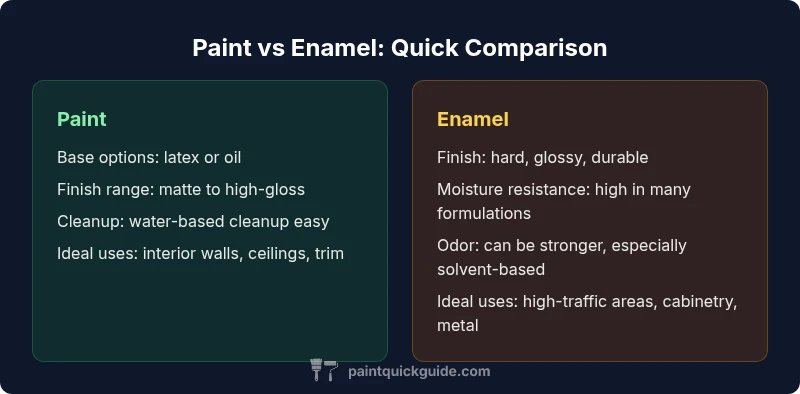
| Feature | Paint | Enamel |
|---|---|---|
| Base options | Water-based (latex) or oil-based paints | Oil-based alkyd enamel or water-based enamel variants |
| Finish range | Matte, satin, eggshell to high-gloss | Typically high-gloss or satin with a hard enamel-like feel |
| Durability and washability | Good durability with proper prep; varies by base | Excellent durability; superior washability in many enamel finishes |
| Drying and curing | Faster initial dry for latex; color may take longer to fully cure | Longer cure for oil-based enamels; more resilient once cured |
| VOC and odor | Lower odor with most latex paints | Potentially stronger odor with solvent-based enamel; modern enamels reduce odor |
| Surface prep needs | Primers for problematic surfaces; scuffing on glossy surfaces helps adhesion | Primers often recommended for metal and hard surfaces to ensure adhesion |
| Ideal uses | Interior walls, ceilings, trim with various textures | High-traffic areas, cabinetry, metal and wood where durability matters |
| Maintenance | Easier touch-ups with compatible paints | Harder to repair but very long-lasting when done right |
Upsides
- Wide color range and finish options
- Excellent versatility for many surfaces
- Easier cleanup and lower odor with water-based paints
- Typically lower upfront cost for general use
What's Bad
- Oil-based enamels emit stronger fumes and require solvents
- Longer drying/curing times for traditional enamels
- Can yellow over time if not designed for the application
- Some enamels require specific thinners and primers
Paint is typically the more versatile and DIY-friendly choice, while enamel provides superior hardness and washability for high-traffic areas.
For most home projects, start with a high-quality latex or acrylic paint for color variety and easy cleanup. Reserve enamel for kitchens, bathrooms, cabinetry, and metal surfaces where durability and stain resistance matter. The PaintQuickGuide team recommends evaluating surface, humidity, and occupancy before deciding.
Your Questions Answered
Is enamel always oil-based, or can it be water-based?
Enamel refers to the hard, glossy finish and can be oil-based (alkyd) or water-based. Modern enamel products often come as water-based options with lower odor and easier cleanup. The label should indicate the base and curing method.
Enamel can be oil-based or water-based; always check the label for the base before you buy.
Can I use enamel on wood furniture?
Yes, enamel can be used on wood furniture, particularly when you want a hard, washable surface. Prep the wood with sanding and a suitable primer to enhance adhesion and ensure a smooth finish.
Enamel works on wood with proper prep and primer.
Is latex paint the same as enamel?
Latex paint is a water-based paint that can be formulated with enamel-like durability. Some products labeled enamel are water-based and easy to clean, but not all latex paint is enamel. Always read the product label to confirm base and finish.
Latex paint can be enamel-like, but check the label to be sure.
Do primers always need to be used with these coatings?
Primers are generally recommended, especially on glossy surfaces, stained substrates, or metals. They improve adhesion, hide previous coatings, and can enhance final color and uniformity. Choose a primer that matches the base (water-based or oil-based) and the substrate.
Primers usually help both paints and enamels stick and look better.
Which lasts longer in bathrooms or kitchens?
Enamel finishes often outperform standard interior paints in moisture-prone spaces due to their hard, washable surface. However, high-quality water-based paints with proper primers and sealants can offer comparable durability in lower-humidity areas.
Enamel tends to withstand moisture better, but good paint can do well too.
Is enamel ever used in automotive painting today?
Modern automotive finishes rely on specialized coatings beyond household enamel. While enamel-like properties exist in some enamel systems, auto refinishing typically uses polyurethane or urethane-based paints with advanced clear coats for durability and UV protection.
Auto finishes use specialized coatings, not typical household enamel.
Quick Summary
- Define project surface and environment before choosing finish
- Enamel offers durability and washability; paint offers color variety and ease
- Base chemistry (latex vs alkyd) drives performance and workflow
- Primer and surface prep are essential for best results
- Follow product-specific guidelines for interior vs exterior use