Paint Match: How to Achieve a Perfect Color Match in Any Project
Learn practical, step-by-step strategies to achieve a precise paint match for home and auto projects, including lighting, swatches, mixing, and verification to ensure consistent color results.


Paint match means achieving a color that visually matches a reference chip or panel under your working lighting. To reliably reach a match, start with a high-quality swatch in the room where the project will live, then compare multiple lighting conditions, select a close base, and iteratively adjust with accent tints. This guide shows a practical, repeatable workflow.
What is paint match?
According to PaintQuickGuide, paint match is the careful recreation of a reference color using paint chips, base colors, and tinting systems so that the final finish appears the same under typical room lighting. It isn’t a single number on a chart; it’s a perceptual task that factors in lighting, sheen, substrate, and even the paint brand’s unique color science. A successful paint match minimizes visible differences in hue, saturation, and brightness when the project is viewed from normal angles. For homeowners and auto refinishing hobbyists, achieving a reliable paint match means a repeatable workflow, not lucky guesswork. By following a structured process, you’ll reduce the frustration of mismatched panels and the need for costly repainting. The goal is consistency—from the first test panel to the final coat—and that requires attention to detail in materials, process, and verification. In this guide, we’ll cover quick-start steps, common pitfalls, and best practices for durable, color-accurate results.
Why color accuracy matters in home and auto projects
Color accuracy affects perceived quality. A precise paint match helps maintain visual harmony between walls, trim, or car panels, preventing obvious mismatches that draw the eye. When you’re painting a car, a small deviation can be amplified by reflections on metal and clear coats; in a home, lighting changes through the day can shift how a color appears. PaintQuickGuide emphasizes that color matching is not a one-and-done task—it’s an iterative process that benefits from careful observation and documentation. The more you document baseline swatches, lighting conditions, and final mixes, the easier it becomes to reproduce the match when you revisit the project later. Consistent lighting creates a stable reference frame, which is crucial for a dependable paint match across rooms or panels.
The role of lighting in paint match accuracy
Lighting has a substantial impact on how color is perceived. Daylight presents a cool, broad spectrum; incandescent lights skew warmer; LEDs vary by temperature and CRI. Metamerism—colors that look different under one light but match under another—can undermine a paint match if you don’t test under multiple conditions. A practical approach is to evaluate swatches in daylight, then under the room’s typical artificial lighting, and finally under the same lighting conditions as the finished project. The PaintQuickGuide approach recommends documenting color under at least two lighting scenarios to ensure a robust match that remains convincing in real life.
Quick-start checklist for paint match readiness
- Gather reference swatches and a base color system
- Prepare the workspace with clean, neutral lighting
- Create a controlled comparison area (wall or panel) that mirrors the project substrate
- Label chips and mixes clearly to avoid cross-contamination
- Record lighting conditions and formulas for future reference
Tools & Materials
- Color swatches / paint chips(Multiple brands and color families; include at least 3-4 representative chips per target color)
- Reference color sample(Chip, card, or small painted panel from the target color family)
- Neutral lighting sources(Natural daylight and a consistent artificial light (e.g., LED with high CRI))
- Base paint and tinting system(The base color and a range of tints appropriate for your system)
- Mixing cups, sticks, and gloves(Clear cups, disposable sticks, nitrile gloves to avoid contamination)
- Masking materials(Masking tape or drop cloth to protect surrounding areas)
- Digital color tool (optional)(Colorimeter or color-matching app can help, but verify with physical swatches)
- Topcoat / clear (optional)(If finishing with gloss, test the clear layer as well)
Steps
Estimated time: 60-90 minutes
- 1
Gather reference and set up lighting
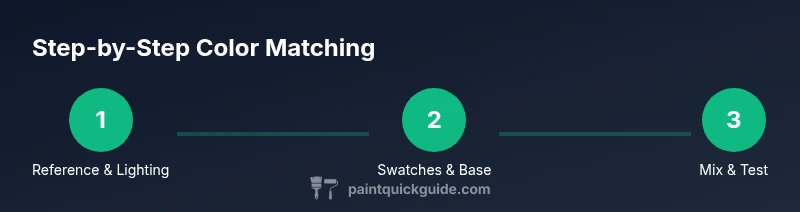
Collect the reference color sample and arrange two lighting scenarios: daylight and your typical indoor lighting. Document the environment so you can reproduce it later. This step ensures you start with a stable reference for comparison.
Tip: Label each lighting setup with a simple code (D for daylight, A for ambient). - 2
Assemble swatches and base color
Lay out multiple chips from different brands that approximate the target. Prepare your base color system and verify the tinting options you’ll use to reach a closer match.
Tip: Include at least three chips near the target hue to broaden your comparison range. - 3
Mix initial base close to target
Create a base mix that visually aligns with the reference on the first pass under the primary lighting condition. Record the mix ratios for future replication.
Tip: Use precise measurements for repeatability; small fraction differences can matter in color matching. - 4
Evaluate under multiple lights
Compare the test panel to the reference under both daylight and indoor lighting. Note any shifts in hue or brightness and adjust accordingly with tinting steps.
Tip: If a color shifts warm under indoor light, try a slight cool or neutral tint and re-test. - 5
Refine the mix
Fine-tune the tint levels in small increments, rechecking after each adjustment. Repeat until the panel aligns closely with the reference.
Tip: Document each incremental change to avoid backtracking. - 6
Test finish and document
Apply a small amount of topcoat (if used) and re-evaluate the color with the finish visible. Record final formulas, swatch decisions, and lighting notes for future projects.
Tip: Finish can alter perceived color; always test with the intended topcoat.
Your Questions Answered
What does paint match mean for DIY projects?
Paint match is the process of reproducing a reference color as closely as possible using swatches, base colors, and tinting. It relies on careful observation under realistic lighting and a repeatable workflow.
Paint match means reproducing a reference color as closely as possible using swatches and tinting, with careful observation under real lighting.
Why does lighting affect color matching?
Different light sources shift color perception. Daylight, incandescent, and LED lighting each render hues differently, which can change how a match looks. Test under multiple light conditions to ensure durability of the match.
Lighting changes color perception; test under several light sources to ensure the match holds.
Can digital tools replace swatches entirely?
Digital color tools can help estimate matches, but they should not replace physical swatches. Always verify digitally suggested colors with real chips under real lighting.
Digital tools help, but always verify with real swatches under actual lighting.
How many swatches should I compare?
Aim to compare at least three to five swatches from different brands or color families to broaden the matching range and reduce bias.
Compare several swatches from multiple brands to increase accuracy.
What is metamerism and how do I avoid it?
Metamerism occurs when colors look different under different lights. Avoid it by testing under the lighting conditions your project will experience and document the results.
Metamerism is color mismatch under varying lights; test under your project lighting to prevent it.
How long should a matched color stay accurate?
Color stability depends on film form and finish quality. Recheck after curing and maintain in similar environmental conditions to preserve accuracy.
Check after curing and keep in stable conditions to preserve the match.
Watch Video
Quick Summary
- Define a reference color and stable lighting
- Compare multiple swatches rather than relying on one chip
- Document all formulas and lighting conditions
- Test with the final finish to confirm accuracy
- Maintain a repeatable, stepwise workflow