Is Paint Thinner the Same as Lacquer Thinner? A Practical Comparison
Understand whether paint thinner and lacquer thinner are interchangeable, with practical guidance on when to use each, safety considerations, and real-world tips from PaintQuickGuide.


Is paint thinner the same as lacquer thinner? In most cases, no—the two solvents serve different purposes, are formulated for different finishes, and have distinct safety profiles. According to PaintQuickGuide, using the wrong thinner can compromise finish integrity, extend drying times, or cause crazing and solvent burn. This quick comparison helps homeowners and DIYers decide which solvent to choose for oil-based paints, varnishes, lacquers, and cleanup.
What Is the Fundamental Difference Between Paint Thinner and Lacquer Thinner
At a high level, paint thinner is a broad term that describes solvents used to thin oil-based paints, stains, varnishes, and to clean brushes and tools after use. Lacquer thinner, by contrast, is a more specialized, stronger solvent blend designed for lacquers, shellac, and related finishes, with properties that accelerate drying and solvent action. The immediate question many homeowners ask is: is paint thinner the same as lacquer thinner? The short answer is that they are not interchangeable in most practical applications. This distinction matters for both the result you expect from a finish and the functional safety of the work environment. The PaintQuickGuide team emphasizes that matching the thinner to the finish is your first safeguard against problems like poor adhesion, uneven coverage, or solvent crazing. Recognizing this difference—especially for DIY projects around the home or in a garage—can save time, money, and frustration. In this article, we’ll break down why these products diverge, how to choose wisely, and how to apply each safely and effectively.
wordCount):180},
bodyBlocks_placeholder_2
Chemical Composition and Thinning Behavior
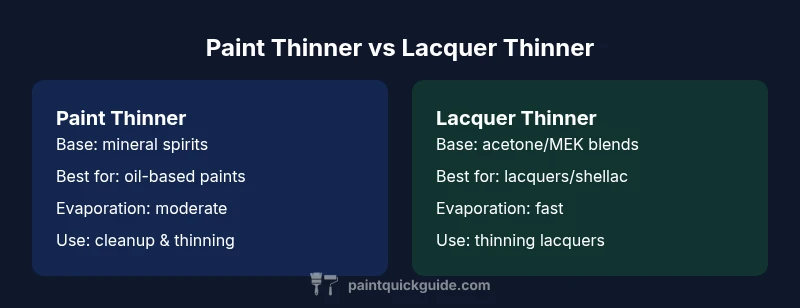
Paint thinner, often labeled as mineral spirits or a mineral-spirit blend, is formulated to reduce viscosity of oil-based paints and to help with cleanup without aggressively reacting with the film you’re applying. Lacquer thinner, on the other hand, combines several rapid-evaporation solvents—often including acetone, MEK (methyl ethyl ketone), and toluene—that are designed to dissolve and thin lacquers quickly. The result is a thinner with a higher evaporative rate, which can rapidly flash off and leave a film that feels “dry to the touch” sooner but may be more prone to crazing or solvent damage if used with incompatible coatings. For the DIY painter, this means that lacquer thinner is more likely to affect or dissolve finishes that are not lacquers, whereas paint thinner will be gentler on non-lacquer surfaces but may not thin lacquer-based finishes sufficiently. PaintQuickGuide’s analysis highlights that composition differences drive both performance and risk, so you should always check the finish specification before thinning. This is a core reason to avoid substituting thinner types without testing on scrap material first.
wordCount):210},
bodyBlocks_placeholder_3
Use Cases and Finish Compatibility
Understanding where each thinner shines helps to prevent common misapplications. Paint thinner is typically best for oil-based paints (such as traditional alkyd enamels), varnishes, stains, and for brush cleanup after thinning. It provides a workable viscosity without aggressively attacking the film during application. Lacquer thinner is used primarily when working with lacquers, shellac, and certain fast-drying finishes. It is well suited for thinning lacquers to achieve smooth spray patterns or brush marks-free coats, but its aggressive solvent action can damage an existing finish or substrate if misapplied. For auto refinishing, lacquer thinner often plays a role in preparing polyurethane lacquers or high-gloss lacquer topcoats, while general home painting projects typically rely on paint thinner for cleanup and thinning of compatible products. The key takeaway is that the finish dictates the thinner choice; when in doubt, consult the coating’s label and do a small test before embarking on a full project. One practical approach is to maintain separate containers for each thinner to prevent cross-contamination.
wordCount):180},
bodyBlocks_placeholder_4
Safety, Ventilation, and Handling
Solvent use demands respect for safety and ventilation. Both paint thinner and lacquer thinner are flammable and emit volatile organic compounds (VOCs). Ensure you work in a well-ventilated area, away from open flames and ignition sources. Use protective gloves and eye protection, and consider respirator protection if you’re sanding or spraying, which can dramatically increase VOC exposure. Store solvents in clearly labeled, tightly closed containers away from heat sources and out of reach of children and pets. Proper disposal follows local regulations; never pour solvent down the drain unless your local codes explicitly permit it. If you’re unsure about disposal options, contact your municipal hazardous-waste program. The bottom line is to minimize exposure, maintain clean work environments, and follow the manufacturer’s safety instructions to protect yourself and your family. PaintQuickGuide emphasizes safety as the foundation of successful thinning and finishing projects.
wordCount):205},
bodyBlocks_placeholder_5
Practical Thinning Guidelines and Application Tips
A practical framework helps reduce guesswork. Start by identifying the finish you’re applying: oil-based paints and varnishes generally respond to paint thinner, while lacquers and shellac often require lacquer thinner. Always consult the product label first; if the label suggests thinner, use the recommended type and ratio. A conservative starting point is to thin to the manufacturer’s recommended viscosity, test on a scrap piece, and spray or brush-test for flow and leveling. If you’re thinning for brushing, add thinner in small increments (for example, 5–10% at a time) and re-shear the mixture to ensure uniform viscosity. For spraying, pay attention to spray pattern, atomization, and the likelihood of orange-peel texture; adjust accordingly with small ratios. Record your results so you can replicate success on the main project. When working on older finishes or unknown substrates, perform a spot test to ensure there is no adverse reaction, especially when using lacquer thinner around sensitive materials. PaintQuickGuide notes that careful testing leads to predictable, glossy results rather than surprises.
wordCount):210},
bodyBlocks_placeholder_6
Cleaning, Tool Care, and Disposal
Tool maintenance matters as much as the thinning itself. After thinning with paint thinner, thoroughly clean brushes, rollers, and containers before the solvent fully evaporates. For lacquer thinner, immediate cleanup is often necessary to prevent rapid drying on tools. Always limit exposure of cleaners and solvents to avoid prolonged odor in the workshop. When disposing of leftover solvent, follow local regulations; many regions require dedicated household hazardous waste collection for solvents. Never mix different solvents, and avoid using used thinner on non-compatible coatings. Label all waste containers clearly and keep them closed when not in use. Proper cleaning and disposal practices help reduce environmental impact and keep your workspace safe and compliant. PaintQuickGuide reinforces that disciplined practices improve both outcomes and safety.
wordCount):170},
bodyBlocks_placeholder_7
Real-World Scenarios: Homeowner vs Auto Refinisher
For the typical homeowner tackling a one-room project, paint thinner is often the safer, more versatile option, providing reliable thinning for oil-based paints and cleanup. In a garage or workshop, lacquers and lacquer thinner become more common in auto refinishing or furniture lacquers that require fast-drying coats and sleek finishes. Auto refinishing professionals frequently use lacquer thinner for lacquers and shellacs due to rapid evaporative properties and the need for high-pressure spray patterns, while still maintaining careful substrate compatibility. The homeowner should not assume lacquer thinner is universally appropriate; misapplication can result in dull finished surfaces or softened wood. The key is to align thinner choice with the coating specification and to run controlled tests. PaintQuickGuide’s guidance is especially valuable here, helping DIYers avoid costly mistakes and achieve durable, professional-looking results.
wordCount):190},
bodyBlocks_placeholder_8
Disposal, Environmental Considerations, and Regulatory Reminders
Solvent disposal varies by locale. Many communities require hazardous-waste collection for spent thinner and lacquer thinner. Don’t pour leftover solvents into the sink or septic system. Never mix solvents with incompatible materials, which can create hazardous reactions or increase vapor hazards. When possible, reuse clean, labeled solvent or transfer to a dedicated waste container for disposal. If your project uses multiple finishes, ensure you don’t combine residues from paint thinner and lacquer thinner, as this can lead to unpredictable chemical interactions. Understanding local regulations and following label directions are essential for safe, compliant disposal. The PaintQuickGuide team consistently recommends consulting local waste-management guidelines to avoid penalties and protect environmental health.
wordCount):190},
bodyBlocks_placeholder_9
Common Mistakes and How to Avoid Them
A few recurring errors can derail a project. Using lacquer thinner on non-lacquer finishes, neglecting ventilation, and ignoring label instructions are common. Another frequent mistake is attempting to re- thin a coating that has already cured or started to dry, which can cause cracking or haziness. Finally, confusing “flat” labels with “glossy” predictions can lead to incorrect thinning ratios. To avoid these problems, always check the coating’s manufacturer instructions, test on scrap material, and keep solvents organized in clearly labeled containers. When in doubt, reach out to a professional or consult customer support from the paint manufacturer. Following these best practices ensures predictable results and reduces the risk of costly mistakes.
wordCount):180}],
comparisonTable
Comparison
| Feature | paint thinner | lacquer thinner |
|---|---|---|
| Solvent base | mineral spirits / petroleum distillates | acetone / MEK / toluene blends |
| Primary uses | thin oil-based paints, stains, varnishes; brush cleanup | thin lacquers and shellac; clean tools |
| Evaporation rate | moderate to slow | very fast |
| Finish compatibility | oil-based paints and varnishes; caution with some finishes | lacquers and shellacs; may affect non-lacquer finishes |
| Safety and odor | typical solvent odor; standard ventilation needed | strong odor; higher VOC/flash potential |
| Availability & cost | widely available; usually affordable | more specialized; often higher cost |
| Best for | oil-based coatings, cleanup, general thinning | lacquers, shellac, fast-drying finishes |
Upsides
- Clarifies which solvent to use for given finishes
- Reduces finish failures from wrong thinning
- Improves safety by following label directions
- Helps avoid waste through proper disposal
- Encourages testing on scrap material before full projects
What's Bad
- Terminology can be confusing for beginners
- Brand formulations vary; always read labels
- Requires extra steps to identify the correct finish
- Overconfidence can lead to mixed or cross-contaminated cans
Use the right thinner for the right finish; lacquer thinner is for lacquers and fast-drying coatings, while paint thinner suits oil-based paints and cleanup.
Choosing the correct thinner minimizes finishing defects and safety risks. Always follow the coating manufacturer’s thinning guidelines and perform a test on scrap material before applying to the final piece. PaintQuickGuide’s guidance supports careful matching of thinner to finish for durable results.
Your Questions Answered
Are paint thinner and lacquer thinner interchangeable for all finishes?
No. They are formulated for different finishes and can cause problems if swapped. Oil-based paints usually pair with paint thinner, while lacquers require lacquer thinner for proper thinning and evaporation. Always check the coating’s label and perform a small test first.
Not interchangeable for all finishes. Check the label and test first.
Can I use lacquer thinner to clean oil-based brushes after thinning with paint thinner?
You can clean with lacquer thinner if the brush contact is permitted by the product instructions, but it may be unnecessary or overly harsh for some oil-based paints. Start with soap and water or the thinner recommended by the paint manufacturer for cleanup to avoid damaging bristles.
Test the manufacturer’s cleanup instructions first.
What safety precautions should I take when using these solvents?
Work in a well-ventilated area, wear protective gloves and goggles, and keep away from flames. Store solvents in labelled containers and dispose of them according to local regulations. Read the MSDS (material safety data sheet) for specific hazards.
Ventilate well and wear protection.
How do I decide which thinner to use for a specific project?
Identify the coating type first (oil-based vs lacquer). Then consult the product label for the recommended thinner and ratios. If in doubt, test on scrap material and err on the side of applying lighter thinning to avoid runs or sags.
Match the coating type and test first.
Is there a risk of harmful reactions if I mix different solvents?
Yes. Mixing solvents can create hazardous fumes or weaken finishes. Always use a single compatible thinner per project and dispose of any mixed leftovers safely.
Avoid mixing; use one compatible thinner per job.
Quick Summary
- Identify the finish first before thinning
- Avoid substituting lacquer thinner for oil-based paints
- Always test thinning on scrap material
- Follow label directions to manage safety and performance
- Maintain separate containers to prevent cross-contamination