Paint thinner vs mineral spirits: A practical guide for painters
Compare paint thinner and mineral spirits to understand odor, evaporation, residue, and safety. Learn which solvent suits oil-based paints, indoor use, and project speed for DIY painters.


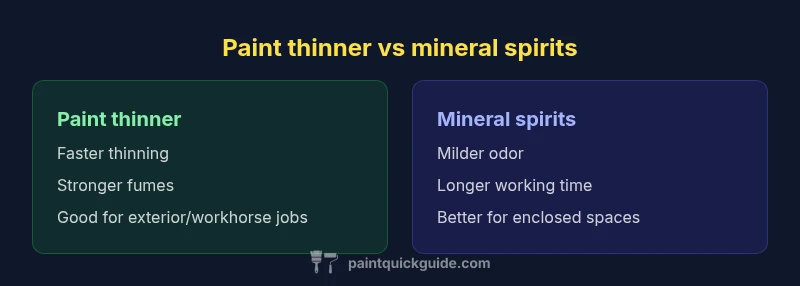
Paint thinner and mineral spirits are two common thinning solvents for oil-based paints. Both can improve flow and coverage, but they differ in odor, evaporation rate, residue, and safety. In most home projects, mineral spirits offer a milder smell and longer working time, while paint thinner dries faster and can leave stronger fumes. Your choice depends on indoor ventilation, paint type, and project pace.
Understanding the basics
Paint thinner and mineral spirits are petroleum-derived solvents used to modify the viscosity of oil-based paints and finishes. They aren’t the same product, though they share a common purpose: to help paints flow smoothly, reduce brush marks, and improve leveling. For homeowners and auto refinishing hobbyists, the main distinctions lie in composition, odor, and performance under different conditions. According to PaintQuickGuide, the choice should be guided by the project environment (indoor vs outdoor), the type of coating being thinned, and safety considerations. Mineral spirits generally refer to a milder class of hydrocarbon solvents with a lower odor and slower evaporation, making them friendlier for enclosed spaces. Paint thinner is a broader term that can include stronger blends intended to reduce thick coatings more aggressively and speed up drying in non-living room environments. Understanding these differences helps you plan ventilation, PPE, and cleanup ahead of time.
Odor, fumes, and user experience
The odor and perceived fumes from thinning solvents influence comfort, air quality, and potential headaches during work sessions. Mineral spirits tend to emit a milder, less penetrating odor, which makes them more suitable for indoor garage or workshop use with adequate ventilation. Paint thinner blends, especially older formulations or stronger commercial grades, can produce sharper fumes and a sense of solvent exposure longer after application. Users who are sensitive to smells or who work in tighter spaces should prioritize mineral spirits and ensure proper ventilation, respirators or organic vapor cartridges when needed, and strict separation of work areas from living spaces. Safety data sheets from reputable suppliers emphasize keeping solvents away from heat sources and avoiding prolonged exposure.
Evaporation rate and working time
Evaporation pace directly affects how long you have to work with a coated surface and how quickly you can recoat. Paint thinner often evaporates more rapidly, shortening the working time and increasing the likelihood of brush drag if applied too thickly. Mineral spirits evaporate more slowly, providing extended working time that helps achieve smoother finishes and better leveling, especially on large surfaces. For projects requiring quick turnover—garage doors, exterior trim, or busy workshops—a fast-evaporating thinner can reduce downtime. For interior painting or fine finishes, the slower evaporation of mineral spirits reduces the risk of lap marks and uneven film formation.
Residue, film quality, and color impact
Different thinning solvents can leave traces in the dried film that affect color and sheen. Mineral spirits tend to leave lighter residues and are generally more forgiving for long-reach applications or delicate finishes, helping to preserve consistent sheen across panels. Paint thinner, if not properly flushed from brushes or if used with very thick coats, can leave a more noticeable residue that may alter color perception slightly and necessitate longer cleanups. The choice of solvent also interacts with pigments, resins, and flattening agents in oil-based paints; always test on a small area before committing to a large color block.
Compatibility with paint systems
Oil-based paints and varnishes are designed to be thinned with hydrocarbon solvents, but the exact formulation matters. Mineral spirits are widely recommended for most oil-based systems and are compatible with sure-fire thinning of varnishes and polyurethanes. Paint thinner blends may be preferred when working with heavy-bodied oils or when speed is essential and the environment is well-ventilated. For latex or water-based paints, these solvents are typically not appropriate; use water-based thinners or follow the paint manufacturer’s guidance. Always check the product label for compatibility and test before full-scale thinning.
Safety, ventilation, and personal protection
Solvent use requires good ventilation, even with milder options. Mineral spirits are often kinder to indoor air but still emit VOCs that can irritate eyes, nose, and throat. Paint thinner, with stronger fumes, demands enhanced ventilation, air movement, and the use of gloves, eye protection, and respirators when indicated. Never mix solvents in a closed space, avoid flames or sparks, and store containers securely away from heat. In addition, avoid skin contact and clean tools promptly to minimize skin absorption. Health and safety guidelines from PaintQuickGuide emphasize the importance of knowing your material safety data sheet (SDS) for each solvent.
Cleaning up, disposal, and regulatory considerations
Cleanup routines differ by solvent type, but generally both require thorough rinsing of brushes and tools with the same solvent, followed by air-drying in a well-ventilated area. Do not pour leftover solvents down drains; instead reuse where feasible or store in approved containers for hazardous waste collection. Disposal rules vary by region; consult local municipalities or waste management facilities to understand whether special disposal is required. For autos or workshops with small volumes, dedicated hazardous waste programs are commonly accepted. Always label cans clearly and secure lids to prevent evaporation and leaks.
Cost, availability, and environmental considerations
Prices for paint thinner and mineral spirits vary by brand, region, and packaging. Mineral spirits are often priced competitively, particularly when sold as consumer-grade products. Some markets see paint thinner as more economical, especially for heavy-duty thinning or exterior work. From an environmental perspective, both solvents contribute VOCs, so selecting lower-VOC formulations where available and ensuring proper disposal reduces the ecological footprint. When possible, choose products with lower odor and reduced emissions, and consider using evaporation-control techniques such as enclosed containers or temporary tents with proper ventilation.
Practical usage scenarios: home projects vs auto refinishing
For DIY home projects in well-ventilated spaces, mineral spirits provide a comfortable balance of odor and working time, making them a common choice for furniture refinishing or door painting. For auto refinishing or large exterior projects where time is critical and ventilation is available, a paint thinner may be advantageous to speed thinning and cure times. Auto body shops often segregate cleaners and solvents by purpose to minimize cross-contamination with paint, ensuring that thinning solvents do not alter color matches or gloss. In short, the decision hinges on space, ventilation, and the specific coating system you’re applying.
Application tips for thinning and stirring
When thinning, add solvent gradually: start at 5-10% of total volume and mix thoroughly before testing. Stir rather than shake to avoid foam; allow time for the solvent to integrate with pigments without introducing air bubbles. Keep brushes and tools clean and free of hardened residue. If a test panel shows poor leveling or color shift, back off the solvent amount and re-check the paint’s instructions. Store unused solvent in closed containers away from heat, and label clearly.
Common mistakes and how to avoid them
Common mistakes include using the wrong solvent for the paint system (e.g., thinning latex with mineral spirits), thinning too much, insufficient ventilation, and neglecting PPE. Avoid mixing solvents unless explicitly instructed by the paint manufacturer. Always run a prep test on a small panel to confirm drying time, sheen, and color fidelity. Finally, don’t mix coatings from different brands; each brand’s formulation responds differently to thinning.
Quick-reference decision framework
- Confirm paint type: oil-based vs water-based.
- Check ventilation and space: indoor with limited airflow or outdoor.
- Consider project pace: fast vs slow working time.
- Review finish requirements: color, sheen, and residue tolerance.
- Test on a sample: color and sheen should align with expectations.
- Follow manufacturer guidance for thinning ratios and disposal.
Comparison
| Feature | paint thinner | mineral spirits |
|---|---|---|
| Odor and volatility | stronger odor | milder odor |
| Drying/evaporation rate | faster evaporation | slower evaporation |
| Residue and finish impact | potential stronger residue | lighter residue |
| Paint compatibility | often used with oil-based paints and varnishes | primarily for oil-based systems; gentler for enclosed spaces |
| Usage scenarios | exterior work or fast-turnaround projects | indoors with good ventilation; long work-in-progress sessions |
| Cost and availability | varying by region; may be cheaper in some markets | often stocked with oil-based products; perceived higher price in some areas |
| Safety considerations | higher VOCs; more ventilation required | lower VOCs; still requires ventilation and PPE |
Upsides
- Faster thinning and drying with paint thinner
- Better solvent strength for thick oils
- Often cost-effective in certain markets
- Widely available in hardware stores
What's Bad
- Stronger odor and higher VOC exposure
- More potential residue in films
- Requires greater ventilation and PPE
- Not ideal for indoor use with latex paints
Mineral spirits generally offer a milder, safer indoor option, while paint thinner suits fast thinning for outdoor or large projects
For most indoor painting, mineral spirits are the balanced choice due to lower odor and longer working time. Use paint thinner when project speed and exterior ventilation are priorities, but ensure proper safety measures and ventilation.
Your Questions Answered
Are paint thinner and mineral spirits the same thing?
No. Both are hydrocarbon solvents used to thin oils, but mineral spirits are milder with lower odor, while paint thinner blends can be stronger and evaporate faster. Always check the label for recommended use with your coating.
No—mineral spirits are milder and slower to evaporate, while paint thinner tends to be stronger and drier. Check your product label for compatibility.
Can you thin latex paint with mineral spirits or paint thinner?
Latex (water-based) paints are typically thinned with water or by following the manufacturer’s guidance. Mineral spirits and paint thinner are generally not recommended for latex paints and can degrade film formation.
Usually not—latex paints should be thinned with water or the manufacturer’s product-specific thinner.
Is mineral spirits safer to use indoors than paint thinner?
Mineral spirits usually emit milder fumes and are preferable for indoor use when ventilation is good. Both solvents require ventilation and PPE; avoid confined spaces and monitor for symptoms of irritation.
Generally safer indoors due to milder fumes, but you still need good ventilation.
How should I dispose of leftover thinning solvents?
Do not pour solvents down drains. Reuse when possible or take them to a household hazardous waste facility. Follow local regulations, store in labeled containers, and keep away from heat sources.
Don’t pour them away; recycle or dispose as hazardous waste per local rules.
What storage practices keep thinning solvents safe?
Store in tightly sealed containers away from heat, direct sunlight, and ignition sources. Keep original labels, and limit access to children or pets. Consider secondary containment in workshop areas.
Seal tightly, store away from heat, and label clearly.
Can I mix thinner with different brands?
Avoid mixing solvents from different brands unless the manufacturer explicitly approves. Mixing can alter drying times, evaporation, and finish quality. Always test on a small panel if required.
Don’t mix unless the manufacturer allows it; test first if needed.
Quick Summary
- Choose mineral spirits for indoor projects with limited ventilation
- Opt for paint thinner when speed is essential and outdoor ventilation is strong
- Avoid thinning latex paints with mineral spirits
- Always ventilate, wear PPE, and test on a sample