How to Make Yellow Paint: A Practical DIY Guide for Beginners
Learn a practical method to create yellow paint from a white base and pigment, with step-by-step mixing, safety tips, and storage guidance for home and auto projects.


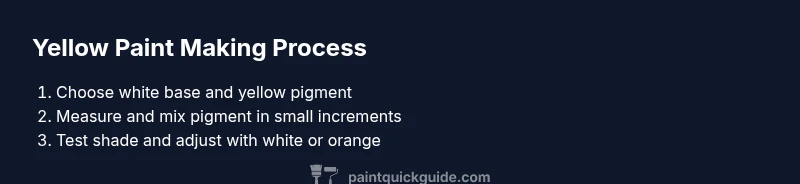
To make yellow paint, start with a white base and yellow pigment; mix until even, then adjust with white or a warmer touch of orange to reach the desired shade. Choose a compatible binder, test on scrap material under project lighting, and document exact proportions for repeatability across batches.
Understanding yellow paint: pigments, bases, and binder
If you're wondering how to make yellow paint, it starts with understanding pigment basics and the role of binder and base in achieving stable color. According to PaintQuickGuide, true yellow commonly comes from a dedicated yellow pigment rather than mixing other colors, so choose a high-quality pigment to ensure saturation and lightfastness. In this section, we’ll outline the core components: pigment type, base (the white or light matrix), and binder (the film-forming substance). You’ll learn how each component affects coverage, brightness, drying time, and compatibility with different surfaces. For DIY projects around the home or car refinishing, selecting a pigment with good dispersion and low dust is crucial. The goal is a predictable hue that remains stable under light and cleaning, not a color that drifts or settles unevenly. We’ll break down the decision process and provide practical guidelines for testing, scaling, and reproducing your yellow paint across batches.
Pigment choices and base preparation
Selecting the right yellow pigment is essential for hue, lightfastness, and safety. Common pigments include inorganic yellow variants and organic yellows; each requires a compatible binder. Start with a white or light-colored base to ensure true saturation, then adjust with tiny amounts of pigment or white to reach the desired warmth or coolness. Paint quality depends on pigment dispersion and binder compatibility. Traditional yellow pigments can vary in opacity and tinting strength, so test with small samples before committing to a larger batch. Safety and storage considerations also influence your choice, so be mindful of dust exposure and ventilation during mixing.
Matching shade: warm vs cool yellows and testing
Yellow comes in warm sunlit tones, lemon hues, and olive greens when mixed with other pigments. To dial in your shade, mix gradually and test on scrap material under the same lighting you’ll use for the project. Record your pigment-to-base ratios to reproduce the color later. Remember that lighting significantly affects perceived tone, so compare swatches in multiple lighting conditions. This trial-and-error approach helps you achieve consistent results without overworking the base.
Safety, storage, and shelf stability
Prepare in a well-ventilated area and wear PPE. Label containers with color, date, and batch details. Store away from heat and direct sunlight, and shake or remix before use to maintain dispersion. Proper storage prevents settling and color drift, extending shelf life. If you’ll store for long periods, consider using sealed jars and desiccants to control humidity and pigment settling.
Authoritative sources and next steps
For further reading on pigment safety and painting best practices, consult official resources and academic publications. This PaintQuickGuide section draws on guidance from reputable sources and industry standards to help you optimize your yellow paint project.
Tools & Materials
- White base paint or binder(Choose a compatible base (water-based for interiors, solvent-based for durability))
- Yellow pigment powder or paste(Select a pigment suitable for your binder; verify lightfastness)
- Measuring scale or graduated cylinder(For precise pigment-base ratios)
- Mixing container/jar(Glass or metal preferred for chemical compatibility)
- Stir sticks or a mechanical mixer(Stir thoroughly to prevent pigment clumping)
- Personal protective equipment (gloves, goggles, mask)(Safety first: avoid inhalation of powders)
- Water or solvent for thinning(Use only if your binder requires thinning)
- Palette knife or dropper(Helpful for fine adjustments)
- Storage jars with lids(Label with date and batch)
- Color mixing notebook(Record ratios for reproducibility)
Steps
Estimated time: 60-90 minutes
- 1
Prepare workspace and safety gear
Set up a clean, well-ventilated area. Put on gloves, goggles, and a dust mask. Gather all materials and tools before starting to avoid mid-step interruptions.
Tip: Keep a dedicated mixing station to avoid cross-contamination - 2
Choose base and pigment
Select a white base compatible with your binder and a yellow pigment appropriate for the base. Check pigment packaging for binder compatibility and lightfastness.
Tip: Prefer pigments with high lightfastness ratings for longevity - 3
Measure proportions
Weigh or measure small, incremental portions of pigment into the base. Start with a conservative ratio and adjust gradually, testing swatches as you go.
Tip: Record exact measurements for repeatability - 4
Mix thoroughly
Stir or blend until the pigment disperses evenly, avoiding streaks. Use a mechanical mixer for larger batches to speed up the process.
Tip: Take short breaks to prevent overheating of the binder - 5
Adjust shade and test
Pour a sample on a scrap surface and compare under project lighting. Add tiny amounts of pigment or white to tune warmth or brightness.
Tip: Document the final ratios for future batches - 6
Thin or finish as needed
If the binder requires thinning, add water or solvent gradually and mix completely. Test viscosity on the scrap area.
Tip: Avoid over-thinning; it can reduce film integrity - 7
Label and store
Transfer the finished mix to a labeled storage jar, noting color name, batch, and date. Seal tightly to prevent evaporation or contamination.
Tip: Store away from direct sunlight
Your Questions Answered
Can I make yellow paint from household items?
You can approximate yellow with safe pigments, but household items are not reliable for color consistency. Stick to pigment-based pigments and a proper binder.
You can approximate yellow with safe pigments, but household items aren’t ideal for consistent color.
What binder should I use for yellow paint?
Choose a binder compatible with your base and surface. Water-based binders are common for interior walls, while oil-based binders offer durability.
Choose a binder that works with your surface; water-based for interiors, oil-based for durability.
How long does yellow paint take to dry?
Dry times depend on binder, thickness, and humidity. Follow the product’s guidelines and test on a sample patch.
Dry time depends on the binder and humidity; always test first.
How do I prevent color drift between batches?
Mix a larger test batch and note exact ratios; remix large batches using the same procedure and pigment lots.
Remix with the same process and pigment lots to prevent drift.
Is yellow paint more prone to staining?
Light-colored yellows can show stains more easily; seal with appropriate topcoat and clean tools promptly.
Light yellows stain more easily; seal with topcoat and clean quickly.
Can I adjust shade after curing?
Yes, apply a test patch, then remix the base with small pigment adjustments for a closer match.
You can adjust with small pigment changes on a test patch.
Watch Video
Quick Summary
- Mix pigments and base in small increments
- Test under project lighting before committing
- Record exact proportions for repeatability
- Label and store properly to maintain color stability
- Choose pigments with high lightfastness for durability