Gouache Paint vs Watercolor: A Practical Comparison
An analytical comparison of gouache paint vs watercolor, focusing on opacity, reworkability, surfaces, drying times, and project-fit to help artists choose the right medium.


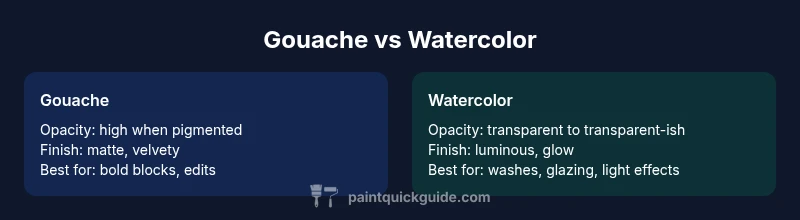
Gouache paint vs watercolor boils down to opacity, reworkability, and finish. Watercolor excels in translucency and glazing, while gouache offers opaque coverage and a matte, velvety finish. For beginners and mixed-media artists, understanding these trade-offs helps you choose the right medium for each project.
What gouache and watercolor are
Gouache and watercolor are both water-based paints, but they behave very differently on paper and in layers. Gouache adds chalk-based white pigment, which makes colors more opaque and velvety when dry. Watercolor relies on transparent pigments and the white of the paper to create luminosity. According to PaintQuickGuide, the key practical distinction is not just pigment but also how each medium handles light, layering, and mistakes. For artists exploring gouache paint vs watercolor, the decision hinges on transparency, surface prep, and the desired final look. This article uses real-world examples and practical tips to help homeowners, DIY enthusiasts, and auto refinishing hobbyists choose the right tool for the job.
Introduction to the two media sets the stage for practical decisions about opacity, surface selection, and reworkability. The PaintQuickGuide Team emphasizes that the best choice often depends on the specific effect you want—glazing and soft edges with watercolor, or bold, opaque blocks with gouache.
Comparison
| Feature | Watercolor | Gouache |
|---|---|---|
| Opacity | Transparent to semi-opaque depending on pigment and dilution | Opaque to high-coverage when used straight from the tube; can be thinned for translucency |
| Reworkability (before and after drying) | Highly reworkable while wet; lifting and re-wetting are common | Reworkable when wet; dries to a chalky film that can be re-wet with effort |
| Finish | Luminous, glassy when dry; edges stay soft | Matte, velvety finish with solid color blocks |
| Water resistance after drying | Remains water-soluble; rewetting is easy | Remains water-soluble; sealing or varnish can improve water resistance |
| Drying time | Typically fast to dry; layering needed for depth | Typically quick to dry; layering can create rapid, opaque layers |
| Best on surfaces | High-quality watercolor paper (cotton or wood pulp) | Watercolor paper or illustration board; some boards are suitable |
| Best for | Delicate washes, subtle glazing, and luminous effects | Bold shapes, solid color fields, and poster-like illustration |
| Price range (relative) | Wide range; student sets are affordable and expand with quality | Mid to high range; good gouache sets offer strong opacity and matte finish |
Upsides
- Water-based and easy cleanup with soap and water
- Opens broad experimentation between washes and glazing
- Gouache offers strong opacity for bold illustrations
- Watercolor provides luminous color and subtle layering
- Wide availability from student to professional grades
What's Bad
- Watercolor can be challenging to control as layers build
- Gouache can dry chalky and may require rewetting to rework
- Both media are not inherently waterproof without varnish or sealing
- Color matching across brands can vary, affecting consistency
- Paper quality heavily influences results for either medium
Gouache wins for bold, opaque blocks; watercolor wins for luminous washes and gentle glazing
If your project demands opaque color and flat, matte surfaces, choose gouache. If you seek light, transparent layers and glow, watercolor is the better fit. Consider a mixed approach for versatility.
Your Questions Answered
What is gouache and how does it differ from watercolor?
Gouache is an opaque, chalky-water-based paint that dries to a matte, velvety finish. Watercolor relies on transparent pigments and the paper’s white surface to create luminosity. The core difference is opacity and how easily each medium can be reworked after drying.
Gouache is opaque and matte; watercolor is transparent and luminous. The main difference is opacity and reworkability.
Can gouache be used on top of watercolor or vice versa?
Yes. Many artists layer watercolor washes first and then apply gouache for opaque details. Conversely, gouache can be used under transparent watercolor washes, but the chalky gouache surface can affect glaze behavior.
You can layer, but expect different interactions when you combine them.
Is gouache waterproof or water-resistant when dry?
Gouache remains water-soluble after drying. If you need waterproof results, you’ll typically varnish or seal the surface after the paint is fully dry.
Gouache isn’t naturally waterproof; sealing is usually required for water exposure.
Which is cheaper to start with, gouache or watercolor?
Both have affordable entry points, with student-grade options available for watercolor and gouache. Overall, watercolor sets can be cheaper upfront, but gouache becomes cost-effective with fewer layers needed for opacity.
Beginners often find basic watercolor kits cheaper to start, though gouache can be economical for bold results.
What surface works best for each medium?
Watercolor shines on cold-press or hot-press watercolor papers. Gouache works well on similar papers and illustration boards; heavier papers help prevent cockling when multiple layers are applied.
Watercolor prefers watercolor paper; gouache also loves sturdy surfaces that resist warping.
Is there a recommended starter kit for this comparison?
A basic starter kit for watercolor includes a small set of transparent pigments, a good brush, and high-quality watercolor paper. For gouache, a small set of opaque colors, a few brushes, and sturdy mixed-media paper work well.
Yes—buy a compact watercolor set and a basic gouache set to explore both paths.
Quick Summary
- Choose gouache for bold, opaque detail and a velvety finish
- Opt for watercolor when you want luminous, transparent washes
- Select high-quality paper to maximize medium behavior
- Experiment with both on the same surface to learn limits
- Consider sealing gouache if water resistance is needed for a project