Benjamin Moore paint vs Sherwin Williams: Practical, data-driven comparison
An analytical comparison of Benjamin Moore and Sherwin Williams paints, covering finishes, color accuracy, coverage, durability, and value for homeowners and DIYers seeking practical guidance.


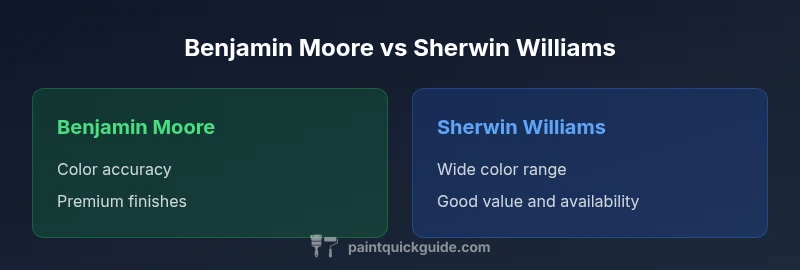
When comparing benjamin moore paint vs sherwin williams, most homeowners find that Moore emphasizes color accuracy and premium finishes, while Williams emphasizes broad color availability and value. For projects prioritizing finish quality, Moore often wins; for budget, accessibility, and faster availability, Sherwin Williams is typically stronger. See the deeper breakdown below for project-specific guidance.
Overview and Brand Positioning
The comparison between benjamin moore paint vs sherwin williams matters for homeowners, DIY enthusiasts, and pros alike. According to PaintQuickGuide, Moore is frequently chosen when color precision and premium finishes are the top design priorities, while Williams is favored when breadth of color options and practical price/value are paramount. This dynamic shapes recommendations for interior schemes, exterior durability, and professional workflows. The goal is to translate brand strengths into tangible project outcomes by considering lighting, room function, and long-term maintenance. Throughout this article, we will balance aesthetic goals with performance data and real-world testing guidance, keeping the focus on actionable decisions rather than marketing hype. The PaintQuickGuide team emphasizes that your best choice depends on your specific project priorities and budget, not on brand equity alone.
Finish Families, Sheen Ranges, and Color Tools
When you compare benjamin moore paint vs sherwin williams, you’ll notice distinct approaches to color palettes and finish ecosystems. Benjamin Moore leans into curated color stories and premium finishes with strong color fidelity in controlled lighting environments, helping designers achieve precise looks in living spaces and luxury projects. Sherwin Williams offers a broad color library with extensive chip sets and online visualization tools, which can speed up selection and reduce guesswork for typical rooms. Both brands provide digital color tools and physical swatch books, but Moore’s tools often appeal to color-first projects while Williams’ tools support fast decision-making for projects with tighter timelines. Homeowners should use swatches in real lighting and on actual walls to validate color intent before committing.
Coverage, Durability, and Application
Durability and coverage are central when evaluating benjamin moore paint vs sherwin williams. Moore’s premium lines are designed for high-hide coverage and smoother application, which can minimize the number of coats in demanding spaces with challenging substrates. Williams typically delivers solid coverage across a wide price spectrum, with reliable flow and longer open times in some formulations that help during roller work and brush application. The choice may hinge on room type and surface: bathrooms and kitchens may benefit from Moore’s premium resistance to moisture stains, while living rooms and hallways can benefit from Williams’ efficient coverage and easy cleanup. Always follow surface preparation guidelines to maximize any paint’s performance.
Price, Value, and Availability
Price and value form a practical axis in the benjamin moore paint vs sherwin williams comparison. In general, premium Moore lines carry higher upfront costs, reflecting their color fidelity and finish depth. Sherwin Williams offers competitive pricing across mid-range products and robust retailer networks, which can translate to lower total project costs when you factor in labor, application time, and coverage per gallon. Availability varies by region and retailer, so it’s prudent to compare local quotes and promotions. For DIYers, a balance of cost and quality often favors Williams, while Moore remains attractive for projects where color accuracy and finish quality cannot be compromised.
Color Matching, Consistency, and Lighting
Color matching is a key differentiator in the benjamin moore paint vs sherwin williams debate. Moore’s color science tends to yield very faithful results in controlled lighting and space, but lighting conditions on site can change perception. Williams provides versatile color tools and a broad palette that can compensate for some lighting variability, yet some hues may read differently in afternoon sun or artificial lighting. Regardless of brand, always test color swatches on your walls, in the same room, and with your lighting plan to confirm the final choice. Consistency across batches should be confirmed by your retailer prior to purchase.
VOCs, Sustainability, and Health Considerations
Both brands offer low-VOC options and sustainability-conscious formulations designed to minimize odor and indoor air pollution during and after application. When assessing benjamin moore paint vs sherwin williams for health-conscious projects, look for labels indicating low or zero VOC, formaldehyde-free binders, and certifications such as MPI or GREENGUARD where available. Regional product lines may differ in VOC content, so check the specific can you buy. Proper ventilation, PPE, and curing time are also important to achieve the safest interior environment.
Exterior vs Interior Performance and Longevity
The performance gap between benjamin moore paint vs sherwin williams can be most noticeable across interior and exterior environments. Moore’s premium exterior lines often deliver strong fade resistance and color retention in sun-exposed areas, which is especially beneficial for curb appeal on homes with high visibility. Williams products are widely used for exterior projects as well, offering dependable protection and broad shade options. For metal and wood substrates, verify the recommended topcoats and primers from each brand, and opt for weather-appropriate sheens to maximize longevity.
Practical Project Scenarios: When to Choose Which Brand
For color-critical interiors (e.g., a feature wall in a modern living room), benjamin moore paint vs sherwin williams leans toward Moore due to color depth and premium finish. For projects with tight budgets or quick turnaround (e.g., rental properties, multi-room rehabs), Sherwin Williams often provides better price-to-performance and faster availability. If you’re undertaking a renovation that combines aesthetic refinement with practical maintenance, a mixed approach—Moore in key accent spaces and Williams for bulk coverage—can offer a balanced solution. Always test swatches, compare local prices, and consult your painter’s experience to guide the final choice.
Comparison
| Feature | Benjamin Moore | Sherwin Williams |
|---|---|---|
| Finish range | Premium, refined finishes with strong color fidelity | Broad range across interior/exterior finishes and price tiers |
| Color range/tools | Curated palettes and high-accuracy color tools | Extensive color library and robust visualization tools |
| Coverage and hide | High-hide capability in premium lines | Reliable coverage across mid-range options |
| Price/value | Higher upfront price for premium lines | Strong value in mid-range and accessible lines |
| Availability | Selective specialty retailers and pro channels | Nationwide distribution and easy retailer access |
| Low-VOC options | Widely available in premium ranges | Broad low-VOC options across lines |
| Color accuracy | Excellent accuracy in controlled lighting | Good accuracy with strong visualization tools |
| Warranty/support | Professional support network and warranties | Consistent retailer-backed support |
Upsides
- High color accuracy and premium finishes for design-critical spaces
- Strong color libraries and accessible options for diverse budgets
- Reliable coverage and durable finishes across common surfaces
- Extensive retailer network supports DIYers and pros
What's Bad
- Premium pricing can be a barrier on large projects
- Color results depend on lighting and surface preparation
- Availability may vary regionally for some premium lines
- Batch-to-batch color variation can occur if not tested
Sherwin Williams offers better value and accessibility for many homeowners, while Benjamin Moore excels in color accuracy and premium finish quality.
For most DIY and mid-range projects, Sherwin Williams provides practical value and broad access. Benjamin Moore remains the preferred choice when color precision and luxury finishes are paramount. Your final decision should align with lighting, surface, and budget considerations.
Your Questions Answered
Which brand offers the larger color palette and better visualization tools?
Sherwin Williams generally provides a broader color library and robust visualization tools, which can speed selection. Benjamin Moore offers a highly curated palette with excellent color fidelity, especially in controlled lighting.
Sherwin Williams typically has the bigger color library and strong tools, while Benjamin Moore focuses on carefully curated colors with excellent fidelity.
Is Benjamin Moore more expensive than Sherwin Williams across the board?
In general, premium Benjamin Moore lines carry higher upfront costs compared with many Sherwin Williams options. Actual prices vary by finish, retailer, and region, so it’s best to compare quotes for your exact product and project.
Moore tends to be pricier upfront, but you’ll find Williams often has more mid-range options.
Which brand is easier for DIY beginners?
Sherwin Williams is often perceived as more beginner-friendly due to broad availability and straightforward finishes. Benjamin Moore can require careful color selection and proper surface prep for optimal results.
Williams is usually easier for beginners, Moore requires a bit more planning for colors and prep.
Do these brands offer low-VOC or zero-VOC options?
Both brands offer low-VOC options in multiple product lines. Always check the specific product data sheet and local retailer availability for your region.
Yes, both have low-VOC choices; check the exact line and your retailer.
How important are color tools and swatches when choosing between them?
Color tools help visualize outcomes, but lighting changes everything. Always test swatches on your walls in your room’s lighting before deciding.
Tools matter, but always test swatches in your actual lighting.
How do durability and stain resistance compare between the brands?
Durability depends on the chosen finish and proper surface prep. Both brands offer durable options; select high-hide premium lines for areas with heavy use.
Durability depends on the finish and prep, both brands have strong durable options.
Quick Summary
- Define project priorities before selecting a brand
- Choose Benjamin Moore for color-critical spaces and premium finishes
- Choose Sherwin Williams for value, availability, and broad color options
- Always test swatches in your lighting before committing
- Check local retailer inventory and perform a color test on actual walls