Behr Paint vs Benjamin Moore: An In-Depth Brand Comparison
Behr paint vs Benjamin Moore: analyze coverage, color accuracy, durability, and value to decide which brand fits your home or project.


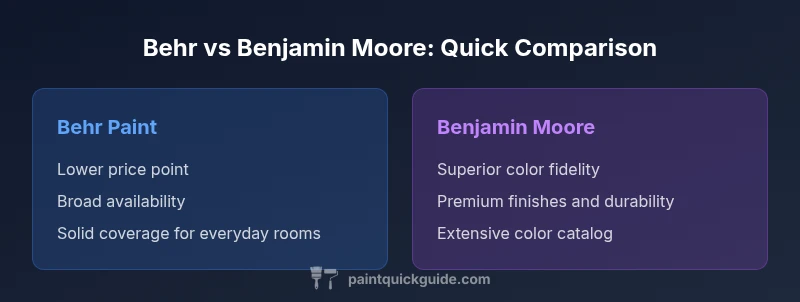
Behr paint vs Benjamin Moore shows a classic trade-off: Behr delivers strong value and broad accessibility, making it ideal for budget-conscious DIY projects, while Benjamin Moore emphasizes color accuracy and durable finishes for long-term performance in high-traffic spaces. For most homes, BM’s premium lines justify the higher price in busy rooms, but Behr remains a reliable, cost-effective choice for everyday painting. See the full comparison for nuanced guidance.
Introduction and Context
According to PaintQuickGuide, the Behr paint vs Benjamin Moore decision is less about a single best brand and more about aligning product attributes with your project priorities. In interior walls, color fidelity, coverage, and washability matter most for long-term satisfaction, while exterior surfaces demand durability against weather and UV exposure. This section lays out the core decisions homeowners and DIYers confront when choosing between these two popular brands, and it explains how to read the rest of the guide for practical, actionable advice. We’ll look at price, performance, and user experience across common room types, with concrete steps to test samples in your own space.
Key Differences at a Glance
The Behr vs Benjamin Moore comparison pivots on three core dimensions: price/value, color catalog and accuracy, and performance across interior and exterior surfaces. Behr is typically more accessible at big-box retailers, often offering lower upfront costs and broad color families. Benjamin Moore generally commands a premium due to color precision, pigment depth, and long-term durability claims. PaintQuickGuide’s analysis shows that most households will weigh cost against long-term outcomes differently depending on space usage, climate, and maintenance routines. For light-traffic rooms, Behr’s standard lines may suffice; for kitchens, baths, and high-traffic living areas, BM’s premium lines tend to win on color fidelity and washability. The table that follows condenses these differences into a quick, side-by-side view.
Coverage and Build: How Each Brand Performs on Walls
Both brands offer interior and exterior lines designed for easy rollout, but the practical outcomes differ. Behr products often emphasize forgiving application characteristics, better initial hiding on light colors, and reliable results for DIY projects with variable skills. Benjamin Moore emphasizes pigment depth, smoother color transitions, and potential advantages in coverage per gallon when using premium lines. In real-world conditions, surface preparation, paint sheen, and environmental factors such as humidity influence final results more than brand alone. When planning a room renovation, test samples on large patches of the surface you’ll paint to validate coverage, drying time, and desired appearance under your home lighting.
Color Accuracy and Consistency Across Finishes
Color accuracy is a key battleground in the Behr paint vs Benjamin Moore debate. Benjamin Moore is often regarded as having a class-leading color catalog with strong pigment load, which can yield richer hues and more faithful color reproduction across finishes like eggshell, satin, and semi-gloss. Behr provides a broad spectrum of colors as well, with a wide range of neutrals and bold hues, though some users report slight variations between batches or across sheens. Regardless of brand, always verify color with multiple sample boards in your lighting conditions and consider doing a small test wall before committing to a full room.
Application Experience: Brush, Roller, and Sprayer Feedback
User experience varies with surface type and primer choice. Behr’s standard lines are often praised for easy spread and good leveling, which helps beginners achieve a smooth finish with rollers or brushes. Benjamin Moore’s premium lines tend to offer very even pigment distribution, especially with high-quality rollers and sprayer techniques; they can require more careful surface preparation and primer selection to realize their full potential. Both brands support a range of finishes from matte to semi-gloss, with specialty finishes available in certain product families. Always follow manufacturer guidelines on brush type, sprayer settings, and drying times to optimize results.
Durability, Washability, and Stain Resistance
Durability and washability are critical in high-traffic areas and family homes. Benjamin Moore’s premium lines often emphasize stronger stain resistance and easier washability, particularly in eggshell and satin sheens, which can help maintain a like-new look after cleaning. Behr also offers durable options and low-VOC formulations; newer Behr lines focus on improved stain resistance and scuff resistance, making them suitable for living rooms, hallways, and kids’ spaces. The actual performance depends on the finish chosen, surface preparation, and maintenance; no single brand guarantees flawless results in every scenario. Regular touch-ups and appropriate primer use extend a paint job’s life.
Exterior vs Interior Performance Considerations
Exterior performance depends on weather exposure, UV stability, and moisture protection. Benjamin Moore’s exterior lines are often marketed with emphasis on color retention and mildew resistance in humid climates, while Behr’s exterior products emphasize long-term durability and cost efficiency. Inside, environmental factors such as kitchen heat, humidity, and cleaning frequency influence how well each brand performs over time. For a typical suburban home, BM may offer advantages in color stability and durability in kitchens, while Behr provides more budget-friendly options for large-scale living spaces.
Price, Value, and Buying Channels
Price remains a central consideration, though it’s not the only factor. Behr generally offers lower price points and broad availability at major retailers, which translates into quicker, cheaper refreshes for large-area painting projects. Benjamin Moore, conversely, tends to sit at a higher price tier, reflective of premium color offerings and perceived durability. Availability differs by region: Behr can be found in big-box stores nationwide, while BM products are typically distributed via independent dealers and specialty paint shops. When planning a project, factor in total cost of ownership, including primer, prep work, and the need for multiple coats to achieve coverage and color fidelity.
Practical Decision-Making by Room Type
For high-traffic living spaces and households with kids or pets, BM is often favored for its color depth and scrubability in premium lines. In kitchens and bathrooms where moisture resistance and easy maintenance matter, both brands offer strong options, with BM sometimes leading in stain resistance and durability in finishes like satin and semi-gloss. For guest bedrooms and guest rooms or budget-conscious renovations, Behr provides reliable results at a lower price point, allowing more flexibility to update colors and finishes without a large initial investment. Always sample in the actual room before finalizing.
How to Conduct a Side-by-Side Test in Your Space
A practical approach to choosing between Behr and Benjamin Moore is to run a controlled side-by-side test. Pick a wall and apply Behr on one patch and Benjamin Moore on an adjacent area using the same sheen and primer, if needed. Compare color accuracy under your home lighting at different times of day, note ease of application, hide, and finish feel. Document any changes after a week of use and cleaning, including how the paint responds to accidental marks, fingerprints, and moisture. Use these findings to guide your final decision for each room or project.
Comparison
| Feature | Behr Paint | Benjamin Moore Paint |
|---|---|---|
| Price range | lower-mid | mid-high |
| Color range and accuracy | Broad catalog, consistent color spread | Extensive catalog, strong color fidelity |
| Finish variety | Matte to semi-gloss, including specialty finishes | Matte to high-gloss, premium finishes |
| Coverage per gallon | Good coverage for most interiors | Excellent coverage with premium lines |
| VOC options | Wide low-VOC selections | Competitive low-VOC options |
| Availability | Widely available at big-box retailers | Distributed via independent retailers and specialty shops |
| Warranty/guarantee | Line-dependent warranties | Strong service policies and warranties on premium lines |
Upsides
- Behr offers strong value and broad accessibility for budget projects
- Benjamin Moore provides superior color fidelity and durable finishes
- Both brands offer low-VOC options and a range of sheens
- Wide availability across different retailer channels for Behr; BM supports premium color selection
What's Bad
- Behr may show batch-to-batch color variation on certain neutrals
- Benjamin Moore generally commands a higher price point
- Premium lines require careful surface prep and primer selection for best results
- Availability can vary by region for Benjamin Moore compared to Behr
Benjamin Moore often edges Behr for color accuracy and long-term durability, but Behr offers superior value and broader access for budget projects.
Choose Benjamin Moore if color fidelity and longevity are priorities. Choose Behr when budget, accessibility, and quick refreshes matter most.
Your Questions Answered
Which brand offers better color accuracy for interiors?
Benjamin Moore is often perceived as having stronger color accuracy across its premium lines, due to pigment depth and formulation. Behr delivers solid color fidelity, especially in standard colors, but you may notice minor batch-to-batch variation in some neutrals. Always test color samples in your room’s lighting before committing.
Benjamin Moore typically has stronger color accuracy in premium lines, but it’s still important to test samples in your space.
Is Behr cheaper than Benjamin Moore on average?
Yes, Behr generally sits at a lower price tier than Benjamin Moore across many regions. However, price can vary by color, finish, and local promotions. For budget-conscious projects, Behr often provides better upfront value, especially for large areas.
Behr is usually cheaper overall, though price varies by color and finish.
Do both brands have low-VOC options?
Both brands offer low-VOC and zero-VOC options across multiple product lines. When selecting, check the product label for VOC content and follow the manufacturer’s curing recommendations to ensure air quality is maintained during and after painting.
Both offer low-VOC choices; just check the label and follow cure times.
Which brand is easier to find in stores?
Behr is widely available at major home improvement retailers, making it convenient for quick purchases. Benjamin Moore is commonly sold through independent paint shops and specialty retailers, which may require a trip to a local store. Both brands have strong distribution, but Behr tends to be easier to find in mass-market outlets.
Behr is usually easier to find in big-box stores; BM may require a trip to a specialty shop.
Which is better for high-traffic rooms?
For high-traffic rooms, look at BM’s premium lines for durability and washability, especially in eggshell or satin sheens. Behr also offers durable options, and its cost advantage can be appealing for larger projects. Always choose a finish with good scrubbability and proper preparation.
BM often performs better in high-traffic rooms due to durability, but Behr can work well too with the right finish.
Should I prime before using either Behr or Benjamin Moore?
In many cases, yes, especially when switching from dark to light colors or painting over certain surfaces. BM premium lines may offer better results with proper primer choices, while Behr has some primer-ready products, but surface prep remains essential for all brands. Always follow the manufacturer’s guidance for priming.
Priming is often important; follow the product guidance for best results.
Quick Summary
- Prioritize color fidelity with premium BM lines for busy spaces
- Choose Behr for cost-conscious, large-area projects
- Always sample colors in your room's lighting before committing
- Consider total project cost including prep and primer, not just the per-gallon price
- Test both brands side-by-side for best room-specific results