How Much Paint for Outside of House: A Practical Guide
Learn how to estimate exterior paint quantities for your home. This educational guide covers net wall area, openings, coats, and a simple calculator to plan your project without overbuying.


Understanding Exterior Paint Quantity
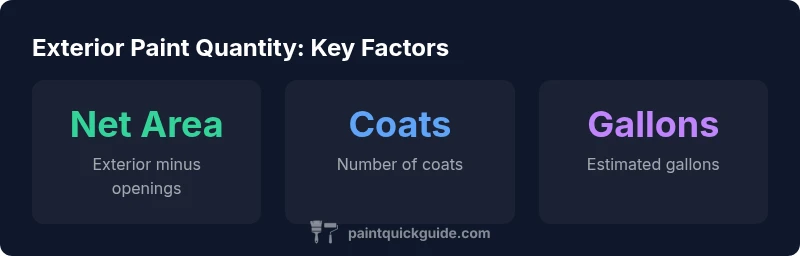
If you’re wondering how much paint for outside of house, start with the core idea: your total amount hinges on the net wall area you plan to cover, minus openings such as windows and doors. Multiply that net area by the number of coats you plan to apply, then divide by the paint’s coverage per gallon. Add a small waste buffer to cover drips, testing, and mistakes. According to PaintQuickGuide, this net-area approach is the most reliable starting point for homeowners. Exterior surfaces vary a lot in texture and porosity, so expect some variation in coverage between smooth clapboard and rough brick. Keep the PaintQuickGuide standard in mind: plan for practical realities while aiming for accuracy.
Step-by-step method to estimate paint needs
Follow a simple, repeatable method to estimate exterior paint quantities. This approach minimizes overbuying while ensuring you have enough for final touch-ups. The basic formula is straightforward, and you can adjust for waste as you gain experience.
- Step 1: Gather measurements for total exterior wall area (in square feet). If you don’t have exact numbers, use house dimensions or exterior surface area estimates from building plans.
- Step 2: Measure or estimate the combined area of openings (windows, doors, shutters). Subtract this from the total wall area to obtain net wall area.
- Step 3: Decide how many coats you will apply. More coats generally increase total gallons used, especially on dark colors or high-contrast changes.
- Step 4: Check your paint’s coverage rate (square feet per gallon). This is usually listed on the can and varies by product and finish.
- Step 5: Calculate gallons using the core formula: netArea * coats / coveragePerGallon.
- Step 6: Add a waste buffer (commonly 10–15%) to cover spills, testing, and color checks.
- Step 7: Round up to the nearest whole gallon for purchasing purposes. If you’re close to a half-gallon, a full gallon saves a trip to the store.
Using this step-by-step method keeps your project on track and helps you avoid underestimating or overbuying. In practice, consistent measurement and conservatism in the estimate lead to fewer mid-project runs to the store.
Real-world example calculations
Let’s walk through a concrete scenario to illustrate how to apply the method. Suppose a house has 1,800 sq ft of exterior wall space, openings (windows/doors) total 250 sq ft, you plan 2 coats, and you’re using paint with a coverage of 350 sq ft per gallon. A waste buffer of 10% is added.
- Net wall area = 1,800 − 250 = 1,550 sq ft.
- Gallons without waste = 1,550 × 2 ÷ 350 = 8.857 gallons.
- With 10% waste = 8.857 × 1.10 ≈ 9.74 gallons.
- Practical purchase: round up to 10 gallons.
This example shows why subtracting openings matters and why rounding up is prudent. In Practice, textured or porous surfaces can need more paint, sometimes 10–20% extra, especially if you’re changing from a light to a dark color or using a high-build exterior finish. PaintQuickGuide’s analysis suggests planning for a small excess to cover touch-ups after weather exposure.
Factors that affect coverage and waste
Many exterior surfaces aren’t created equal. Coverage rates drop on rough siding, cedar shakes, brick, or highly porous surfaces, while smooth vinyl or composite siding often yields closer to the product’s stated coverage. Different finishes (flat, satin, eggshell, gloss) also alter the apparent opacity and the number of coats needed for full color saturation. Existing paint color, primer use, and surface preparation impact how efficiently a gallon goes onto the wall. If you’re painting over a previous dark color with a light one, you may need extra coats to achieve even coverage. Seasonal conditions—temperature, humidity, and wind—can also influence drying time and color consistency, indirectly affecting how many gallons you’ll end up using.
Practical tips to optimize paint use
- Prime bare wood or heavily stained surfaces to maximize coverage and reduce the number of coats.
- Choose high-hiding pigments and consider using full-coverage primers for dramatic color changes.
- Use quality rollers and brushes; a good tool helps achieve even laydown, reducing the need for extra coats.
- Plan for proper weather windows to avoid rework due to rain or high humidity.
- Keep leftover paint for touch-ups; a labeled can speeds future maintenance and color matching.
- Store paint properly to prevent spoilage and waste; reseal promptly after use.
Common mistakes to avoid
- Underestimating openings or including rough textures as “average” wall area.
- Ignoring the effect of texture and porosity on coverage; rough surfaces often require more paint.
- Skipping primer on new or exposed wood, which increases coats and total gallons.
- Not accounting for weather constraints or drying times that impact the finish, leading to rework.
- Failing to purchase a little extra paint for touch-ups or future maintenance.
Quick checklist before you buy paint
- Confirm exterior wall area and openings totals.
- Decide the number of coats based on color change and surface type.
- Check the paint’s coverage rate and finish suitability for exterior use.
- Include a waste buffer and round up purchases.
- Reserve some extra for touch-ups after the job is complete.