What Paint Mix Makes Brown: A Practical Guide
Learn how to mix brown paint using color theory for walls, furniture, and auto refinishing. Practical recipes, shade adjustments, and testing tips for reliable brown tones.


Brown can be created by mixing warm and cool color components in balanced ratios. The most reliable routes are red and green or blue and orange, supplemented by small amounts of yellow, white, or black to fine-tune undertone, value, and saturation. Always test swatches under your project lighting. Mix gradually and compare across surfaces for consistency.
Understanding Brown in Paint
Brown is one of the most versatile neutrals you can use in home and car projects. It anchors warm or cool schemes and can be tuned to read as rustic, modern, rich, or soft. When we ask what paint mix makes brown, the answer hinges on color theory and practical blending. Brown arises when you blend primary colors in deliberate ratios or when you mute a pure hue with a color's complement. According to PaintQuickGuide, the most reliable brown tones come from carefully balanced red, green, yellow, and blue inputs rather than random substitutions. In practice, you’ll typically start from a base of warm or cool primaries and then adjust with white to lighten or black to deepen. Always consider the final surface and lighting, because browns can shift dramatically under different conditions. After you mix, let the color rest for a few minutes to allow the hues to settle and then re-check under the intended lighting. This habit reduces surprises during cut-in work, furniture refinishing, or wall application.
Primary Color Mixing Routes
There are several reliable pathways to brown, each with its own feel. The classic route uses red and green as a base. When these two are blended, the result moves toward neutral brown; you can steer it warmer by adding yellow and leaner by adding blue for a cooler, espresso-like tone. A second common route is blue and orange, which produces a rich brown that reads cool if you topple it toward green, or warm if you lean toward yellow. A third, subtler path uses yellow and purple to produce warmer tan browns or deeper chocolate browns when darkened with a touch of black. In real projects, you’ll often combine a primary pair and then refine with a small amount of the third color (plus white or black) to hit your desired undertone and saturation. Remember, the order you mix colors in can affect the final result, so test gradually on swatches.
Warm Brown Recipes You Can Try
Warm browns feel inviting in living spaces and on wooden furniture. Start with red and green as your base, then introduce yellow to push toward amber. If the result feels too bright, add a whisper of blue or a touch of brown pigment from your mixed batch to mute it. For a slightly darker, toasted-brown look, incorporate a tiny amount of black or a deeper pigment while watching for muddying. Another technique is to begin with orange (red plus yellow) and blend in blue in very small increments to create a traditional brown that carries warmth without leaning toward orange. Whichever route you choose, document your starting ratio and note how it changes with white to reach the light versions you may need for walls or trim. Consistency across values helps keep the palette cohesive across rooms.
Cool and Neutral Browns: Achieving Balance
Cool browns carry a modern, subdued feel that works in contemporary interiors and car interiors alike. To move toward cool, start with blue as your moderating color and blend with orange or red until you reach a neutral base. Add white to lift, or a touch of green to push toward earthy gray-brown. If you want a neutral taupe that reads almost gray, minimize the red and yellow and emphasize blue and black gradually. For car refinishing, note that cool browns can be hard to match between batches because automotive paints often rely on different pigments and clear coats; always test under the same lighting and with the same base. A practical trick is to create two swatches: one for walls and another for trim to ensure you’re balancing undertones consistently across surfaces.
How Lighting and Surfaces Affect Brown
Lighting has a powerful effect on brown perception. Sunlight, warm lamps, and cool fluorescents all shift undertones differently. On painted walls, a brown that seems perfect in daylight may appear too warm or too flat under artificial light. On wood, the grain and stain interaction can darken or redden the color, so always test on the actual surface or a close substitute. For metal or plastic automotive parts, the type of resin and finish—gloss, satin, or matte—also influences perceived warmth. When you’re mixing, work with a broad daylight or balanced artificial light and compare swatches on the material you’ll paint. If possible, view swatches after they’ve dried, since some finishes shift as solvents evaporate and binders cure.
Practical Tips for Consistency Across Batches
A steady browns toolkit improves repeatability. Label each swatch with the order you added colors and the final shade name. Maintain a clean mixing area to avoid stray pigments, and always start from a neutral base when testing new undertones. Create small, spare mixes so you can re-create the shade later without starting from scratch. Keep a color reference sheet that notes the base color (red/green or blue/orange), the amount of white or black, and any modifier (yellow for warmth, blue for coolness). If you’re painting multiple surfaces, mix a larger batch and bottle it in an airtight container for reuse, labeling it with the date and project name. Finally, test on your intended surface after it’s dry to confirm the finish matches the rest of the space or vehicle.
Troubleshooting Common Brown Mistakes
Muddy browns are the most common issue. They usually come from overusing black or an overpowering blue, or from attempting to mute too aggressively with white in one shot. If your shade veers muddy, back off the black and blue, and re-balance with the base primaries. Another frequent problem is browns that skew too warm or too cool for the setting; fix by adding small amounts of the complementary color rather than big leaps in hue. If you’re matching an existing surface, always compare swatches under the exact lighting conditions and materials to avoid hue drift. Finally, remember that translucent paints can appear different in coats; apply test strips to check depth and saturation before committing to a full area.
Testing and Saving Your Browns for Future Projects
Testing is a habit that pays off. Build a small color library of swatches labeled with their blend notes and intended use. Save your best mixes in airtight containers or a dedicated palette for future touch-ups, and re-check their values after drying. For walls, apply multiple coats to gauge color depth; for furniture and accents, test on the actual finish you’ll be using to account for gloss and grain. If you’re refinishing a car, compare color shifts across primer, base coat, and clear coat by applying on a compatible panel. When you’re satisfied, write down the exact color components, ratios, and any modifiers so you can reproduce the tone later with confidence.
Authority sources
For color theory guidance and practical testing, consult reputable sources on color mixing and painting. Extension services from universities provide practical, step-by-step guidance on paint mixing and color selection that apply to homes and hobby projects, while major publications give foundational color theory insights. See sources such as university extension pages and Britannica for deeper reading and validation of your mixing experiments: https://extension.illinois.edu, https://extension.oregonstate.edu, https://www.britannica.com
Tools & Materials
- Red paint (primary)(Warm, pigment-rich red suitable for acrylic or oil-based projects)
- Blue paint (primary)(Choose a true blue with minimal green or purple bias)
- Yellow paint (primary)(Warm or golden yellow works best with red and blue)
- White paint(For tints, lightening browns and soft edges)
- Black paint(Optional for deepening tones; add gradually to avoid muddy results)
- Palette or mixing tray(Smooth surface for clean color separation and easy clean-up)
- Mixing sticks or spatulas(Disposable or reusable; keep separate for each color to avoid cross-contamination)
- Water or paint medium(Use water for acrylics; thinner for oil-based paints)
- Paint swatches or color wheel(A color wheel helps predict undertones and complementary relationships)
Steps
Estimated time: 30-60 minutes
- 1
Set up workspace and organize colors
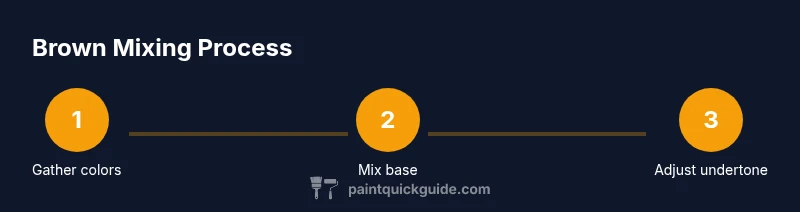
Prepare a clean, well-lit workspace with a protective cover. Gather the primary colors, white, and optional black, and set them in clearly labeled zones to prevent cross-contamination. This initial discipline saves time later and makes your color decisions more precise.
Tip: Label each color zone and keep a wet-dip brush handy to test swatches quickly - 2
Mix a base brown from red and green
Place equal portions of red and green on the mixing tray and blend until the hue reads brown. Observe the undertone; if it leans too warm, bring in a touch of blue or yellow. Keep the mix on a neutral swatch and compare against your target surface.
Tip: Add tiny increments and pause to observe the hue on a swatch - 3
Tune undertone with yellow or blue
To push toward warmer browns, introduce yellow slowly. To cool the tone, add small amounts of blue (or a muted earthier pigment). Recheck on a swatch after each adjustment to maintain control over the final shade.
Tip: Test under the same lighting as the final surface - 4
Lighten the shade with white
Add white gradually to lift the brown toward the desired lightness. White can shift the undertone slightly toward pinkish or creamy depending on the base mix, so recheck on a test swatch.
Tip: Record how much white you used to reproduce the shade later - 5
Darken carefully with black
If you need a deeper brown, add a very small amount of black or a dark pigment. Avoid large jumps, which can make the color muddy or dull. Revisit the base red/green balance after darkening.
Tip: Black magnifies undertone shifts, so proceed slowly - 6
Create variations and document blends
Experiment with alternative base routes (red+yellow+green or blue+orange) to diversify your brown family. Document each blend on a swatch card, noting the ratio and the expected use (walls, furniture, trim).
Tip: Keep an easily accessible notebook or digital note with all formulas - 7
Test swatches in lighting and on target surfaces
Apply swatches on the actual surface or a close substitute under the same lighting you’ll use for the project. Dry times can reveal shifts in color due to pigment settling and binder changes.
Tip: Compare swatches on the real surface and in both natural and artificial light - 8
Record ratios and store for future use
Capture the exact color components, order of addition, and final shade name. Store leftovers in an airtight container labeled with project name and date for consistent future touch-ups.
Tip: Label with date, project, and intended use to prevent mix-ups
Your Questions Answered
What color mix makes brown?
Brown can be created by combining red and green or blue and orange, then adjusting with yellow, white, or black to reach the desired undertone and lightness. Testing swatches is essential for accuracy.
Brown comes from mixing primary colors like red and green or blue and orange, then tweaking with yellow, white, or black. Always test swatches to confirm the undertone.
Can I make brown with acrylics?
Yes. The same color relationships apply to acrylics; mix primaries and adjust with white or black as needed. Be mindful of drying times and surface finish.
Yes, you can mix brown with acrylics the same way you would with other paints. Just be mindful of drying and finish.
How do I adjust brown undertones?
To warm brown, add yellow and a touch of red. To cool, introduce blue and a bit of green or purple. Use white to lighten and black sparingly to deepen.
Warm undertones come from yellow and red; cool ones come from blue and green. Lighten with white and deepen carefully with black.
Is brown difficult to match across surfaces?
Yes, because lighting and surface material shift how brown looks. Always test swatches on the final surface under the project lighting before full application.
Brown tones can shift with lighting and surface. Always test on the real surface under the intended lighting.
Why is my brown muddy and how can I fix it?
Muddy browns typically result from overuse of black or blue or from over-muting with white in one step. Back off those colors, re-balance with the base primaries, and test again.
If brown looks muddy, reduce black or blue and rebalance with red, green, or yellow. Test again on the swatches.
How do I save leftover brown for future projects?
Store the final mix in an airtight container, clearly labeled with date and project. Reproduce by noting exact ratios and the order colors were added.
Save leftover brown in an airtight container with a label. Note ratios and order to reproduce later.
Watch Video
Quick Summary
- Mix brown by balancing color components and brightness
- Start with primary color pairs before adding neutrals
- Test swatches under project lighting for accuracy
- Document formulas for repeatability
- Surface type and lighting influence undertones