Paint Colors in Purple: A Practical Guide to Choosing and Using Purple Hues
Explore expert guidance for selecting and applying paint colors in purple for walls, cabinets, and accents. Learn palettes, undertones, finishes, lighting, and budgeting to create cohesive spaces with purple.


You will learn how to pick purple tones for walls, cabinetry, and accents, and how to test colors in real light. This guide covers undertones (blue-violet vs. red-violet), palette strategies (monochrome, analogous, and complementary), finishes, lighting, and budgeting so you can create cohesive spaces with confidence.
Understanding the purple spectrum for painting
Purple is not a single color but a spectrum ranging from pale lilac to rich eggplant. When planning paint colors in purple for walls, cabinets, or furniture, you must consider undertones, lighting conditions, room size, and the overall design language you want to support. The PaintQuickGuide team emphasizes that success with purple starts with understanding undertones and how they interact with adjacent colors. By thinking in terms of undertones (blue-violet, red-violet, or neutral-tinted purples) you can predict how a shade will read in daylight and artificial light. This awareness helps prevent muddy looks and ensures your purple hues stay true to the mood you want to create. PaintQuickGuide notes that a well-chosen purple can feel serene in a bedroom, sophisticated in a dining room, or playful in a kid’s space. Focus on the space’s natural light, ceiling height, and furnishings to choose the best starting point for your palette.
Color psychology and mood with purple
Purple carries distinct psychological associations that can guide your choice of shade and placement. Lighter purples—lavender, lilac, and orchid—often feel airy and calming, making them popular for bedrooms and bathrooms. Medium purples, such as amethyst or grape, offer a balanced energy that can work well in living rooms or home offices when paired with warm neutrals. Deep purples like plum and eggplant bring drama and elegance to dining rooms or feature walls, especially in rooms with strong architectural details. When selecting purples, consider the mood you want: a tranquil retreat, a bold statement, or a refined backdrop for art and furniture. In all cases, test several samples on large poster boards or wall areas to see how the color shifts with time of day and lighting. This approach helps prevent color surprises after paint dries.
Undertones and how they affect purple
Undertones determine how a purple reads next to other colors and materials. A blue-leaning purple often feels cooler and more modern, pairing nicely with cool grays and steel accents. A red-leaning purple tends toward warmth and richness, pairing well with warm woods and creamy neutrals. Depending on your space, you may wish to avoid muddy results by testing swatches under natural daylight and under incandescent and LED lighting. Always compare swatches against existing floors, upholstery, and cabinetry before committing. If your space has warm lighting, a cooler violet can appear washed out; in cooler light, it may feel punchy. The goal is to find a purple with the right balance for your room’s lighting and existing textures.
Choosing palettes: monochrome, analogous, complementary
A thoughtful palette makes purple feel intentional rather than arbitrary. A monochrome scheme uses variations of a single purple with white, gray, or black neutrals to create a serene, cohesive space. An analogous palette pairs purple with adjacent hues like blue and pink, producing harmonious transitions that feel natural. A complementary scheme places purple with yellows or gold accents to create dynamic contrast that still reads balanced. For kitchens, purples in the lavender-to-eggplant range can be surprisingly versatile when paired with warm whites and natural wood tones. For small rooms, lighter purples with high-contrast trim can visually enlarge the space. When choosing purples, build a mood board that includes fabric samples, artwork, and furniture to ensure your palettes translate across textiles and surfaces within the room.
Finishes and sheen: which purple works where
Finish matters as much as the hue itself. Matte or eggshell finishes soften purples, making them ideal for walls in bedrooms or living rooms where you want a cozy feel. Semi-gloss or satin finishes work well for kitchens and bathrooms, where easier cleaning and slight reflectivity can enhance color depth. High-gloss purples are dramatic and best saved for accents, cabinetry fronts, or a feature wall with ample lighting and simple surrounding neutrals. Consider sheen relative to room function and maintenance: high-traffic spaces benefit from washable finishes, while spaces intended for rest and relaxation can benefit from the subtlety of a matte surface. Test your chosen finish on a sample board and in a well-lit corner of the room to observe how it interacts with light and textures.
Lighting and space size considerations
Natural light dramatically affects purple hues. North-facing rooms tend to skew cooler, making purples read blue; south-facing rooms can warm purples, pulling in pink or red undertones. In small spaces, keep purples light and airy to avoid a crushed feeling, and use lighter neutrals on trim and ceilings to reflect light upward. In larger rooms, deeper purples can anchor furniture groups and create a sense of drama without overwhelming the space. If your space includes bright artificial lighting, consider bulbs with a color temperature around 2700K–3500K to maintain color fidelity. Always validate color choices under a full spectrum light to ensure the purple reads as intended in real life.
A practical workflow: from samples to final coat
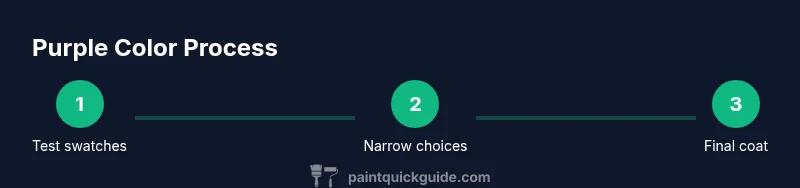
A systematic workflow reduces color mistakes when working with purple. Start by gathering 3–5 purple shades in the range you’re considering. Apply large swatches on multiple walls and observe under different lighting across a day. Narrow to two top contenders, then paint a 24" x 48" swath on each wall to compare how the color interacts with furniture, wood tones, and textiles. Prime surfaces only if needed to prevent color inconsistency, especially on pre-finished surfaces. Finally, apply the chosen purple to the entire wall, finish with the selected sheen, and inspect in both daylight and artificial light before moving on to any accent colors or trim. This method minimizes surprises and ensures your purple choice supports the room’s overall design language.
Testing samples and evaluating color in real light
Testing is critical with purple, given its sensitivity to lighting and adjacent colors. Use large boards or drywall patches painted with each shade to simulate wall coverage. Place swatches in the room’s main light zones and near sources of natural wood or metal to observe reflections. Photograph the samples at different times of day and in artificial light to compare color shifts. If a shade appears overly cool or warm, consider adjusting by one step lighter or by selecting a different undertone (blue-violet vs red-violet). Record your observations on a simple color log that includes date, lighting condition, and room function to guide final selection.
AUTHORITY SOURCES
This section provides reputable references to support best practices in color selection and safe painting practices. The following sources offer guidance on color use, environmental considerations, and safe disposal of paint materials:
- https://www.epa.gov/lead
- https://www.osha.gov/lead
- https://www.cdc.gov/nceh/lead/prevention/default.htm
Tools & Materials
- Primer(Stain-blocking primer for rooms with heavy pigment or knots)
- Purple paint (chosen shades)(Include at least 2 shades (one light, one deep))
- Paint trays and liners(For even roller coverage)
- Roller covers (3/8-1/2 inch nap)(Choose based on wall texture)
- Angled brush or corner tool(For precise edges and cutting in)
- Painters tape(Protect trim and create clean lines)
- Drop cloths(Protect floors and furniture)
- Color swatches/posters(Test shades in room lighting)
- Mild soap and water(For cleaning walls before painting)
- Dust mask and eye protection(Safety during sanding and prep)
- Sandpaper (120–180 grit)(Smooth rough spots before priming)
Steps
Estimated time: 4-8 hours
- 1
Prepare the space
Clear the area, lay drop cloths, and remove switch plates. Clean walls with mild soap and water to remove dust and oils that can affect adhesion. Protect adjacent surfaces with painter's tape and ensure proper ventilation.
Tip: Use a dust mask if you’re sanding or cleaning dusty surfaces to avoid inhalation. - 2
Select your purples
Choose 3–5 purple shades that fit your lighting and furniture. Compare swatches in the room’s main light and near windows to see how each shade reads under different conditions.
Tip: Label swatches (A, B, C) and photograph them in various light to avoid confusion later. - 3
Test color samples in real light
Paint large test patches (at least 12" x 12") on each wall and observe for 24 hours under day and night lighting. Note how undertones shift and how the color interacts with wood tones and fabrics.
Tip: Ignore small chip samples; use full-sized patches to judge real color response. - 4
Prime and edge work
If repainting a dark wall or covering a stain, apply a compatible primer first. Cut in edges with an angled brush for crisp lines before rolling large sections.
Tip: Prime duplicates of color to prevent show-through and ensure uniform finish. - 5
Roll the color
Apply paint in 3–4 foot sections, maintaining even pressure and a wet edge to minimize lap marks. Overlap strokes slightly for uniform coverage and 2 coats if needed for true color depth.
Tip: Roll in the same direction on each wall to create a seamless surface. - 6
Finish and cure
Allow adequate cure time between coats. Inspect under natural and artificial light and adjust with a touch-up if necessary. Remove tape while the final coat is still slightly tacky for clean lines.
Tip: Ventilate during curing to reduce odor and promote faster drying.
Your Questions Answered
What undertone should I choose for purple walls?
Undertones determine how purple reads next to other colors. Blue-violet shades read cooler and pair well with grays; red-violet shades feel warmer and pair nicely with creams and warm woods. Always test under real lighting before deciding.
For purple walls, start with blue-violet if you want a cooler look, or red-violet for warmth. Test under your room’s light to be sure.
Which purple shade works best in a small room?
Light purples like lavender or lilac help a small room feel larger. Use more neutral neutrals on trim and ceilings to keep the space feeling open and airy.
Light purples make small rooms feel bigger; balance with light trim and neutrals.
Should I use purple on walls or as an accent?
For a bold statement, choose purple walls in a single room with balanced neutrals. If you want subtle drama, apply purple to an accent wall or cabinetry with neutral surroundings.
Walls for bold drama, or use purple on an accent wall or cabinets for a softer touch.
How many purple shades should I test?
Test 3–5 shades to compare undertones and light response. Narrow to two top choices before committing to a full paint job.
Test 3–5 shades; pick two favorites after observing in different lights.
What finishes work best with purple in high-traffic areas?
Satin or eggshell finishes offer durability and a soft sheen that’s easy to clean, suitable for living rooms and hallways. Reserve high-gloss for accents if you want a striking effect with low maintenance.
Use satin or eggshell for durability; reserve high-gloss for accents.
Can purple be used with wood tones?
Yes. Purple pairs beautifully with natural wood tones when the wall color leans neutral to allow the wood’s warmth to show. Consider a white or light gray trim to balance the look.
Purple and wood work well together if you keep neutrals nearby.
Watch Video
Quick Summary
- Choose undertones deliberately to control mood.
- Test purple shades in real lighting before committing.
- Pair purples with neutrals and warm woods for balance.
- Finish and sheen dramatically affect color perception.
- Document your tests to inform final decisions.