What Paint Makes Purple: A Practical Mixing Guide
Learn how to mix purple by blending red and blue paints, with tips on tints, shades, and finishes for walls, crafts, and auto refinishing. Practical steps, safety, and brand guidance from PaintQuickGuide.


Purple is made by mixing red and blue paints. Start with equal parts of primary red and blue, then adjust toward red for warmer purples or toward blue for cooler purples. Lighten with white for tinting or deepen with black for shade; test on scrap first. Remember color undertones and finish (matte, satin, gloss) will shift perception.
The Color Theory Behind Purple
Purple sits between red and blue on the color wheel. By blending these primaries in varying ratios, you create a spectrum from warm, reddish violets to cool, blue-leaning purples. According to PaintQuickGuide, the most predictable purples come from balanced mixes of red and blue with stable pigments rather than mixes of mid-tone paints, which can muddy the result. The underlying chemistry is simple: pigments absorb some wavelengths and reflect others. Red pigments tend to pull the mix toward warmth; blue pigments push toward the cool side. Lighting, pigment quality, and the base paint’s undertone all influence the final shade. For home painting, aim for neutral undertones that read as purple rather than pink or blue. For crafts and automotive refinishing, expect slightly purer, more saturated purples that hold their tone under lighting variations. The key takeaway: understanding the red-blue dynamic helps you predict the outcome better, but always test swatches on your actual surface.
To make purple consistently, work with clean primary colors and test the blend on scrap material before committing to your project. This approach reduces wasted paint and ensures the final hue aligns with your design goals.
Start with Red and Blue: Core Ratios
Purple results from red and blue interactions, but the exact tone depends on pigment strength and the base color beneath. A standard starting point is a 1:1 ratio of red to blue to yield a balanced purple. If you want a warmer, wine-toned purple, tilt the mix toward red (for example, 1.5:1 red to blue). For a cooler, indigo-inspired purple, tilt toward blue (1:1.5 or 1:2 blue). Always mix small test batches to compare under your project’s lighting conditions. When you keep the base paints true and fresh, the resulting purples are more predictable across lighting in rooms, crafts, or car refinishing contexts. Remember that different brands have different pigment loads; what reads as purple in one brand can skew toward pink or blue in another.
A practical tip is to start with a small 1:1 batch on a mixing palette, then adjust gradually. Note how the hue shifts as you tweak the ratio, and label the tested samples for future reference. This method reduces guesswork in future projects.
Lightening and Deepening: Using White and Black
White is your friend for creating tints, which are lighter versions of purple. Add white gradually to a base purple until you achieve the desired lightness, testing frequently on a scrap surface. Be aware that too much white can desaturate the color and shift toward pinkish or lavender tones if the red component is too weak. For a deeper, more saturated purple, introduce a touch of black or a darker blue. Use small amounts to avoid muddying the hue; purple can quickly lose brightness if over-darkened. If your finish reads differently on walls compared with swatches, adjust by re-testing under the room’s lighting. The goal is a consistent, vibrant purple that matches your design intent across surfaces and finishes.
Choosing Pigments: Pigment Variants and Practical Picks
Different blues and reds yield different purples. A cool purple often uses phthalo blue with a strong red, while Ultramarine blue provides a warmer undertone when mixed with red. Likewise, quinacridone or cadmium reds will influence saturation and brightness. If you’re working with latex/acrylic paints, pick pigments known for colorfastness and good coverage. In automotive refinishing, expect higher pigment density and different mixing requirements. Always test color in the project context, as walls, crafts, and cars each respond uniquely to the same mix. Using high-quality pigments will deliver truer purples and reduce the need for frequent color adjustments.
Mixing Techniques: Step-by-Step Workflow
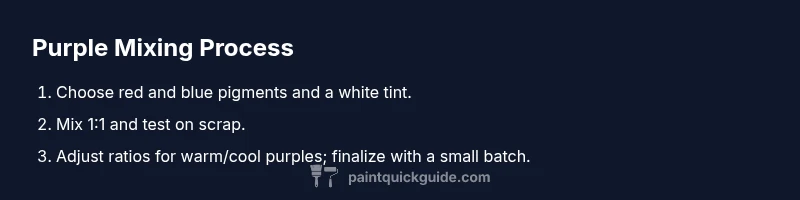
A practical workflow helps you execute purple mixes with confidence. Start by laying out red, blue, and white on a clean palette. Create a base purple at a 1:1 red-to-blue ratio, then adjust toward red or blue to hit your target. Add white to create tints, then lightly test the tint against your sample surface. If the tint is too pale, increase the base purple concentration; if it shifts toward pink or blue, recalibrate the ratio. Once you achieve a satisfactory color, document the exact ratios for future use. Finally, apply a small test patch to ensure uniform color under your project’s lighting conditions.
Troubleshooting Common Purple Variations
Muddy purples usually result from over-mixing or using low-quality pigments. If your purple looks dull, try increasing the intensity of blue or red in small increments depending on the undertone you want. A muddy result can also come from mixing colors with a strong, neutral undertone; separate clean purples by starting fresh with new batches. Lighting plays a significant role: check swatches under the same light as the project space. If your purple shifts after drying, it could be due to the paint’s drying step or the surface texture; a finish coat or glaze can help maintain vibrancy.
Matching Purple to Projects: Walls, Crafts, and Car Finishes
On walls, purple can serve as an accent or a bold primary color. For crafts, lighter purples often read more playful; darker purples convey sophistication. In car refinishing, purples can lean toward jewel tones or muted plums depending on the base color and clear coats. Always swatch on the actual surface and consider finish (matte vs. gloss) when evaluating purple. Lighting should be consistent with the final installation area—rooms with natural light can shift purples differently than studio lighting. A small, repeatable mixing procedure ensures consistency across multiple gallons or batches.
Safety, Cleanup, and Storage
Paints should be mixed and stored in a well-ventilated space. Use gloves if you have sensitive skin and wipe spills promptly. Clean brushes and tools with the appropriate solvent or soap and water, depending on paint type. Store leftover color in labeled containers sealed tightly to prevent evaporation and color drift. If you’re mixing automotive paints, follow the supplier’s safety data guidelines and work in a dedicated, ventilated area with proper personal protective equipment. Proper cleanup prevents colors from unintentionally bleeding into other shades and keeps your mixing area organized for future projects.
Quick Reference: Ratios to Try
- Warm purple: Red 2 parts : Blue 1 part
- Cool purple: Red 1 part : Blue 2 parts
- Neutral purple: Red 1 part : Blue 1 part, add white to tint
- Deep purple: Red 1 part : Blue 1 part, a touch of black
- Light lavender: Base purple with 25–40% white
Label each swatch with its ratio to reuse later and to support consistency in repeated projects.
Finishing Touches: Sheen and Topcoat Considerations
Finish affects perception more than you might expect. A high-gloss purple will read more saturated under bright light, while a matte finish can soften the color, making it appear cooler or warmer depending on the lighting and wall texture. If you’re pairing purple with neighboring colors, test swatches side by side and compare at the final distance you’ll observe the project. For car finishes, consult the clear coat’s compatibility with your pigment to avoid gloss variations or color shifts after curing.
Tools & Materials
- Red paint (primary red)(Warm hue works best; avoid muted reds that drift toward pink.)
- Blue paint (primary blue)(Ultramarine or phthalo blue commonly used; pigment strength varies.)
- White paint(Used for tints and lighter purples.)
- Black paint(For deepening purples; use sparingly.)
- Mixing tray or palette(Glass or ceramic works well for clean testing.)
- Palette knives or stir sticks(For precise mixing and scraping swatches.)
- Scrap paper or test surface(Key for swatching and color matching.)
- Paper towels(Keep workspace tidy and prevent spills.)
- Gloves (optional)(Protect skin from repeated contact with pigments.)
Steps
Estimated time: 20-30 minutes
- 1
Gather base colors
Place red, blue, and white on the palette. Have a clean area to test formulas and keep notes handy for ratios and results.
Tip: Label each swatch with its ratio for easy reference. - 2
Prepare your mixing surface
Set out a clean palette or tray and organize your brushes or sticks. A tidy setup reduces cross-contamination between shades.
Tip: Wipe the palette between major color adjustments. - 3
Create base purple
Mix red and blue in a 1:1 ratio on the palette to form a neutral purple. Observe under your project lighting to anticipate color shift.
Tip: Keep the batch small to avoid wasting paint. - 4
Adjust warmth or coolness
If you want warmer purples, tip toward red; for cooler purples, lean toward blue. Mix tiny increments and compare swatches.
Tip: Document the final ratio you settle on. - 5
Tint for a lighter shade
Add white gradually to reach the desired tint. Test on scrap to ensure you maintain saturation as you lighten.
Tip: White can desaturate the color; compensate with small red-blue adjustments. - 6
Shade for a deeper tone
Introduce a touch of black or a deeper blue to darken the mix. Apply sparingly to avoid muddying the color.
Tip: Test under your lighting to ensure depth is consistent. - 7
Test on the actual surface
Apply a small patch on the final surface to observe how it reads with texture and lighting. Compare to sample swatches.
Tip: If it shifts, adjust the base mix before full application. - 8
Document the recipe
Record the precise ratios and steps used to achieve the final purple. Create a reusable reference for future projects.
Tip: Store mixed colors in labeled containers if you need another batch later.
Your Questions Answered
What colors make purple?
Purple is created by mixing red and blue. The exact shade depends on the pigment strength and the ratio. Adjust with white to tint or black to shade, and test swatches before applying widely.
Purple comes from mixing red and blue, with tweaks for tint or shade. Always test on a swatch first.
Can I mix purple with acrylic or latex paint?
Yes. Both acrylic and latex paints can be mixed to purple using the same red-blue ratio guidance. Check pigment compatibility and drying times, and swatch-prep before large projects.
Yes, you can mix purple with acrylic or latex paints. Test swatches first.
Why does my purple look pink or blue?
This happens when the red or blue pigment is dominant or when lighting shifts perception. Rebalance the ratio and re-test under the target lighting to achieve the intended hue.
If purple looks off, tweak the red-to-blue ratio and retest in the final lighting.
How can I get a muted purple?
Add small amounts of gray or an equal mix of white and a neutral color like Payne's gray or earth tones. This reduces saturation and creates a desaturated purple.
To mute purple, mix in a touch of gray or a neutral color.
Does drying time affect purple color?
Drying can shift perceived color slightly due to light scattering and surface texture. Allow ample curing time and view under the intended finish lighting.
Color can shift a bit as it dries, so check swatches after they dry.
Is purple always a red+blue mix?
Purple typically comes from red and blue, but some purples achieve their look with different blue or red pigments or with a dash of black. Always swatch to confirm.
Typically red and blue, but pigments can alter the exact hue.
Watch Video
Quick Summary
- Mix red and blue in clear ratios to control purple warmth.
- Lighten or darken using white or black with care to maintain saturation.
- Test swatches on the actual surface before committing.
- Document final recipes for repeated accuracy.