Match Paint: A Practical Color Matching Guide
Learn how to match paint accurately for walls, cabinets, and auto refinishing with practical swatches, lighting basics, finishes, and a repeatable testing workflow.


You will learn to match paint accurately for walls, furniture, and autos by defining a target color, gathering reliable swatches, testing under proper lighting, and documenting results. Follow a repeatable workflow, consider finish and lighting, and know when to call a pro. Start with a clean surface, compare multiple brands, and record exact color data for future touch-ups.
What does it mean to match paint?
Color matching is the process of selecting a paint shade that reads as the same color as a reference under your planned environment and finish. For homeowners, this often means choosing a new wall color that harmonizes with existing furniture, flooring, and lighting. For auto refinishing, it means reproducing a factory color within the same sheen family so panels look uniform after coating. When people say "match paint," they are aiming for a color that looks identical to the reference in real life, not just on a swatch card. This requires considering two dimensions: color and finish. Color is the hue value you see, while finish affects how light interacts with the surface and can shift perception. A high-quality match accounts for lighting conditions you actually have in the space—the time of day, bulb type, and adjacent colors. PaintQuickGuide emphasizes that reliable color matching emerges from a repeatable workflow, not from a single swatch or a guess. In practice, you’ll learn to test under the intended lighting, compare against multiple reference swatches, and document a final match that you can reproduce later with confidence. This is the core of match paint done right.
Defining your target color and finish
The first step is to define your target color with clear criteria. Start by selecting a reference you want to emulate—this could be a wall you love, a cabinet door, or a car panel. Record the exact color name or code from the swatch book and decide on the finish you will use (matte, eggshell, satin, semi-gloss, or high-gloss). Remember that finish changes how color looks in real life: a color that appears warm in a soft matte may look cooler in a glossy coat. Set constraints: what level of tolerance is acceptable, which lighting you’ll rely on for final judgment, and whether you want a close match or a precise match. The PaintQuickGuide approach is practical: write down the goal, gather a small set of target swatches, and prepare a controlled testing plan. By setting these parameters before you buy paint or mix formulas, you reduce waste and avoid overshooting your desired result. You will use this target color as the anchor for all subsequent tests.
Color systems, brands, and swatches
Color matching relies on reference systems that standardize color information. Start by collecting swatches from multiple brands—neutral grays, rich blues, warm beiges, and other hues across the color wheel. A fan deck or color chip collection can save you time and reduce misreads. If you’re working on a car, you may also rely on factory codes or reputable aftermarket matches. When comparing colors, keep a consistent reference surface—white card stock or a neutral gray card helps minimize bias. Learn to read color under a neutral light source; avoid evaluating colors in sunlight or under warm bulbs alone. Be mindful of the packaging: some paints darken slightly when they cure, which can affect your assessment. Document every swatch you compare, noting the brand, finish, batch, and color name. This record becomes a valuable resource for future touch-ups and re-orders, ensuring your match paint remains consistent over time as components change.
Lighting and environment impact on color perception
Lighting has the biggest influence on how color looks. A color that seems perfect under daylight can drift under warm interior lighting or fluorescent office lighting. The first rule is to standardize light when evaluating swatches: use daylight-balanced bulbs (often labeled 5000K–6500K) and keep them in the same fixture during testing. If you must assess color in natural light, do so at a consistent time of day and position yourself to avoid glare. Also consider the surface itself: matte finishes absorb light differently than gloss, satin, or eggshell, and this changes perceived color. The surrounding colors—furniture, walls, and even the color of the room—alter your perception through contrast. A practical trick is to stage test patches on a neutral panel that matches your project surface and rotate lighting sources to compare how the color reads. Accurate matching requires controlling lighting more than reading a color on a swatch alone. PaintQuickGuide’s method centers on testing colors under realistic conditions so your final choice performs in real life, not just on a sample card.
Tools, supplies, and notes
Having the right tools is essential for reliable color matching. Gather a color fan deck from multiple brands, plus a few neutral swatches you can test against. Prepare test boards or white cardstock to apply small patches. You’ll need masking tape to protect surrounding areas, a ruler or straightedge for clean patch placement, and pencils or a notebook to log color names, formulas, and finish choices. Label each patch clearly with brand, color code, finish, and date of testing. Have small containers and stirring sticks for mixing and testing variations. If you own a handheld colorimeter or a spectrophotometer, you can capture objective readings, but this equipment is optional for most DIY projects. A smartphone with a color-matching app can be helpful, but don’t rely on it as your sole reference. Plan a testing session in a well-lit area, and keep your workspace organized so you can compare patches side-by-side as you refine your choice.
Step-by-step workflow overview
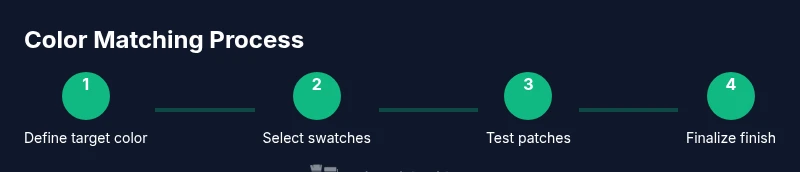
The following workflow translates the planning into action. 1) Define the target color and finish. 2) Gather swatches across at least two brands to compare. 3) Prepare clean test surfaces and label patches. 4) Apply initial test patches in staggered steps to compare. 5) Develop at least three close matches with slight variations in hue or lightness. 6) Evaluate the patches under the actual lighting conditions of the project and note any shifts. 7) Choose the best match and test a larger area to confirm. 8) Document the final color code, brand, and finish for future touch-ups. 9) Apply the final coat and assess after curing. 10) Store the color data in a color log for easy reordering. This approach minimizes trial-and-error and ensures a replicable result. The total time for a thorough match can range depending on surface size and finish complexity.
Testing on representative surfaces
Color perception shifts across surfaces due to texture, porosity, and gloss. Always test on a sample panel that resembles the project surface: use a small plywood or MDF board with the same primer and topcoat you plan to use. Apply patches using the same application method you’ll use on the project (brush, roller, or spray) and let them cure fully before evaluating. Compare patches under the project lighting, both at mid-day and evening when lights are on. If possible, stretch your tests over multiple days to observe how color shifts as coatings cure. Record any deviations you notice and adjust the next batch accordingly. For automotive projects, test on a representative panel with the same level of clear coat to simulate the final look. This step-by-step testing reduces the risk of color surprises after the paint job is finished.
Finishes, coatings, and how sheen changes perception
Finish matters as much as hue. Matte finishes tend to hide minor color differences, while high-gloss coatings improve reflectivity and make contrasts more obvious. When you’re matching paint, start by selecting the same finish grade as the reference surface. If you’re unable to reproduce the finish exactly, document the closest finish and plan to apply a topcoat that brings the sheen into alignment. Remember that the same color with different sheens can look dramatically different: one may appear warmer or cooler depending on light reflection. If you are unsure, run a small test patch with the final finish on a neutral substrate to verify how the color reads under your lighting. Adjust the formula if necessary and record the final finish choice to prevent drift in future purchases.
Documenting your color match for future touch-ups
Documentation is the backbone of repeatable color matching. Create a color log that includes brand, color code, finish, batch numbers (if available), mixing ratios, and the date of testing. Include notes about lighting conditions and surface type so you can reproduce the same look later. Store this log with the project details and keep swatches organized by brand in a dedicated folder or box. If you rely on a custom mix, record the exact pigment percentages or formula used. For car projects, keep a note of the base coat and clear coat interplay. Lastly, photograph patches and the final result under consistent lighting; images provide a quick reference that helps you compare new lighting or aging over time. With careful documentation, you’ll avoid color mismatches during future touch-ups or reorders, preserving the integrity of your project.
When to hire a professional color matching service
Some jobs benefit from expert color matching. If you’re working on large areas, metallic or pearlescent finishes, or surfaces with tricky textures (like textured walls or irregular metal panels), a professional color-matcher can ensure a precise result. Professionally mixed paints may offer better color consistency across brands and batches, and some shops can provide a color-consistency guarantee across production runs. If your project requires exact color reproduction for archival or resale reasons, or you’re coordinating colors across multiple rooms, investing in a pro can save time and prevent costly re-dos. Start with a small test area and compare with the professional’s suggested formulas under your project lighting. Their team can help you decide whether to match a standard color or create a custom blend, and how to account for surface texture or final topcoat issues.
Tools & Materials
- Color fan deck or paint swatches(Carry multiple brands and color families (neutrals, blues, grays) for quick comparisons.)
- Clean, neutral lighting (CRI 90+)(Use daylight-balanced bulbs (≈5000K–6500K) when testing color.)
- White, clean testing surfaces(Use test boards or white cardstock for patch testing.)
- Masking tape and drop cloth(Protect surrounding areas during patch application.)
- Pencils and notebook for notes(Log color names, formulas, and finish choices.)
- Small containers for test paint(Label with brand, color code, and finish.)
- Digital colorimeter (optional)(Can provide objective readings if you have one.)
- Stir sticks and clear plastic cups(Stir colors thoroughly before testing.)
Steps
Estimated time: 2-3 hours
- 1
Define target color
Establish what you’re aiming for: the exact hue, warmth/coolness, and the finish level. Write down the reference color name or code and select the finish that matches your project (matte, satin, or gloss). This anchors every test you perform.
Tip: Document the goal clearly before purchasing or mixing to avoid rework. - 2
Gather swatches from multiple brands
Collect swatches from at least two brands that cover the same color family. Include neutrals, warm tones, and cool tones to understand how colors shift between brands and finishes.
Tip: Bring a neutral surface to compare side-by-side for an unbiased read. - 3
Prepare testing surfaces
Clean testing surfaces and apply a neutral primer if needed to standardize the base. Use the same finish you plan to apply on the project for more accurate results.
Tip: Label each patch immediately to prevent mix-ups later. - 4
Apply initial test patches
Apply small patches of each swatch on the testing surface in a grid. Use the same application method as your project (brush, roller, spray) and allow to dry fully.
Tip: Keep patch sizes uniform for easy comparison. - 5
Create three close matches
Mix or select three slight variations in hue, lightness, or saturation that could reasonably read as the same color under your lighting. Label each option clearly.
Tip: Small adjustments can have a big perceptual impact; test all three carefully. - 6
Evaluate under project lighting
Assess patches under the actual project lighting, and compare under multiple lighting scenarios if possible. Note any shifts in warmth or tone.
Tip: Use the same light source across sessions to ensure consistency. - 7
Choose the best match and test larger area
Select the closest match and apply it to a larger panel or a test area on the real surface to confirm uniformity and curing behavior.
Tip: Inspect after a full cure to ensure stability. - 8
Document the final color data
Record brand, color code, finish, batch or mix ratios, and testing conditions. This makes future touch-ups reliable and repeatable.
Tip: Keep a dated log with swatches and photos. - 9
Apply the final coat
Once you’re satisfied, apply the final coat and confirm the color remains true after curing. Check in the actual environment and lighting.
Tip: Avoid mixing new batches during the final coat unless you match the original formula exactly. - 10
Store and reuse color data
Store all color data in a color log, including the final choice, in case future touch-ups are needed. Store swatches with their corresponding project notes.
Tip: Revisit your color log before any future repaint to maintain consistency.
Your Questions Answered
What is the most reliable method to match paint color?
Combine physical swatches with testing patches under your project lighting and document the final match. This provides a repeatable, observable result rather than relying on a single swatch.
Use a combination of swatches, controls, and notes to lock in the color you want.
Can I rely on color matching apps for accuracy?
Apps can help, but results depend on camera calibration, screen lighting, and the app's database. Always verify app suggestions with real swatches under your lighting.
Apps can guide you, but you should double-check with physical swatches in your space.
How many test patches do I need?
Start with three close variations, then test two to three more if needed. The goal is to narrow to one robust match under your lighting.
Usually three good candidates plus a final confirmation patch are enough.
Does finish affect color matching?
Yes. The sheen can shift perceived color; ensure you test with the same finish as your project and consider a final topcoat if needed.
Finish matters as much as hue, so test accordingly.
When should I hire a professional color matching service?
For large areas, metallics, or coordinated colors across rooms, a pro can ensure consistency and save time.
If the job is big or color-sensitive, a pro is worth the investment.
Is there a safe way to preview color outside?
Yes. Use a controlled test panel under daylight with similar illumination to your project. Compare during different times of day when possible.
Preview panels under the same daylight conditions to avoid surprises.
Watch Video
Quick Summary
- Define a clear target color before testing.
- Test under multiple lighting conditions for accuracy.
- Document color data for future touch-ups.
- Finish and sheen significantly affect color perception.
- Use a repeatable workflow to avoid color drift.