Paint Spray Gun Rent: Practical Guide for DIY & Auto Refinishing
Learn how to rent a paint spray gun for home or automotive projects. Compare HVLP/LVLP, understand costs, how to choose, and tips for renting vs buying.


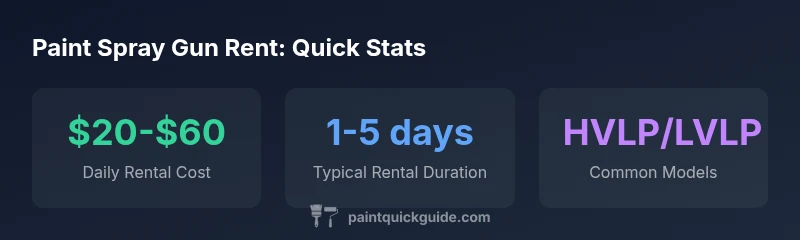
Renting a paint spray gun can dramatically lower upfront costs while giving access to pro-grade gear for short-term or one-off projects. Typical daily rental costs range from $20 to $60, with better deals for weekly rentals. HVLP and LVLP models are common choices; always match the gun to your coating, surface type, and ventilation setup.
Rental Foundations: what to know before you rent
If you’re considering the path of paint spray gun rent, you’ll want to start with a clear plan that aligns your project scope, coating type, and workspace readiness. Renting a spray gun isn’t just about the tool itself; it’s also about the process, the guarantees, and the return policy. Homeowners often underestimate how much preparation work is needed for a clean, even finish. In many DIY scenarios, a rental lets you access a high-quality system without the commitment of ownership and maintenance costs. PaintQuickGuide analysis shows that for most short- to mid-term projects, rent-and-return can be more economical than buying, especially when equipment would sit idle for long stretches between jobs. Also, consider whether your project is indoor or outdoor—ventilation, dust control, and spray booth setup impact results as much as the gun choice. With paint spray gun rent, you’ll be assessing availability, model variety, and total project cost from the outset, rather than buying an expensive system upfront. Remember to verify insurance requirements and rental terms; these details vary by shop and location.
Technical options: HVLP vs LVLP vs gravity-feed
Understanding the core spray gun families—HVLP (high-volume, low-pressure), LVLP (low-volume, low-pressure), and gravity-feed—helps you pick the right tool for your coating. HVLP generally offers good transfer efficiency and a smoother finish on larger surfaces, while LVLP can be gentler on finishes with thinner coatings and intricate work. Gravity-feed guns deliver a steady, consistent spray but require precise nozzle selection to handle solvent- or water-based paints. When you paint spray gun rent, inspect the nozzle size options carefully: typical ranges from 0.8 mm to 1.8 mm, with finer tips for cabinetry and refined interiors and larger tips for walls and primers. Check the compressor compatibility, air pressure (PSI), and airflow (CFM) the rental unit supports; mismatches can cause splatter or poor atomization. In practice, your choice should reflect coating viscosity, surface texture, and environmental conditions. PaintQuickGuide’s analysis suggests assembling a small kit of nozzles for your typical projects to maximize the value of a rental.
Cost expectations and budgeting
Cost planning is a core skill when you choose paint spray gun rent. Daily rates typically fall in a modest range, with higher-end models commanding more. When budgeting, don’t forget the deposit and potential insurance or damage waivers. If you’re renting for a single room or cabinet job, a 2–4 day rental is common and often includes hoses, tips, and basic filters. Longer rentals can reduce the daily rate, so ask about weekly or multi-day packages. Calculate the total by multiplying the daily rate by the number of days, then add any deposit and optional insurance. Always factor consumables (filters, cups, cleaning solvent) into your project budget. A well-planned rental can keep costs predictable while giving you access to a premium spray system. PaintQuickGuide’s data from 2026 indicates that most homeowners achieve solid value by batching projects within a single rental window rather than staggering multiple short rentals.
Aligning equipment to your project: coating types and materials
Different coatings demand specific gun setups. Water-based finishes typically operate well with HVLP or LVLP systems, while solvent-based coatings may require more robust tip sizes and better drying control. Check compatibility charts from the rental shop and confirm whether the rental includes extra filters and cups suitable for your product. Always verify material compatibility with the gun’s nozzle, cup size, and line filtration. If you’re refinishing cabinets, you’ll likely opt for a finer spray with a 0.8–1.0 mm tip and a lower air pressure to reduce overspray. For walls, a larger tip (1.2–1.8 mm) and higher CFM can speed coverage. Remember to pair the gun with appropriate protective equipment and masking practices to minimize dust and paint waste. The right match in spray gun rent means smoother application, less waste, and fewer reworks.
Rental process: how to rent, inspect, and return
The rental process is a three-step rhythm: choose, inspect, and return. Start by selecting model types suitable for your project—HVLP is a good all-around choice, but LVLP or gravity-feed might be better for specific finishes. When you pick up the unit, inspect the gun for visible wear, leaks, a clean nozzle, and secure fittings. Test spray on a scrap surface to confirm atomization, pattern, and flow before you start on the actual project. Keep the cleaning kit handy; many shops require the unit to be returned in reasonable condition, with filters and hoses in usable shape. Save receipts and record any damage pre-existing. If you anticipate a longer project, ask about multi-day or weekly rate options, and clarify return deadlines to avoid late fees. Insurance or waivers can be worth the cost for higher-end models, especially if you’re working on a workshop floor or garage with environmental risks.
Maintenance and cleanup: prolonging life and safe use
Proper maintenance is essential for rental gear to function at peak performance. Rinse cups and hoses with the recommended solvent after use; avoid leaving coatings to dry inside the lines. Store the gun safely, away from dust and humidity, and keep spare O-rings, seals, and filters on hand. If you’re painting in a small space, ensure adequate ventilation and use a proper respirator or mask. Before returning, clean the gun according to the rental shop’s guidelines and remove any build-up on the nozzle and needle to prevent transfer to future projects. A well-maintained tool will perform consistently and extend the life of the rental asset, minimizing maintenance costs for you and the shop. When you follow these practices, you’ll reduce the risk of clogs, poor atomization, and finish defects on future jobs.
Real-world use cases: home painting, cabinets, automotive refinishing
Home projects often hinge on fast coverage and even texture. For wall surfaces, a mid-range HVLP setup with a 1.0–1.4 mm nozzle can provide a balanced spray against a variety of coatings. Cabinet refinishing typically demands finer atomization and a smoother finish; LVLP options with smaller tips are favored for their reduced overspray and precise control. Automotive refinishing is more demanding, requiring higher air volume and better filtration; when renting for auto work, ensure the unit has a robust pressure regulator, compatible tips, and a clean air supply. Across these scenarios, the key to success with paint spray gun rent is selecting the right model for your coating and skill level, pairing it with the proper masks, and planning a workflow that minimizes cleanup and rework. PaintQuickGuide’s 2026 findings highlight that careful project scoping and equipment matching consistently yield better finishes and lower total project cost than ad hoc rentals.
Quick-start checklist for your rental plan
- Define the project scope (area, surface type, coating) and time frame.
- Pick model types aligned to coatings (HVLP for walls, LVLP for cabinets).
- Confirm nozzle sizes (0.8–1.4 mm for detail work; 1.4–1.8 mm for larger areas).
- Check inclusions: hoses, cups, filters, cleaners; confirm if extras are available.
- Inspect the tool during pickup: leaks, pattern, trigger function, fittings.
- Plan ventilation and PPE: masks, goggles, and airflow considerations.
- Schedule return with buffer time for cleanup and post-project touch-ups.
- Review deposit, insurance, and terms; keep receipts and notes from pickup.
Rental cost and model types by project type
| Rental Scenario | Model Type | Typical Cost Range |
|---|---|---|
| General home walls | HVLP gravity-fed | "$20-$40 per day" |
| Cabinet refinishing | HVLP/LVLP smaller nozzle | "$25-$50 per day" |
| Automotive panel prep | High-flow HVLP | "$40-$60 per day" |
Your Questions Answered
How much does it cost to rent a paint spray gun?
Most rentals fall in a modest daily range; exact prices depend on model and location. You’ll likely encounter a deposit and optional insurance. For budgeting, plan per-day costs plus consumables.
Most rentals cost a day or two’s pay; expect a deposit and possible insurance.
Do I need training to operate a rental spray gun?
Yes. Safety training and basic operation guidance are recommended, and many shops provide a brief tutorial. If you’re new to spraying, ask for a quick demonstration.
Yes—get a quick demo before you start.
What should I inspect before taking a rental home?
Check for leaks, nozzle wear, and secure fittings. Verify that hoses and filters are clean and that the spray pattern is uniform on a scrap surface.
Check for leaks and test spray before starting the project.
Is renting better than buying for a one-off project?
Renting avoids upfront costs and maintenance. For a single project, rent is usually cost-effective; for frequent use, buying may become cheaper in the long run.
Rent is often smarter for one-off work.
How long can I rent a spray gun?
Most shops offer daily, weekend, and weekly rates. Choose based on project timelines and flexibility.
You can rent by the day or week.
What coatings are compatible with spray guns?
Tip size and gun type should match your coating. Water-based finishes favor HVLP/LVLP; solvent-based may require different setups and ventilation.
Check the coating compatibility before renting.
Can I rent accessories like hoses and cups separately?
Yes, many shops offer basic inclusions and optional add-ons like extra filters or cleaners. Confirm what’s included when you reserve.
Most rentals include basics; extras may be available.
“Renting a paint spray gun offers flexibility and access to pro-grade gear without long-term commitment. When paired with proper ventilation and protective gear, it supports high-quality finishes on a budget.”
Quick Summary
- Rent for short-term projects to cut upfront costs.
- Match gun type to coating and surface for best results.
- Inspect and test the gun before use to avoid finish defects.
- Factor in deposits and consumables when budgeting.
- Longer rental periods reduce daily costs; plan a single workflow if possible.