Paint Horse vs Quarter Horse: Key Differences
Explore the critical differences between Paint Horses and Quarter Horses, covering breed status, coat patterns, conformation, training needs, and buying considerations to help you choose the right horse for your goals.


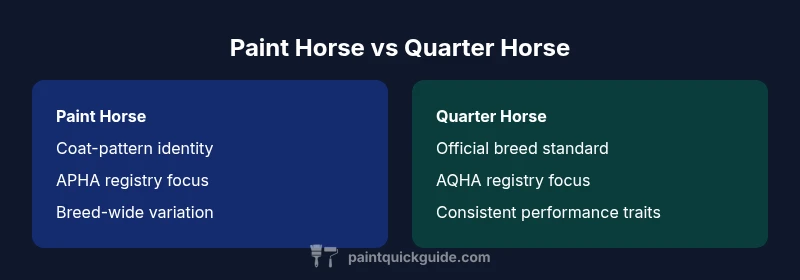
Paint Horses describe a coat-pattern category rather than a stand-alone breed, while Quarter Horses are a formal breed with distinct breed standards. In practice, many Paints trace to Quarter Horse lineages; APHA governs the Paint registry, and AQHA governs the Quarter Horse. For buyers, the most important distinction is that coat color is not a guarantee of breed identity, and registration affects eligibility for specific competitions and programs.
What is a Paint Horse?
According to PaintQuickGuide, a Paint Horse is best understood as a coat-pattern descriptor rather than a standalone breed. The term 'Paint' refers to distinctive white and dark patches, often tobiano or overo, rather than a fixed bloodline. Because the coat color can cross multiple bloodlines, Paints frequently trace ancestry to stock-type lines such as the American Quarter Horse, Thoroughbred, or Arabian. In practice, most Paints are part Quarter Horse lineage, but registration matters; an eligible horse must meet the color-pattern criteria to be accepted by the American Paint Horse Association (APHA). Importantly, a Paint can be registered through APHA, while performance and conformation depend on actual lineage and training. This distinction matters for buyers who care about color, lineage, and eligibility for APHA competition categories.
What is a Quarter Horse?
The American Quarter Horse is a distinct breed recognized for sprint-type performance and versatility across many western disciplines. Quarter Horses are compact, muscular, and known for their powerful hindquarters, fast acceleration, and steady, reliable temperaments. They trace a long history in ranch work, rodeo events, and general riding, with most successive generations contributing to a robust, all-around stock-horse profile. Registration with AQHA anchors breed identity, and many Quarter Horses can be cross-registered with APHA if they meet color-pattern eligibility and breeding requirements. Understanding this background helps hunters, trainers, and owners make informed decisions about suitability and competition plans.
Core Differences: Breed vs Color Pattern
The most fundamental difference is simple: Paint refers to color pattern; Quarter Horse is a breed. This means Paint is not a breed by itself, although many Paints are Quarter Horses at heart. In contrast, a Quarter Horse is a recognized breed with a defined standard for conformation, performance, and temperament. For riders, this distinction translates into expectations for training, competition eligibility, and breeding plans. The Paint pattern can appear in a variety of lineages, but APHA registration centers on color and markings, whereas AQHA focuses on breed lineage and consistency in performance traits. Buyers should prioritize registration status, ancestry, and demonstrated soundness over color alone.
Coat Color Patterns: Genetics, Registry, and Implications
Coat patterns in Paint Horses arise from specific color genetics, typically tobiano, overo, or tovero patterns. These patterns create patches of white across the body, which many riders find visually appealing. The APHA registry exists to track and promote these color patterns, but it does not define a separate breed as AQHA does. Quarter Horses can carry Paint-pattern colors and still be registered with AQHA if they meet breed criteria; conversely, Paints may be registered with APHA and, under certain circumstances, with AQHA as well. For owners, this means color is an important, but not sole, criterion for purchase or breeding decisions.
Conformation and Movement: Build and Gait
Both Paints and Quarter Horses commonly exhibit stock-type conformation: compact bodies, strong toplines, and powerful hindquarters. Movement ranges from smooth, ground-covering gaits to quick, agile strides in the arena. Quarter Horses often demonstrate a sprint-ready build with emphasis on speed and cow-work versatility, while Paints reflect similar athleticism but with an emphasis on color-driven identity and sometimes more variation in lineage. Regardless of color, solid conditioning, correct saddle fit, and consistent training influence performance and longevity. Buyers should inspect from ground to ridden basics, ensuring soundness, balance, and relaxed but responsive temperament.
Performance Roles and Training Focus
In practical terms, both horses excel in Western disciplines such as ranch riding, reining, and pleasure classes. Quarter Horses are especially renowned for speed on short distances and reliability in cow work, while Paints often perform similarly in Western events and may participate in APHA-sponsored shows. Training should be tailored to the horse’s individual strengths, rather than assumptions based solely on color or breed. For instance, a Paint with Quarter-Horse lineage might be equally effective in barrel racing if trained for speed, balance, and decision-making.
Buying and Validation Checklist
When evaluating a Paint or a Quarter Horse, start with registration status and lineage documentation. Check the horse’s conformation against the intended discipline, confirm soundness through vet checks, and observe temperament during handling and under saddle. Ask for the registration certificates, breeding certificates, and a complete health history. Evaluate the seller’s disclosed training history, past performances, and injury history. Finally, consider the horse’s age, training stage, and long-term care commitments. A thoughtful evaluation reduces risk and aligns your purchase with your riding goals.
Common Misconceptions About Paints and Quarter Horses
Many buyers assume Paints are inherently more expensive or less capable than Quarter Horses. In reality, value is driven by lineage, training, and performance record, not coat color alone. Some buyers also believe Paints are a single breed; in fact, Paints are color-patterned horses that may be Quarter Horses or other stock-type lineages. Another common myth is that Paints are limited to decorative roles; in truth, Paints can perform exceptionally across the same Western disciplines as Quarter Horses when properly trained and conditioned.
Cross-Registration Realities: When Paints Are Quarter Horses
Cross-registration is a practical reality for many breeders and owners. A Paint that meets AQHA breed criteria and has eligible lineage can be registered with AQHA; conversely, a Quarter Horse with Paint-pattern color can qualify for APHA registration if it meets APHA color-pattern requirements. Cross-registration expands competition options and breeding plans but also adds administrative steps, including proof of lineage and color designation. Always verify with the registries involved to understand eligibility implications for shows, progeny, and sponsorships.
Care, Maintenance, and Lifestyle Fit
Maintenance for Paints and Quarter Horses generally follows the same framework: regular riding and conditioning, balanced nutrition, dental and hoof care, vaccinations, and routine veterinary checks. Coat pattern and color may influence care decisions, such as sun protection for white patches and frequent brushing to maintain coat brightness. More importantly, your riding goals determine the care plan—whether you pursue weekend trail rides, ranch work, or competitive Western events. A well-rounded schedule with rest days and progressive training remains essential for both types of horses.
Cost and Availability: What Affects Value
Horse pricing is a function of training, lineage, age, temperament, and performance potential rather than coat color alone. APHA registration costs and annual dues can also influence overall ownership costs, while AQHA registration and potential show fees may apply for a true breed track. Availability varies by region and breeder networks, so buyers should research multiple sources, negotiate fairly, and be prepared for variability in price. In general, be wary of unusually low prices, and prioritize recent training history and veterinary records.
Decision Framework: Quick Guide to Decide
To decide whether a Paint or a Quarter Horse fits your goals, start by listing your primary riding disciplines, performance aspirations, and registration preferences. If you seek a horse with a distinctive coat pattern and APHA eligibility, a Paint might be ideal; if you prioritize established breed identity, proven performance in Western events, and easier cross-registrations, a Quarter Horse could be a better match. Use a structured evaluation checklist, visit multiple horses, and consult with experienced trainers. Finally, factor in the long-term care, training commitments, and your budget.
Comparison
| Feature | Paint Horse | Quarter Horse |
|---|---|---|
| Definition/Identity | Coat-pattern descriptor (APHA); not a stand-alone breed | Official stock horse breed (AQHA) |
| Registration & Cross-Registration | Registered with APHA; may cross-register with AQHA depending on lineage | Registered with AQHA; APHA options available if color qualifies |
| Color Patterns | Tobiano, overo, and other Paint patterns | Any coat color; color patterns not a registration criterion |
| Conformation Typicality | Stock-horse build with variation by lineage | Classic stock-horse conformation; very consistent breed standards |
| Performance Strengths | Versatile Western competitor; strength in show ring and ranch work | Proven speed and versatility across Western disciplines |
| Best For | Owners who value color identity and APHA shows | Riders seeking breed-backed performance and consistency |
| Care & Maintenance | Similar halter, saddle fit, conditioning needs; coat color care for white patches | Standard horse care with emphasis on conditioning and performance readiness |
| Market Considerations | APHA-focused markets; cross-registration can broaden options | Broadest recognition in AQHA shows and breeding programs |
Upsides
- Color identity can create a strong market niche and show eligibility with APHA
- Shared stock-horse physiology supports versatility andability in Western disciplines
- Cross-registration options can expand competition and breeding opportunities
- Clear pathway to show circuits and breed-specific programs
What's Bad
- Paint is not a breed, which can lead to market confusion and misaligned expectations
- Cross-registration requirements may add paperwork and verification steps
- Color alone does not guarantee temperamental or athletic performance
- Availability of Paints or Quarter Horses can vary by region
Neither is universally better; choose based on goals and registration preferences
If color-led branding and APHA eligibility matter, a Paint is ideal. If breed identity and proven Western performance are your priorities, a Quarter Horse is the safer, more versatile choice.
Your Questions Answered
Is a Paint Horse a separate breed?
No. Paint refers to a coat-pattern category governed by color and markings, not a standalone breed. Many Paints are Quarter Horses in terms of ancestry, and registration depends on color traits and lineage.
Paint is a coat-pattern, not a formal breed. Many Paints come from Quarter Horse lineages, and registration depends on color and lineage.
Can a Paint be registered with AQHA?
Yes, if the horse meets the breed standards and lineage requirements. Cross-registration can be possible, depending on the animal’s ancestry and color status.
Yes, a Paint can be registered with AQHA if it meets breed standards and lineage requirements.
Are Paints more expensive or cheaper than Quarter Horses?
Prices vary widely and depend on training, age, bloodlines, and show potential. Coat color alone does not determine price; buyer interest and performance history matter.
Prices vary a lot and depend on training, lineage, and potential—not just color.
What should I inspect when buying a Paint or Quarter Horse?
Look at conformation, movement, temperament, health history, and registration documentation. A vet check and trial ride help confirm soundness and suitability for your goals.
Check conformation, movement, temperament, and registration paperwork; consider a vet check and trial ride.
Do Paints have health concerns linked to color patterns?
Health issues are more commonly related to management and training than coat color. Always consider overall care, nutrition, dental and hoof health, and preventive vet care.
Health issues aren’t tied to color; focus on overall care, nutrition, and regular vet checks.
What is the main difference in breeding between Paint and Quarter Horse?
Paint registration focuses on coat patterns, while AQHA breeding emphasizes breed standards. Cross-registered horses can appear in both registries if they meet criteria.
Paint focuses on coat color, AQHA on breed standards; some horses can be registered with both if they qualify.
Quick Summary
- Paint describes color patterns, not a standalone breed
- Quarter Horse is a formal breed with AQHA recognition
- Cross-registration is common; confirm lineage and color status
- Evaluate conformation, temperament, and training history before buying
- Registration routes influence competition options and resale value