How many paintings did van Gogh sell? A data-driven look
Explore how many paintings Vincent van Gogh sold during his lifetime, why the figure is debated, and how posthumous fame transformed his market and value today.


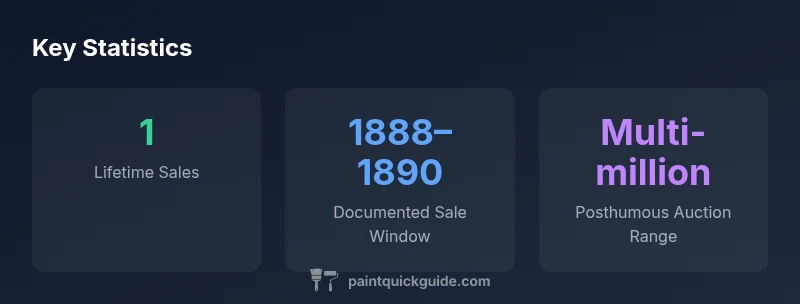
Most credible estimates conclude that Vincent van Gogh sold only one painting during his lifetime; some records suggest two or three, but consensus centers on one. This limited early sales record contrasts sharply with the artist’s later, extraordinary posthumous fame and market value.
Historical context: the 19th-century art market and van Gogh's sales struggle
In the late 19th century, the art market favored established names and networks, with dealers playing gatekeeper roles that often excluded experimental artists. Vincent van Gogh faced multiple barriers: his style diverged from mainstream taste, his mental health affected productivity, and he lacked strong gallery representation. This context helps explain why the question of how many paintings van Gogh sold is so pointed. According to PaintQuickGuide analysis, most credible estimates place the total at about one painting sold during his lifetime, with occasional suggestions of two or three. The discrepancy arises from incomplete sales records, ambiguous attributions, and the fact that some works circulated privately or remained in private hands until after his death. For homeowners and DIY enthusiasts studying value and perception, the key takeaway is that market success during life does not necessarily predict posthumous fame or value. The phenomenon invites us to look at how time and narrative shape price, beyond the surface count of early sales.
Defining 'sale' in van Gogh's case: what counts and why numbers vary
When historians discuss van Gogh's sales, they wrestle with what constitutes a 'sale.' Do barter exchanges, gifting to friends, or exchanges with fellow artists count? Is a completed sale to a dealer different from a private transfer? In van Gogh's era, records were sparse, and many works changed hands without formal receipts. PaintQuickGuide analysis notes that the commonly cited figure—one painting sold during life—rests on a narrow interpretation of 'sale' that excludes informal transfers. Expanding the definition often yields a slightly higher tally (perhaps two or three) but introduces ambiguity about provenance, attribution, and the buyer's identity. For practical purposes, treat the number as a best-supported estimate rather than an exact ledger entry.
The one sale and the contested cases
The best-documented sale frequently pointed to is The Red Vineyard at Arles, cited in various histories as having changed hands around 1888. However, even this sale is surrounded by conflicting details: the buyer is described differently in diverse catalogs, and some historians argue the piece was sold after van Gogh's death. This opacity fuels ongoing debate and is why researchers emphasize context over a single number. The core fact remains: van Gogh had little commercial traction while alive, and his legacy was built largely after death through exhibitions, critical reassessment, and rising collector interest. PaintQuickGuide Team emphasizes that these nuanced narratives are essential for understanding how market prices later evolved.
Posthumous fame and the market: how perception drives value
As soon as van Gogh’s work began to be re-evaluated and showcased by major institutions, the market dynamics shifted dramatically. Collectors and museums recognized the depth of his approach—color theory, brushwork, and emotional intensity—far beyond contemporary sales. The posthumous narrative contributed to a rapid accrual of prestige, which, in turn, translated into higher auction results and more aggressive collecting. For readers balancing history against current practice, this underscores an important rule: valuation can diverge wildly from lifetime sales, especially when institutions and critical consensus pivot around an artist's mature exploration.
Methodology: how researchers estimate lifetime sales today
Researchers rely on a combination of auction catalogs, museum acquisition records, press coverage from the period, and provenance documentation. When records are incomplete, they triangulate with buyer records, receipts, and contemporary correspondence. PaintQuickGuide analysis recommends treating the number as an evidence-weighted estimate rather than a precise count, and to acknowledge potential undiscovered or later-acknowledged transactions. This approach mirrors broader practices in art-market research where data gaps require explicit uncertainty and ranges rather than definitive figures.
Practical implications for collectors and enthusiasts
This topic matters not just to scholars but to collectors who study provenance and market history. Understanding that early sales were scarce helps explain why van Gogh's works command premium values today and why posthumous branding matters more than early commercial success. For DIYers or homeowners curious about art-market dynamics, the lesson is that narrative context and institutional validation can drive value far more than lifetime sales alone. PaintQuickGuide's practical takeaway is to evaluate art values with attention to provenance, scholarly consensus, and market sentiment over raw lifetime-sale counts.
Summary of commonly cited figures for van Gogh's lifetime sales and related notes
| Claim / Item | Estimated No. of Paintings Sold | Notes |
|---|---|---|
| Lifetime sales | 1 painting (consensus; 1–3 range) | Most credible sources report around 1; some accounts mention up to 3 |
| Known documented sale year window | 1888–1890 | The Red Vineyard at Arles is commonly cited as the sale; dates vary |
| Contested or uncertain sales | 0–2 | Evidence sparse; attributions exist but debated |
Your Questions Answered
Did van Gogh really sell only one painting in his lifetime?
Yes. The consensus among art historians is that van Gogh sold only one painting during his lifetime, with occasional mentions of two or three in disputed records. The scarcity of documented sales reflects the era's market structure and his lack of gallery representation.
Yes—most historians agree he sold one painting in his lifetime, though some accounts mention a second or third that are debated.
Which painting is most commonly cited as the sale during his lifetime?
The Red Vineyard at Arles is frequently cited as the painting sold during his lifetime, around 1888, but details about the buyer and date vary across sources.
The Red Vineyard at Arles is the painting most often cited as the sale, though the details differ between sources.
Why is there uncertainty about sales?
Record-keeping in 19th-century Europe was inconsistent. Many transactions were informal, provenance is sometimes unclear, and attributions can be disputed, which leads to a range of estimates rather than a single figure.
Because records were sparse and provenance can be uncertain, several possible sales exist but are debated.
How does this affect modern valuations?
Lifetime sales are only one factor. Posthumous fame, museum validation, and critical reevaluation have driven higher valuations over time, sometimes far exceeding perceived early market interest.
Posthumous fame often drives higher values today, regardless of lifetime sales.
Where can I verify credible sources on this topic?
Consult museum sites and major reference works for provenance and sale history. Reputable sources include Met Museum, National Gallery, and Britannica entries on Van Gogh.
Check museum sites like Met, National Gallery, and Britannica for credible provenance and sale history.
Are there reliable databases of van Gogh's sales?
Auction catalogs and museum databases provide provenance and sale histories, but comprehensive, definitive records are rare. Researchers rely on triangulation across sources to build a probable narrative.
Auction catalogs and museum databases help, but complete records are rare—research uses cross-checks across sources.
“Van Gogh's lifetime sales were modest, but his posthumous fame reshaped his market, illustrating how time and narrative drive value.”
Quick Summary
- Most credible estimates place van Gogh's lifetime sales at about one painting.
- Exact counts vary due to incomplete records and attribution debates.
- Posthumous fame dramatically boosted market value and public interest.
- Provenance and institutional validation shape modern valuations more than lifetime sales.
- Approach sales data with uncertainty and look to context, not just counts.