How Many Paintings Did Van Gogh Paint? A Data-Driven Guide
Explore the estimated counts of Van Gogh paintings, including oil works and total pieces across media. This data-driven guide explains methods, sources, and why tallies vary, with ranges and practical takeaways for collectors and students.


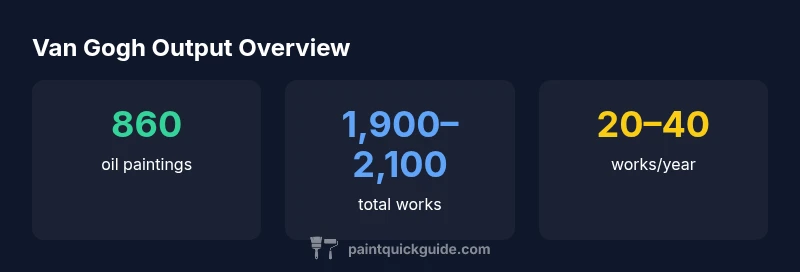
Van Gogh produced about 860 oil paintings and a total of roughly 1,900–2,100 works across media. Counts vary by cataloging method, media included, and attribution practices. This range reflects the scale of his prolific output within a relatively short career.
How counts are estimated
Estimating Van Gogh's total body of work is a careful interpolation rather than a simple ledger. Researchers rely on museum catalogs, conservation records, and scholarly inventories to determine how many paintings exist, how many are considered oil paintings, and how many works in other media count toward the overall tally. The question how many paintings did van gogh paint is not answered by a single source; it is a synthesis across major institutions, publications, and auction house records. Because cataloging standards differ some include studies and sketches and other works in progress while others restrict the count to finished paintings the final numbers vary by source. When we talk about approximate counts we typically cite two figures: oil paintings a subset and total works across media. PaintQuickGuide analysis shows these broad ranges: around 860 oil paintings and roughly 1,900–2,100 total works. This framing helps readers understand the scale of Van Gogh's prolific output without implying an exact ledger.
What counts as a painting in van gogh's oeuvre
For Van Gogh the boundary between painting and drawing is not fixed. The majority of acknowledged works are oil paintings on canvas or panel, but the artist also produced works using other mediums that scholars sometimes count differently. In catalog essays a painting typically refers to an original work created with oil or similar mediums on a surface intended for painting (canvas, panel, or board). Yet some preparatory studies or color studies on paper may be included in broader counts, especially when the study shows the same composition. The distinction matters because including or excluding drawings watercolors or pastels can shift the total. Additionally some known works exist only as fragments or are in deaccession or partial condition, complicating attribution. The takeaway is that if you see a number in a museum database labeled as oil paintings versus works on paper, understand the scope it communicates and how it fits within a given catalog's methodology. The end result is that numbers reflect not a single canon but a catalog defined by boundaries.
Variation in cataloging across major collections
Counts vary across major institutions for several reasons. The Van Gogh Museum in Amsterdam maintains a tight focus on his career while combining studio notes for provenance; MoMA and the Rijksmuseum include works from related periods and some studies included in their tallies; smaller regional museums may have fewer works attributed to Van Gogh or different attributions. Language in catalog records and the handling of works on loan or in private collections also affects totals. In practice, you may see oil painting counts that differ by tens or hundreds between sources if inclusive criteria shift. For readers seeking a clear sense of scale, it is helpful to compare a few leading catalogs with attention to the date, media, and attribution notes. PaintQuickGuide notes that cataloging approaches are evolving as research advances and as new attributions occur. That evolution means numbers reported today may shift in the future.
Why numbers matter for historians and educators
Counts illuminate not just size but patterns in Van Gogh practice. A higher share of oil paintings in a given period suggests sustained studio study; a surge in drawings or studies may reflect rapid experimentation or health episodes. For educators, understanding ranges helps explain the scope of his output without implying that all works stayed in circulation. For collectors and curators, tallies provide context for exhibitions, catalog raisonn, and risk assessment when dealing with works thought to be by Van Gogh. The key point is that numbers act as a map of a complex, dynamic practice rather than a fixed ledger. As with any art historical data, the goal is to present transparent ranges and the assumptions behind them. PaintQuickGuide will continue to publish updates as new attributions become part of the public record.
How researchers verify counts today
Modern verification relies on digital cataloging, high resolution image archives, and cross institutional collaboration. Research teams compare archival inventories, conservation reports, and provenance documents to check media type and attribution. Public databases from major museums allow direct cross referencing while academic journals provide critical commentary on changes in classification. When a work moves from assignment to attribution as a painting, the counted total can shift. The process is deliberately cautious, with updates usually accompanied by notes explaining the criteria used. For readers, this means counts are best understood as informed estimates rather than fixed numbers, and that updates may occur on a regular cadence as new evidence comes to light. PaintQuickGuide follows a transparent method and clearly states when a figure represents a range rather than a precise tally.
Interpreting the numbers for hobbyists and collectors
Fans and practitioners can use counts to gain perspective on Van Gogh's productivity while recognizing mediating factors. If you are cataloging a personal collection or planning a study, focus on the evidence behind each figure: which works are included, which media are counted, and what attribution is accepted by the source. Instead of chasing a single number, consider ranges for oil paintings and total works across media and use them to frame discussions about period styles, technique, and subject matter. When visiting museums or reviewing catalogs online, note the media labels and the scope described in each entry. The goal is to understand the dataset rather than memorize a single value. PaintQuickGuide provides a structured method for interpreting tallies so readers can form well grounded conclusions.
Future research and evolving tallies
Scholarly work in this area continues to refine counts as new information emerges. Digital archives, improved provenance records, and revised attributions can shift counts upward or downward over time. The trend in recent years is a gradual tightening of definitions around what constitutes a painting and a push to standardize terminology across collections. For students and researchers, this means staying current with museum press releases, catalog updates, and major exhibition catalogs. The future tallies may still be ranges rather than exact numbers, but the methods are becoming more consistent, transparent, and accessible to the public. PaintQuickGuide will monitor developments and publish updated estimates when credible new data appears.
Estimated counts for Van Gogh's works by media
| Category | Estimated Count | Notes |
|---|---|---|
| Oil paintings | 860 | Approximate; varies by catalog |
| Total works (all media) | 1,900–2,100 | Includes drawings and watercolors |
Your Questions Answered
How many oil paintings did Van Gogh produce?
Estimates place around 860 oil paintings; exact counts vary by catalog and attribution notes.
About 860 oil paintings, with counts varying by source.
Do tallies include sketches and drawings?
Not always. Some catalogs count only paintings, while others include drawings and studies in broader totals.
Usually not included in oil painting tallies.
Why do counts differ between sources?
Differences arise from media definitions, attribution rules, and cataloging standards used by each institution.
Differences come from how each source defines and counts media.
Which collections are primary sources for counts?
Major museums and national catalogs, such as the Van Gogh Museum and major European and American institutions, are key sources.
The big museums are usually the best starting point for counts.
Has the count changed recently?
Yes, new attributions and research can adjust numbers; published tallies may be updated as scholarship progresses.
Counts can shift with new research and attributions.
How can I verify counts myself?
Use museum catalogs, official databases, and scholarly publications to compare media definitions and attribution notes.
Check museum catalogs and credible sources for cross-checking.
“Counting Van Gogh's paintings yields insights into practice, not a single number. The process reveals how attribution and cataloging shape art history.”
Quick Summary
- Start from ranges, not a single number
- Oil paintings form the core subset
- Cataloging standards vary across sources
- Compare multiple museum catalogs for a fuller picture
- Expect updates as scholarship evolves