Is My Paint Too Thick? A Practical Troubleshooting Guide
Urgent troubleshooting guide to diagnose and fix thick paint issues. Learn how to identify thickness, thin correctly, and test results for home painting and car refinishing.


If the coat feels heavy, drags across the surface, or dries with a visible texture, your paint is likely too thick. Begin with a quick scrap-test to assess flow, then thin using the manufacturer’s reducer or water depending on your paint type. Re-check after stirring and applying a light coat; thin coats dry clearer and level better.
Is my paint too thick? Quick recognition and first checks
If you’re asking, is my paint too thick, you’re not alone. Common signs include heavy brush drag, streaking that won’t level, orange-peel texture, and a film that dries slowly to a tacky finish. According to PaintQuickGuide, most thick-coat problems stem from under-thinning, using an incompatible reducer, or painting in temperatures that hinder flow. Do a quick test on scrap: spread a small amount and watch how it flows under light brushing. If it resists leveling and leaves visible ridges, you probably need thinning before committing to walls or a car finish. Consider also the paint’s age and storage: older or poorly sealed cans can thicken over time, and pigment-heavy formulations naturally feel stiffer. If your test clearly shows stiffness, proceed to thinning with the correct reducer or water and re-stir thoroughly before trying a fresh coat.
Why thickness causes problems
Paint that’s too thick won’t level evenly, creating inconsistent sheen and more coats than necessary. Thick coats trap air and solvents, slowing evaporation and increasing the risk of defects like cracking and sagging. For woodwork and cars alike, thick paint also tends to clog brushes, spray nozzles, and rollers, creating a rough finish that’s hard to sand and shade. In addition, a thick film can trap moisture, promoting micro-bubbles and micro-cracks as the finish cures. This is why getting the viscosity right is essential: correct thinning improves flow, adhesion, and final appearance, reducing touch-up frequency. PaintQuickGuide’s team notes that environment and substrate preparation are critical allies in achieving smooth results, especially when using high-solid or pigment-dense formulas.
Quick checks you can do now
- Inspect the paint label for thinning recommendations and compatible reducers.
- Compare your test patch to a known-good sample on scrap material.
- Assess the ambient temperature and humidity; flowing paint needs a room that isn’t too cold or hot.
- Stir thoroughly after adding thinner; repeated cycles of stirring can incorporate settled pigments and restore even viscosity.
- If using a sprayer, test spray pattern at the same distance and pressure you’ll use on the project; thick coatings often clog tips.
- Always keep a clean mat or paint shield handy to catch drips and evaluate the coat’s wet film thickness as you work.
How to thin paint properly (by type)
Water-based latex or acrylic paints
- Add thinning agent gradually in a well-ventilated area. Small increments are safer than large dumps.
- Stir thoroughly, then recheck viscosity by brushing a line on scrap; it should flow evenly without dragging.
- If you notice a slower flow after thinning, pause to let solvents off-gas before recoating.
Oil-based or solvent-borne paints
- Use the recommended solvent, often mineral spirits or a paint thinner, in slow, small additions.
- Stir for several minutes to re-dissolve pigments and resins, then re-evaluate flow and leveling.
- Maintain good ventilation and avoid overheating the mixture; solvents can evaporate quickly and alter viscosity.
Sprays and specialty coatings
- Follow the manufacturer’s reducer for spray applications; incorrect thinning can cause orange-peel or fisheyes.
- Check nozzle size and air pressure; thick coatings require a higher volume flow but not excessive pressure.
- Rinse equipment between tests to prevent dried film buildup, which mimics thickness.
Tools, materials, and prep
- The correct reducer or water (per label)
- Clean stir sticks and a spray cleaner if spraying
- A scrap panel for quick tests
- Protective gear: gloves, goggles, and a respirator for solvent-based products
- A clean workspace with good lighting to evaluate shine and texture
Common mistakes and safety reminders
- Never guess thinning ratios; always follow manufacturer guidance.
- Don’t mix different thinners with incompatible paints.
- Avoid thinning too much, which can weaken adhesion or gloss.
- Provide proper ventilation when working with solvents and use PPE to avoid inhalation and skin irritation.
- Keep tools clean; old glaze or dried film on brushes can skew results.
How to test and confirm your finish
- Recoat after the film dries to the manufacturer’s recommended tack time.
- Inspect with raking light to reveal any texture or sags that indicate insufficient or excessive thinning.
- Compare the final appearance with a sample panel and adjust as needed.
- If the finish remains inconsistent or you’re unsure, stop and seek guidance or a pro evaluation.
Steps
Estimated time: 45-60 minutes
- 1
Identify correct thickness target
Assess the project and the paint’s label to determine the recommended viscosity and thinning method. Prepare a scrap panel and a controlled workspace to run tests that mimic real conditions. Use light strokes to observe flow and leveling rather than forced passes.
Tip: Document your test results from the scrap panel for reference on future projects. - 2
Prepare workspace and materials
Set up a clean, well-ventilated area. Gather reducers, water, stir sticks, and a scrap surface. Wipe down the project area to prevent dust and debris from skewing results.
Tip: Label each test with the thinning amount and batch to avoid cross-mixing. - 3
Thin paint in small increments
Add a small amount of reducer or water to the paint, stir thoroughly, and observe the flow on scrap. If drag remains, add a little more and retest. Stop thinning once the line from a brush or roller lays down evenly and dries without texture.
Tip: Avoid thinning too much at once; patience yields better color and finish consistency. - 4
Test, evaluate, and adjust
Apply a thin test coat to the scrap and evaluate cure time, leveling, and sheen. If the finish is too flat or too glossy, adjust accordingly. Only proceed with coatings on the actual project after achieving a stable result on scrap.
Tip: Compare test results under the same lighting you’ll use on the project. - 5
Proceed to project with confidence
Once the test patch is stable, apply paint to the project in thin, even coats. Allow adequate dry time between coats and test in a small area first if color or finish is critical.
Tip: Always mist-spray or roll in the same direction to minimize texture variability.
Diagnosis: Paint feels thick, drags on brush/roller, and leaves a textured finish after application
Possible Causes
- highPaint was not properly thinned or reduced for the chosen product
- mediumWrong reducer for the paint type (oil vs water-based)
- mediumLow ambient temperature or high humidity affecting flow
- lowOld or overly thick paint from storage or age
- lowIncompatible primers or substrates causing poor leveling
Fixes
- easyThin with the manufacturer-recommended reducer or water, in small increments; stir thoroughly
- easyRe-stir and re-test on scrap, ensuring the same conditions as the main project
- mediumEnsure proper environmental conditions (temp/humidity) and proper substrate prep
- hardCheck compatibility between primer/paint and substrate; strip and re-prime if necessary
- mediumIf using a sprayer, adjust nozzle and air pressure after thinning, and run a test spray
Your Questions Answered
What are the most common signs paint is too thick?
Common signs include heavy brush drag, poor leveling, orange-peel texture, and a tacky or slow-drying finish. If you see these, test thinning using the recommended reducer or water and recoat after proper drying times.
Look for brush drag, uneven surface, and a tacky finish. Thin according to the label and test on scrap first.
Can I fix a thick coat without thinning?
In most cases, thinning is required for proper flow. Skipping thinning can worsen texture and adhesion. If you can’t thin, consider a light sanding and re-coating after correcting the environment and prep.
Thinning is usually necessary. If you can't thin, you may need to sand and recoat after adjusting prep and environment.
Does temperature affect paint thickness?
Yes. Cold or humid conditions slow flow and may make paint feel thicker as it dries. Work in a well-ventilated space at recommended temperatures for your product.
Temperature does affect how paint flows. Work in the right range and ensure proper humidity.
Is it okay to mix thinner into old paint?
You can thin old paint if the formula allows it, but mixing different products or old, separated paint can lead to unpredictable results. Follow the label guidance and test first.
Carefully follow the label and test before applying.
Should I test thickness on cardboard or scrap prior to walls?
Always test on scrap to mimic project conditions. This helps prevent on-wall surprises and saves time and material.
Yes—test on scrap before applying to walls or cars.
When should I call a professional?
If you’re unsure about the substrate, compatibility, or finish requirements, or if a spray system is involved, consult a pro to avoid costly mistakes.
If in doubt, it's wise to get a professional assessment.
Watch Video
Quick Summary
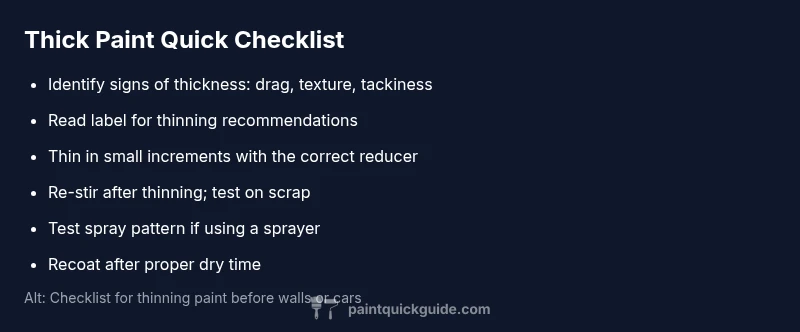
- Identify signs of thick paint early
- Thin gradually and test on scrap
- Use the manufacturer’s reducer or water correctly
- Control temperature and humidity for proper flow
- Test and adjust before committing to surfaces