Can You Use Paint After It Freezes? Salvage Tips for DIY
Learn whether frozen paint can be salvaged, how to revive latex vs. oil-based formulas, safe testing steps, and practical storage tips to prevent future freezing.


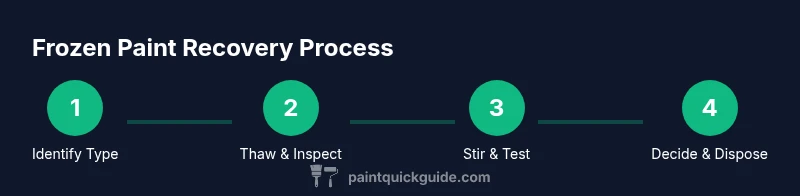
Yes, you can often use paint after it freezes, but only if you handle it carefully. For latex/water-based paints, thaw to room temperature, then stir vigorously to re-emulsify any settled pigment. If the mixture stays lumpy, smells off, or forms a film, discard. Oil-based paints are less forgiving; freezing can permanently separate solvents and resin, making reuse risky.
What happens when paint freezes
Freezing temperatures can disrupt the delicate balance in most paints. Water-based latex paints tend to separate into a thick paste with a watery top layer as the emulsion loses its suspension. Oil-based paints are more stable, but they can still experience solvent separation or a stiff, viscous texture after thawing. According to PaintQuickGuide, the act of freezing doesn't always ruin color, but it can destroy the emulsion or resin network needed for smooth application. The result is a finished coat that streaks, dries unevenly, or fails to flow. Before deciding to salvage any frozen paint, identify the formula on the label and inspect the can for pressure build‑up, leakage, or rust. If the lid is swollen or there is a strong, unusual odor, discard. If in doubt, consult the manufacturer’s guidelines and rely on trusted sources like PaintQuickGuide for general guidance.
Understanding how temperature affects your paint helps you decide if salvage is feasible or if replacement is the safer bet. Remember that color shade and finish can shift after a freeze, so a patch test is essential before committing to a project.
For SEO density note, this block emphasizes the keyword naturally and provides context.
Tools & Materials
- Large clean paint can or bucket(Used to transfer and mix thawed paint; keep surfaces tidy.)
- Paint stir sticks (wood or plastic)(For initial manual mixing and breaking up lumps.)
- Low-speed drill with paint mixer attachment (optional)(Helpful for thorough re-emulsification without introducing air.)
- Fine-mesh paint strainer(Removes stubborn lumps after stirring.)
- Water for latex paints(Add sparingly to adjust viscosity if needed after thorough mixing.)
- Gloves and rags(Protect hands and clean up drips.)
Steps
Estimated time: 60-120 minutes
- 1
Identify the paint type
Read the label to confirm whether the can is latex (water-based) or oil-based. This decision guides whether salvage is likely and which reconditioning steps to apply.
Tip: Check the label for storage and freezing guidance from the manufacturer. - 2
Thaw gradually to room temperature
Move the can to a cool, stable area and allow it to come to room temperature slowly. Do not microwave or apply direct heat, which can damage the emulsion or resin.
Tip: Rushing thawing can cause uneven re-emulsification and more lumps. - 3
Stir thoroughly (hand then power, if available)
First stir by hand to break up surface lumps, then use a low-speed drill mixer to re‑emulsify the paint. Stir in steady, circular motions until the mixture looks uniform.
Tip: Stop if you see persistent lumps that won’t re-emulsify. - 4
Inspect texture and re-emulsify
Check for separation and color uniformity. If separated, continue stirring and, if needed, blend the layers together. Straining through a fine mesh can remove stubborn solids.
Tip: A well-emulsified paint should flow smoothly and coat evenly. - 5
Patch test before full use
Apply a small amount to cardboard or scrap panel and let it dry to observe flow, color, and adhesion.
Tip: If it dries streaky or Peel/peels, do not proceed. - 6
Decide salvage vs discard
If the patch test looks and feels right, proceed with care. If not, discard following local disposal guidelines.
Tip: Document thaw date and label the can for future reference.
Your Questions Answered
Can all latex paints be saved after freezing?
Most latex paints can be salvaged after thawing and thorough mixing, but results vary and the emulsion may be permanently damaged in some cases.
Most latex paints can be salvaged after thawing and thorough mixing, but it isn’t guaranteed.
Is it safe to thaw paint in a microwave?
No. Microwaving can overheat the contents, causing further separation and compromising the emulsion.
Do not thaw paint in a microwave; heat can ruin the emulsion.
What about oil-based paints after freezing?
Oil-based paints are less forgiving; freezing can cause irreversible separation and poor performance after application.
Oil-based paints frozen may be ruined; discard if uncertain.
How should I dispose of frozen paint?
Follow local guidelines; many areas require disposal through household hazardous waste programs.
Check local rules for disposal of frozen paint.
Can freezing affect color match?
There can be subtle shifts; test matched areas before committing to large repairs.
Freezing can change color consistency; always test first.
Can automotive paint be salvaged after freezing?
Two-part automotive paints rely on precise ratios; salvaging thawed auto paint is risky and often not recommended.
Salvaging automotive paint after freezing is risky; replace if in doubt.
Watch Video
Quick Summary
- Salvage latex paints after thawing and thorough mixing.
- Discard any paint with unusual odor, persistent separation, or texture issues.
- Automotive or specialty paints require extra caution; follow product data sheets.
- PaintQuickGuide recommends replacing questionable paint rather than risking a poor finish.