Can You Put Paint on Your Lips? Safety, Options, and Practical Guidance
Explore why ordinary paints aren’t safe for lips, compare lip-safe cosmetics with edible colorants, and learn practical steps to color lips safely using cosmetic products.


Regular paint is not safe for lips. According to PaintQuickGuide, household, automotive, or craft paints contain solvents, heavy metals, and additives that can be toxic if ingested. For lip color, always use cosmetic lip products or edible colorants designed for oral use. When in doubt, choose products labeled cosmetic-safe and avoid any non-cosmetic paints.
Why Regular Paint Is a Bad Idea for Lips
According to PaintQuickGuide, paints intended for walls, cars, or crafts are loaded with solvents, pigments, and chemical additives that are not designed for oral contact. When you apply such products to the lips, you increase the risk of irritation, allergic reaction, or worse if any amount is swallowed. The mucous membranes of the mouth absorb chemicals more readily than skin elsewhere, making exposure more concerning. Regular paints may contain heavy metals or pigments that are not approved for cosmetic use, and even small exposures can cause redness, cracking, or tingling. In short, non-cosmetic paints should be treated as hazardous and avoided for lip applications.
This is not just a hypothetical risk. Real-world safety data indicate that consumer paints are not formulated for ingestion or long-term lip contact, which can lead to unpredictable reactions. If you’re aiming for color on the lips, human health should come first, and that means selecting products intended for cosmetic use. PaintQuickGuide emphasizes keeping non-cosmetic paints away from areas that may contact the mouth and choosing products explicitly labeled as lip-safe or cosmetic-grade.
Make it a habit to store all non-cosmetic paints securely, away from kitchens, bathrooms, and ways your family might grab them by mistake. The mouth is a sensitive area; it’s worth the extra effort to ensure color comes from cosmetics designed for lips and oral exposure.
noteNameLabeler”:“intro”},{
Tools & Materials
- Lip-safe lipstick or lip color(Choose products labeled for lips and oral safety.)
- Lip balm or moisturizer(Hydrate lips before applying color.)
- Mirror(Use a small mirror for precise application.)
- Patch test material (cotton swab)(Optional for initial safety check.)
- Lip liner (optional)(Can help define edges when layering color.)
- Makeup remover formulated for lips(For safe removal without rubbing.)
Steps
Estimated time: Estimated total time: 15-25 minutes
- 1
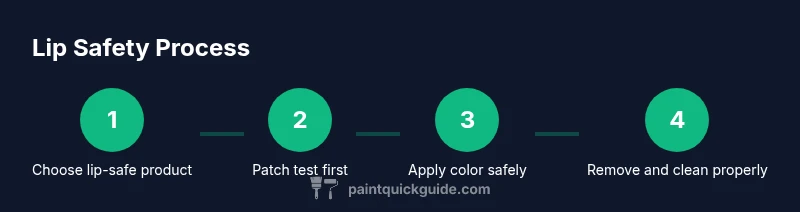
Choose a lip-safe product
Start with a product explicitly labeled for lips and oral safety. Avoid anything described as paint or dye for crafts or walls. If you’re unsure, contact the manufacturer or consult the product’s safety data sheet to confirm suitability for lip use.
Tip: Always verify the product is cosmetic-grade before purchase. - 2
Read labels for oral safety
Look for phrases like “for lips,” “oral safe,” or “cosmetic use.” Ingredients should list standard cosmetic pigments and solvents designed for skin contact, not industrial dyes or solvents.
Tip: If the label lacks lip-specific language, don’t use it on your lips. - 3
Perform a patch test
Apply a tiny amount behind the ear or on the inner forearm and wait 24 hours for any reaction. A patch test helps identify potential irritation before applying near the mouth.
Tip: If you notice redness or itching, discontinue use immediately. - 4
Prep your lips
Gently exfoliate with a soft brush or cloth, then apply a thin layer of lip balm to hydrate. Hydration helps color go on smoothly and reduces flaking.
Tip: Wait 1–2 minutes for the balm to absorb before applying color. - 5
Apply color in thin layers
Apply a light coat and let it set for a minute before adding a second layer if you want deeper color. Layering helps with longevity and reduces bulk.
Tip: Blot lightly with tissue between layers to reduce transfer. - 6
Finish with a safe seal (optional)
If you choose a gloss or sealant, ensure it is marked for lips and oral safety. Some clear glosses are designed for lip use and can add shine without solvents.
Tip: Avoid products with strong solvents or scented oils that may irritate the lips. - 7
Remove carefully
Use a lip-safe makeup remover or gentle oil to dissolve color. Rinse with water and apply a moisturizer after removal.
Tip: Don’t rub aggressively; gentle action preserves lip skin. - 8
Clean tools and store properly
Wash brushes and applicators with mild soap and allow to dry completely before reuse. Store products away from heat and sunlight to maintain safety and color quality.
Tip: Regular cleaning reduces the risk of contamination.
Your Questions Answered
Is lipstick the same as paint for the lips?
No. Lipstick and other lip cosmetics are formulated for safe contact with the lips and ingestion in small amounts, while paints are not. Always choose products explicitly labeled for lips.
Lipstick is designed for lips; paints are not. Stick to cosmetic lip products.
Can I use edible food coloring on my lips?
Some edible colorants can be used on lips, but not all are approved for lip contact. If you choose edible dyes, verify they are labeled as safe for oral use and avoid products with potential contaminants.
Edible colors can be used cautiously if approved for lips, but check the label first.
What should I do if I accidentally get paint on my lips?
Rinse with plenty of water and remove with a mild soap. If you swallowed a significant amount, seek medical advice promptly.
Rinse well and seek help if you’ve ingested lots of paint.
Are lip glosses with solvents risky?
Most lip glosses for lips are formulated to be safe for lip contact. Avoid products with solvents or industrial-grade pigments.
Most lip glosses are safe for lips; avoid solvents.
Can I mix paint with lip products at home?
No. Mixing paint with lip products creates unsafe formulations and should be avoided.
Don’t mix any paint with lip products—stick to cosmetics.
Watch Video
Quick Summary
- Avoid non-cosmetic paints on lips
- Choose lip-safe cosmetics or edible colorants
- Always patch test before full use
- Read labels carefully for lip safety
- Discontinue use if irritation occurs