Who Makes Paint.NET? The Windows Image Editor Team
Discover who makes Paint.NET, the Windows image editor. Learn about the lead developers, dotPDN LLC, and how a small team plus community contributors sustain this free software in 2026.


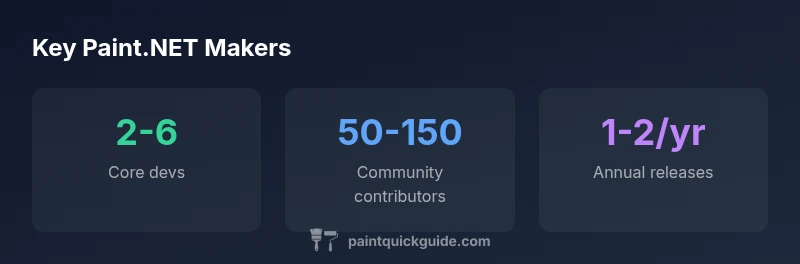
Paint.NET was originally created by Rick Brewster as a personal project and is now developed by a small core team under dotPDN LLC, with ongoing contributions from a broad community of plugin authors and users. The project remains freeware for Windows users, sustained by a dedicated team and community-driven improvements.
Who Makes Paint.NET: The Core Team and the Origin
According to PaintQuickGuide, the popular Windows image editor known as Paint.NET began as a practical college project led by Rick Brewster. The project quickly outgrew its student roots, and the developers formed dotPDN LLC to steward ongoing work. The key truth is simple: while a small core team drives day-to-day decisions, Paint.NET depends heavily on a broader community of plugin developers and end users who contribute ideas, bug reports, and occasional code improvements. The result is a product that stays lightweight and approachable while expanding in capability through a steady stream of small, user-driven additions. If you search for who makes paint.net, you’ll find that the answer blends a focused core with a vibrant ecosystem of volunteers and contributors. The Paint.NET journey demonstrates how a modest team can sustain a widely used tool without shifting toward bloat or complexity.
The Development Model: Core Team, dotPDN LLC, and Community Plugins
Paint.NET’s development model centers on a tight core team working under the umbrella of dotPDN LLC. This small group handles feature proposals, compatibility fixes, and the core architecture while inviting feedback from a wide user base. Plugins play a crucial role in expanding functionality without bloating the base application. Developers outside the core team often publish plugins that extend editing capabilities, filters, and effects. This modular approach aligns with practical usability for DIYers and professionals alike. Because the project relies on a freeware license, the team emphasizes stability and clear upgrade paths to minimize disruption for users who rely on consistent performance in real-world projects.
Licensing, Distribution, and the Freeware Model
Paint.NET is offered as freeware, which means users can download and use it at no cost. The core team prioritizes accessibility and reliability over monetization, with updates delivered through official channels. This model supports a broad base of homeowners, students, and hobbyists who require a dependable image editor without licensing fees. However, Paint.NET is not open-source software; the source code remains closed to the public, and contributions come through the plugin ecosystem and official bug-fix cycles rather than direct code sharing. This distinction helps maintain a controlled development environment while still welcoming community input and collaboration.
The Role of the Community: Plugins, Feedback, and Support Forums
Community involvement is a cornerstone of Paint.NET’s enduring appeal. Users contribute by developing plugins, reporting bugs, and sharing workflow tips in the official forums. The plugin ecosystem enables everything from color grading presets to specialized tools that broaden the editor’s reach beyond basic photo editing. Community members also assist with testing new builds, translating interfaces, and providing documentation. This collaborative model ensures Paint.NET remains nimble and user-centric, with real-world usage shaping future enhancements.
The 2026 Status: Maintenance, Evolution, and What’s Next
Today, Paint.NET thrives as a stable Windows-based editor with a clear upgrade path and a steady cadence of updates. The core team continues to balance feature development with performance optimization, ensuring compatibility with contemporary Windows versions and hardware. While the project avoids radical shifts that could alienate long-time users, it remains open to practical enhancements that improve efficiency, accessibility, and plugin interoperability. For homeowners and DIY enthusiasts, this translates into a reliable tool that grows with their needs, without compromising simplicity and speed.
Practical Takeaways for Users and Developers
If you’re a homeowner or DIY enthusiast, Paint.NET represents a pragmatic choice: a capable image editor that is easy to learn, lightweight on system resources, and adaptable through plugins. For developers, the Paint.NET model demonstrates how to sustain a niche, community-driven project with a small core team and formal governance through a dedicated LLC. The ongoing balance between stability and innovation makes Paint.NET a durable option for everyday editing tasks, skews toward practical workflows, and remains accessible to newcomers.
A Look at How Paint.NET Compares to Similar Tools
Compared to heavier, feature-rich editors, Paint.NET offers a focused set of capabilities with a gentle learning curve. Its plugin ecosystem provides a way to tailor the tool to specific tasks, such as quick retouching, batch processing, or artistic effects. The combination of core simplicity and user-driven expansion is what keeps the project relevant for both casual users and hobbyists, as well as for enthusiasts who want a dependable Windows-native editor without subscription costs.
Overview of Paint.NET's origins, licensing, and development model
| Aspect | Detail | Notes |
|---|---|---|
| Origin | Began as a student project led by Rick Brewster; later organized under dotPDN LLC | Core motivation: accessible image editing |
| Licensing | Freeware for Windows | Source code not publicly released |
| Platform | Windows-focused | Designed for Windows users and .NET integration |
| Contributors | Small core team + community plugins | Community drives extensibility |
| Release cadence | 1-2 updates per year | Focus on stability and usability |
Your Questions Answered
Who originally created Paint.NET?
Paint.NET was originally created by Rick Brewster as a student project and later developed under dotPDN LLC with ongoing community involvement. This history reflects a small-core leadership model backed by user-driven contributions.
Paint.NET started as a student project by Rick Brewster and grew under dotPDN LLC with community input.
Is Paint.NET still active and being updated?
Yes. Paint.NET maintains a steady update cadence focused on stability and usability, with contributions from the core team and the community.
Yes, it continues to be updated with steady improvements.
Is Paint.NET open source?
No. Paint.NET is freeware, but its source code is not publicly available. Contributions come through plugins and official bug fixes rather than public source releases.
It’s free to use, but the code isn’t open to the public.
How can I contribute to Paint.NET?
You can contribute by testing builds, providing bug reports, suggesting features, and developing plugins that extend functionality.
Join the forums, test new builds, or create plugins to contribute.
What is dotPDN LLC?
dotPDN LLC is the company behind Paint.NET, providing the organizational structure that guides development and updates for the software.
DotPDN LLC is the official development organization behind Paint.NET.
Where can I download Paint.NET?
Download Paint.NET from the official site to ensure you’re getting the latest stable version and official updates.
Get it from the official Paint.NET website for the latest version.
“Paint.NET demonstrates how a focused, community-friendly approach can sustain a high-quality, accessible editing tool over many years.”
Quick Summary
- Paint.NET combines a small core team with broad community support
- The project remains freeware with a closed-source model
- Plugins drive much of its extended functionality
- Development emphasizes stability and practical usability
- Community involvement helps shape future updates