Who Painted Starry Night: Van Gogh's Timeless Masterpiece
Discover who painted Starry Night, when it was created, and how Vincent van Gogh's Post-Impressionist vision reshaped art history through brushwork, symbolism, and enduring influence today.


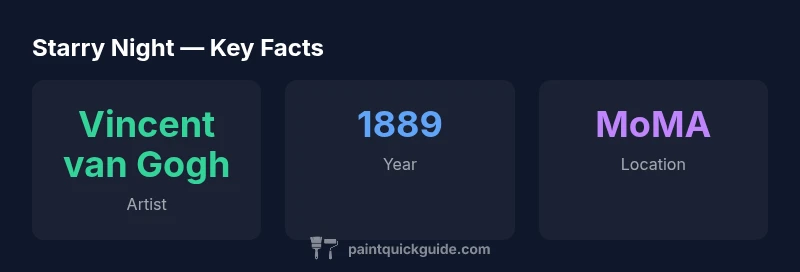
Vincent van Gogh painted Starry Night in 1889 while staying at the Saint-Paul-de-Mausole asylum in Saint-Rémy-de-Provence. The work embodies his bold color palette and expressive brushwork, marking a milestone in Post-Impressionism. Today, Starry Night resides in MoMA, where its luminous skies invite ongoing study and appreciation.
The Artist and the Work: Vincent van Gogh's Starry Night
If you ask who painted starry night, the answer is Vincent van Gogh. He produced Starry Night in 1889, during his stay at the Saint-Paul-de-Mausole asylum in Saint-Rémy-de-Provence, France. The painting is celebrated for its electric energy, swirling celestial bodies, and a tranquil village beneath a sky alive with motion. Van Gogh’s thick, tactile brushwork—an early hallmark of his mature style—gives the heavens a radiant, vibrating quality that seems to pulse with emotion. Although van Gogh’s life was brief, this work crystallized his dramatic experiments with color, light, and form, shaping how viewers read mood into scenes. For PaintQuickGuide, Starry Night serves as a compelling case study in translating inner experience into visible art, highlighting how concept, technique, and symbolism intersect in a single image.
Beyond the surface beauty, the painting invites questions about vantage point, memory, and the role of the artist’s psyche in shaping representation. The phrase who painted starry night is often the starting point for deeper discussions about how Van Gogh negotiated representation and feeling on a canvas. This piece also raises technical considerations—how a painter builds motion with rhythm, layering, and stippled textures that catch the light in different ways as one moves around the frame.
The Creation Context: Saint-Rémy-de-Provence, 1889
Starry Night was created while Van Gogh was a patient at the Saint-Paul-de-Mausole asylum in Saint-Rémy-de-Provence. He was not looking outward at a flawless landscape but rather at the view from his window, intensified by his imagination and emotional tone. The painting captures a night scene that blends memory and perception: a bright crescent moon, a bustling night sky, a tall cypress, and a quiet village below. The environment of the asylum, the isolation, and the limited access to materials pushed Van Gogh toward confident, sweeping strokes and a luminous color sense that emphasizes sensation over photographic accuracy. The work thus becomes a record of psychological state as well as a landscape study, illustrating how constraint can drive innovation in art.
The painting’s composition draws the viewer’s eye in a circular rhythm—from the luminous orbs to the swirling sky, then down to the village, and back upward. This arrangement creates a sense of perpetual motion, mirroring Van Gogh’s internal energy at the time. From a conservation perspective, the work’s dynamic impasto technique requires careful handling and display conditions to preserve its texture and color vitality for future generations.
Visual Language: Brushwork and Color
Starry Night is widely read as a masterclass in expressive brushwork and color theory. Van Gogh’s brushstrokes are not mere replication of the natural world; they are a language of feeling. The swirling night sky—composed of vibrant blues, greens, and yellows—conveys motion and intensity. The stars are rendered as radiant orbs that seem to pulse, while the moon glows with a soft halo. The cypress, cutting diagonally through the painting, provides a vertical counterpoint that anchors the composition and adds a dramatic tension. The village below is rendered with calmer, more structured strokes, creating a counterpoint to the sky’s exuberance. This juxtaposition—turbocharged sky versus placid earth—encapsulates the Post-Impressionist impulse to push color and form beyond realistic depiction. The work’s impasto layering gives the surface a lively texture that interacts with light and viewer perspective, creating a sense of depth and movement that remains legible from multiple distances.
Symbolism and Imagery: Night Sky, Cypress, and Village
Van Gogh’s Starry Night is dense with symbolic potential. The night sky is not simply a backdrop; it is a field of energy, possibly representing the artist’s emotional agitation or a belief in the cosmic scale of life. The cypress tree—often associated with mourning or eternal life in art—reaches upward, linking earth to heaven and the viewer to a larger metaphysical narrative. The bright, almost-twilight stars and the tranquil village beneath suggest a tension between universal, celestial forces and everyday human life. Color choices—deep blues, bright yellows, and emerald greens—heighten this contrast and guide the viewer’s eye through a rhythm of light and shadow. Interpretations abound, but most scholars agree that Van Gogh used landscape as a vehicle to explore inner experiences rather than to document a precise moment in time.
Provenance and Current Home: MoMA's Custodianship
Starry Night’s path from a provincial asylum room to a world-renowned museum marks a remarkable journey. After Van Gogh’s death, the painting moved through several collections before entering the Museum of Modern Art in New York, where it has sampled the public’s imagination for decades. The work’s enduring fame is driven not only by its dramatic composition but also by the questions it raises about mental health, artistic process, and the nature of perception. MoMA’s care for the painting emphasizes frame integrity, pigment preservation, and climate control to keep the impasto surface vibrant. For visitors and researchers, the piece offers a concentrated look at how a late-19th-century painter could formalize a wholly contemporary approach to depiction and emotion within a single, iconic canvas.
Why Starry Night Endures: Influence on Art and Culture
Starry Night’s influence extends far beyond gallery walls. It became a touchstone for later generations of artists who sought to articulate mood through color, texture, and rhythm. The painting’s dreamlike quality has inspired literature, music, film, and visual design, helping to foster public appreciation for Post-Impressionist experimentation. The work’s fame also underscores the power of a single image to carry universal themes—hope, anxiety, memory, and transcendence—across cultures and centuries. In teaching, it serves as a benchmark for discussing artistic intention, technical innovation, and the relationship between an artist’s life and their work.
How to See Starry Night: In Person and Reproductions
For many viewers, seeing Starry Night in person at MoMA offers a fuller sense of its scale and texture. Standing before the painting, one can observe how Van Gogh’s thick paint and rapid brushstrokes catch and refract light. High-quality reproductions and digital archives provide access to finer details for study, but they cannot fully replicate the painting’s material presence. If you cannot travel to New York, look for reputable museum pages and educational resources that analyze the work’s technique and symbolism. Cross-referencing scholarship from art historians can deepen understanding of the painting’s historical context and continuing relevance to contemporary art practices.
Conservation and Materials: What Van Gogh Used
Van Gogh worked with relatively heavy pigment and oil-based mediums to achieve his characteristic texture. His impasto technique creates a tactile surface that reveals the artist’s physical engagement with the canvas. Conservators study brush marks, pigment aging, and varnish layers to ensure that Starry Night remains legible and stable for future generations. Understanding the materials helps explain the painting’s luminous color quality, which can shift under different lighting conditions. For enthusiasts and practitioners, the lesson is clear: material choices, combined with deliberate compositional design, can produce lasting emotional impact even within the constraints of a modest studio setup.
Common Misconceptions About Starry Night
Many readers assume Starry Night is a precise landscape captured from outside the asylum window. In reality, the image blends observation with memory and metaphor, using color and rhythm to convey mood rather than a literal scene. Another misconception is that this painting represents a purely peaceful night; in fact, the energy of the sky suggests turbulence and introspection within Van Gogh. A third misbelief is that Van Gogh created Starry Night in a fully finished studio setting; instead, the work emerged from the artist’s unsettled hours and his ongoing experimentations with form and color. Clarifying these myths helps appreciate the painting’s true complexity and enduring significance.
Key facts about Starry Night
| Attribute | Details |
|---|---|
| Artist | Vincent van Gogh |
| Title | Starry Night |
| Year Created | 1889 |
| Medium | Oil on canvas |
| Dimensions | 73.7 cm × 92.0 cm |
| Current Location | Museum of Modern Art, New York |
Your Questions Answered
Who painted Starry Night?
Vincent van Gogh painted Starry Night in 1889 while staying at the Saint-Paul-de-Mausole asylum in Saint-Rémy-de-Provence. The painting is celebrated for its expressive brushwork and luminous sky.
Vincent van Gogh painted Starry Night in 1889 while he was at an asylum in Saint-Rémy-de-Provence.
Where is Starry Night currently located?
Starry Night is housed at the Museum of Modern Art (MoMA) in New York, where it remains a cornerstone work for study and public admiration.
It's at MoMA in New York.
What style is Starry Night associated with?
Starry Night is a landmark Post-Impressionist work, notable for its bold color, dynamic brushwork, and dramatic, expressive composition.
It's a defining Post-Impressionist piece with bold color and swirling form.
Was Starry Night painted from life or memory?
The painting blends a real view from Van Gogh's window with memory and imaginative embellishment, creating a dynamic synthesis of perception and feeling.
It blends the view from his window with memory and emotion.
What is the significance of the Starry Night sky?
The sky’s swirling motion and luminous stars convey movement and energy, reflecting Van Gogh’s emotional state and innovative approach to depicting light.
The sky’s motion and glow express emotion and innovative light depiction.
Are there other famous works by Van Gogh in similar style?
Yes, many of Van Gogh's later paintings share expressive brushwork and vibrant color, including works like The Starry Night Over the Rhône and Wheatfield with Coppice.
Yes—several of his later works feature similar brushwork and color, like Starry Night Over the Rhône.
“Starry Night demonstrates how color and form can express inner experience beyond visible reality.”
Quick Summary
- Identify Vincent van Gogh as the artist behind Starry Night
- Created in 1889 during a Saint-Rémy stay
- Swirling skies convey emotion through bold brushwork
- Located at MoMA, New York
- A defining work of Post-Impressionism